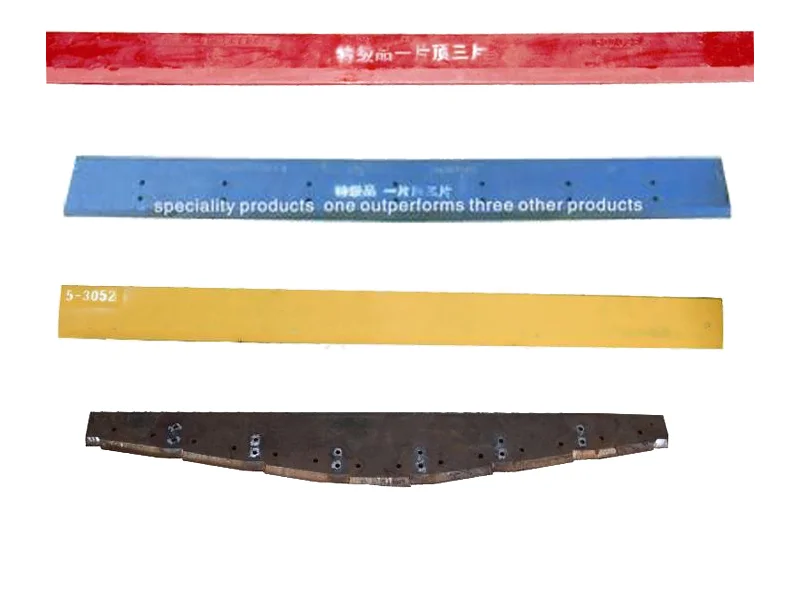
Explore cutting-edge and blade-plate references for loader buckets. Match the blade outline, hole pattern and thickness to your drawing or existing part.
Brand names identify catalog references and do not imply affiliation. Model references alone do not confirm compatibility. Numbered references distinguish source entries and do not establish different geometries.
Cutting edge or wear plate?
A cutting edge and a wear plate do different jobs, and neither replaces the other. The cutting edge runs along the front of the bucket and cuts the material; the bevel on its leading side is what enters the ground. A wear plate is fixed to the bucket floor, the side plates or the inside of the bowl to take abrasion where material runs across the steel, and it has no cutting bevel.
The references listed on this page are cutting edges and blade plates. Bucket wear plate is reviewed as a drawing-based part - plate size, thickness, hole pattern and where it is fixed - and is quoted on that basis rather than matched to a catalog reference.
Cutting edge and wear plate compared
Part
Where it sits
What it does
How it fails
Cutting edge / blade plate
Along the front edge of the bucket, bolted or welded
Cuts the material and protects the front of the bucket floor
Bevel wears back, the plate thins, bolt holes elongate
Wear plate
Bucket floor, side plates or inside the bowl
Takes abrasion from material running across the surface
Thins evenly, cracks at the edges, or wears through
Nothing on this page implies a stock wear-plate range. Send the plate outline, thickness and mounting detail for a review.
Cutting edges by type
Four groups cover the loader edge range, and each group label describes the reference rather than a standard dimension class. Standard edges are the plain blade and base-edge references. Extended, wide and narrow references change the length or the cutting width. Thickened edges carry a heavier section where a plate wears through by abrasion. Rock profile edges are the heavier, often bowed plates for compacted and broken ground.
A bucket usually carries teeth around the edge as well, and the two wear at different rates: replacing an edge while worn teeth stay in place simply moves the load onto the new plate.
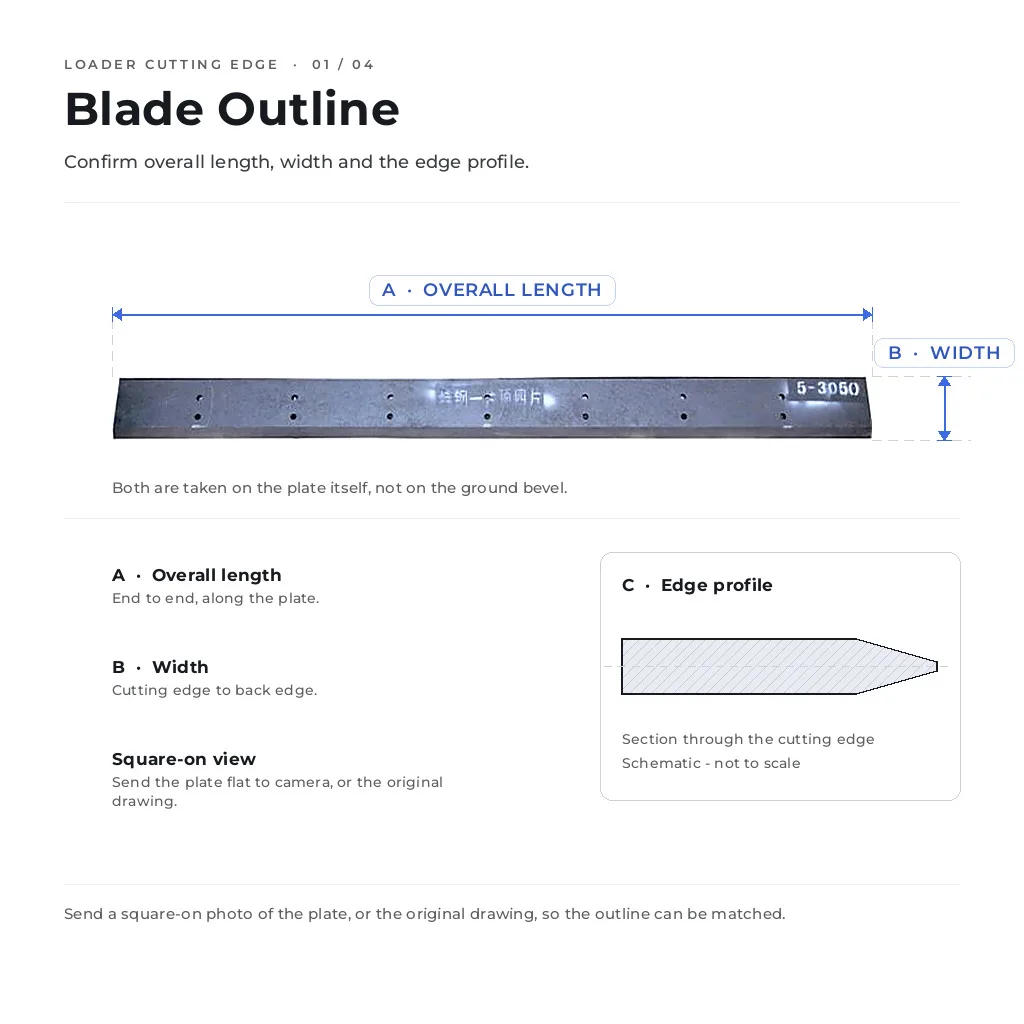
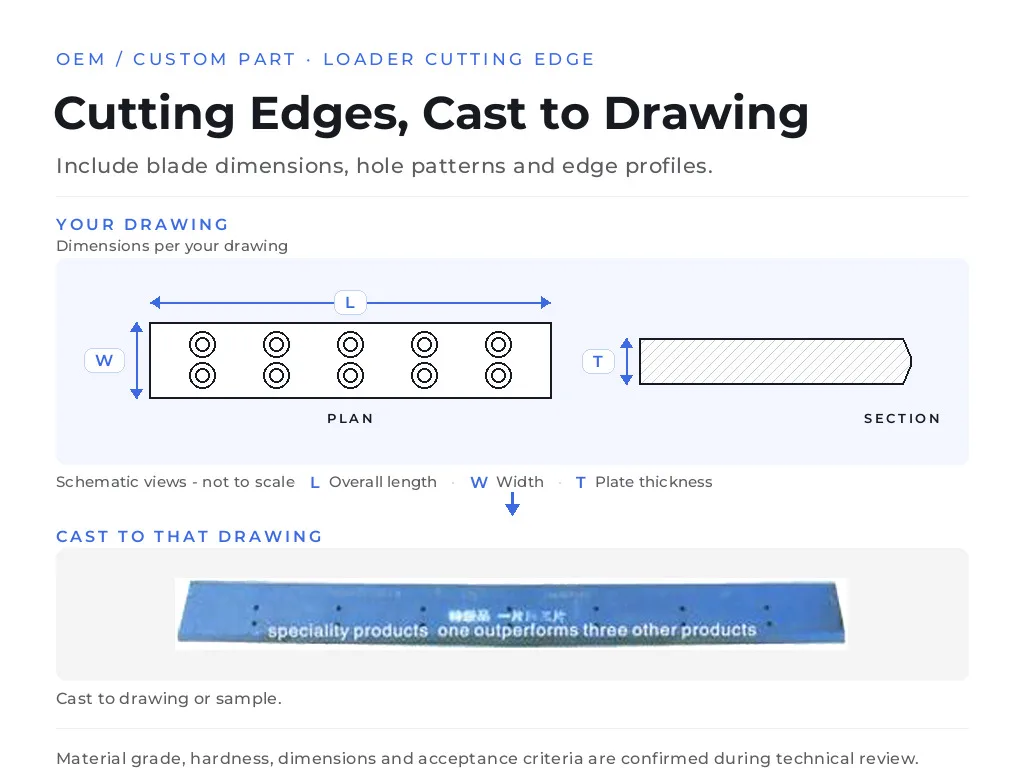
Confirm overall length, width and the edge profile.
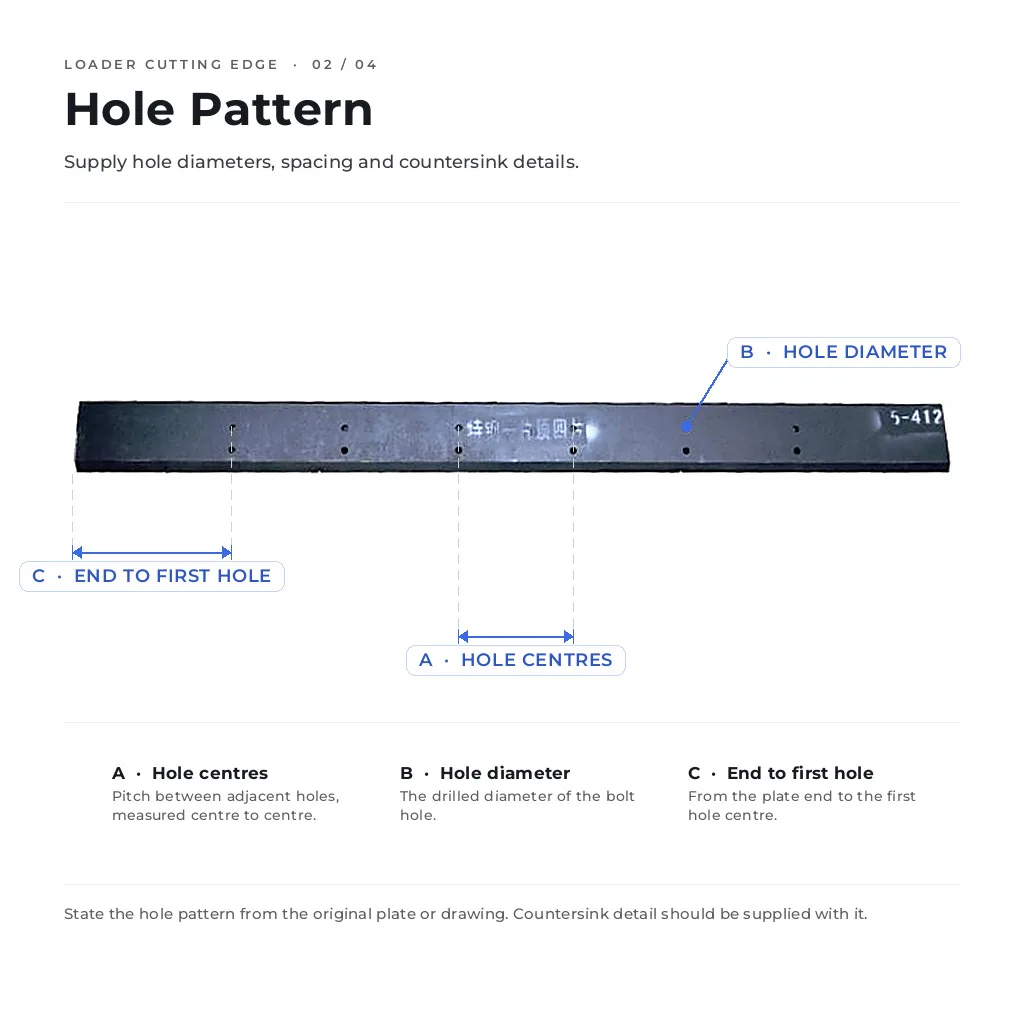
Hole Pattern
Supply hole diameters, spacing and countersink details.
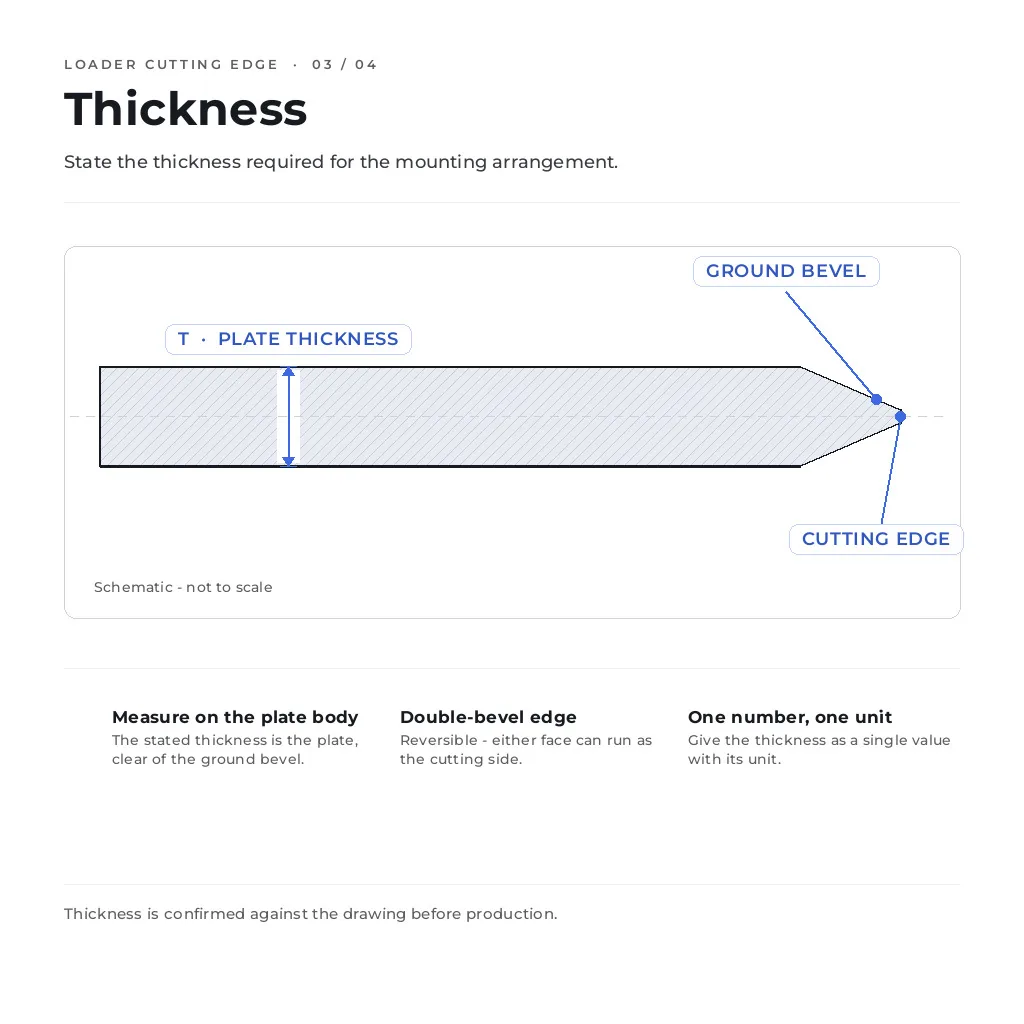
Thickness
State the thickness required for the mounting arrangement.
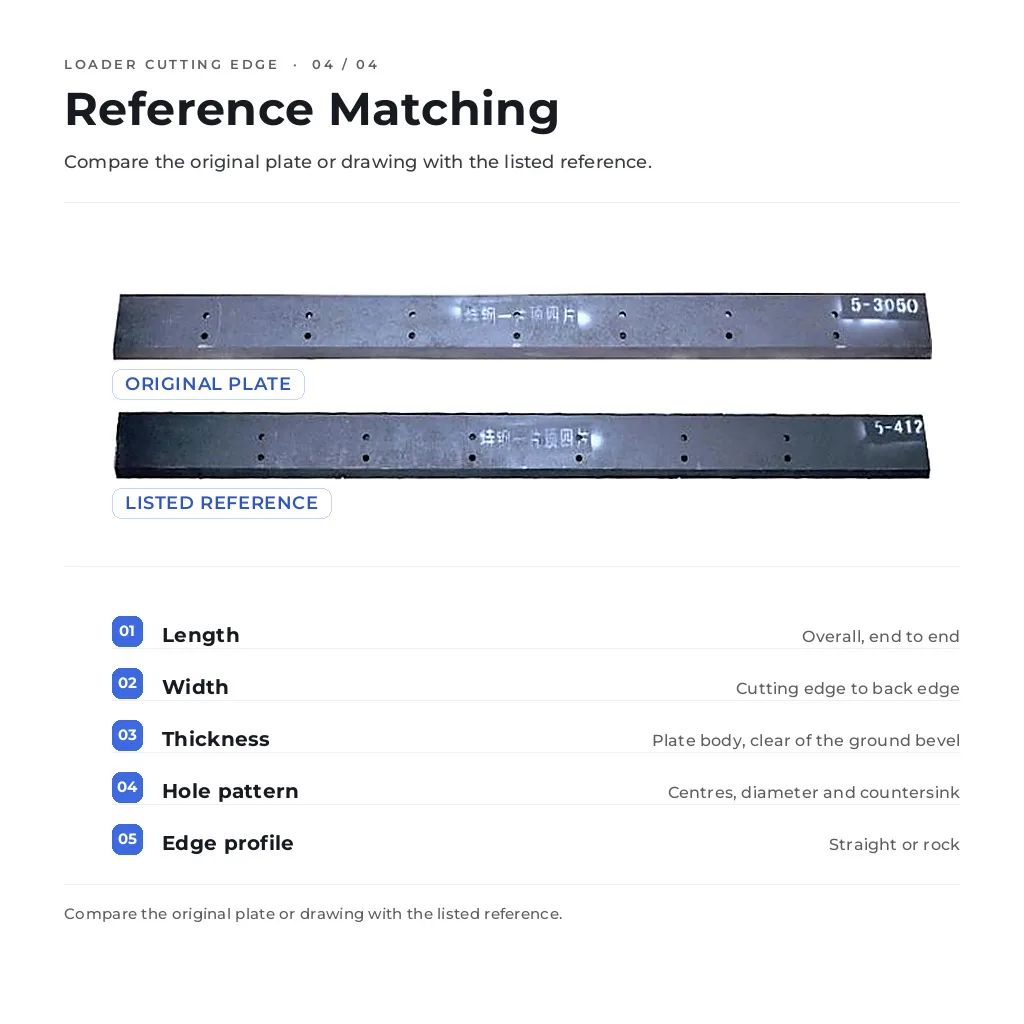
Reference Matching
Compare the original plate or drawing with the listed reference.
A CLEARER SOURCING CONVERSATION
Why Work With Us
From model selection to a clearly defined inquiry.
Reference-focused selection
Compare the listed part references and component forms.
OEM project discussion
Bring drawings, samples and marking requirements.
Technical review
Define material, process and inspection requirements.
Bulk-order planning
Organize quantities by part for your purchasing inquiry.
FROM REFERENCE TO REQUIREMENT
How to Order
A typical order follows these steps, subject to the agreed quotation.
Send Reference / Part Number
Confirm Product / Drawing
Quotation
Production
Inspection
Shipment
BEFORE YOU INQUIRE
Frequently Asked Questions
Which dimensions have to be measured before a loader cutting edge is ordered?
Four values carry most of the risk: overall length, the width from the cutting side to the back edge, the plate thickness measured away from the worn bevel, and the hole pattern. For the pattern, measure from the side edge to the centre of the first hole, then the distance between hole centres, and the hole diameter, and confirm the holes are countersunk. The same machine model can have carried more than one bucket over its life, so the worn plate is measured rather than the machine being trusted for the fit.
What is a double bevel reversible edge, and can mine be turned over?
A double bevel edge has a bevel on both long sides and is normally fastened with countersunk plow bolts, so when one edge dulls the plate can be unbolted, turned through 180 degrees and worked on the second edge. That doubles the interval for the same part, and it is the usual arrangement on a loader bucket. It only applies if your bucket carries a bolted double bevel edge: a welded or single bevel plate cannot be reversed, so confirm how the existing edge is fixed before a replacement is chosen.
Do the numbers in the reference names - 301, 3032, 5209, 717 - mean anything dimensional?
They preserve the reference labels of the source catalog an entry was collected under. They are not length, width, thickness or a universal part number, and reading them as measurements is one of the commonest ways to end up with a plate that does not fit. Identify the part from the drawing, from the number on the plate if it is legible, or from measurements, and send the machine model as context rather than as the fitment.
Are these edges cast, and what material are they made from?
The catalog photographs and source names do not establish how a given plate was produced, so no single route is claimed for the group. Plates of this type are commonly made from heat-treated wear-resistant or boron steel, where the hardness achieved in treatment is what governs how quickly the bevel wears back. For a specific part the material grade, hardness and manufacturing route are agreed during technical review, and the agreed requirement is recorded so it can be checked on the delivered plates.
My edge is worn but the bolt holes are still sound - can it be hardfaced instead of replaced?
Hardfacing can extend the life of an edge where the wear is even and does not reach the bolt holes, and where the plate is not cracked, bent or worn back to the bucket body. It stops being a sensible option once the bolt holes are oval, the plate is deformed, or the bucket itself is being touched, because then the fit rather than the surface is what has failed. Send photographs of the wear and the hole area so the two cases can be told apart before any work is done.
An edge has worked loose or come off during work - what should be checked?
A bolted edge is only as good as its fastening. Plow bolts work under vibration, they stretch in service, and a reused bolt can fail and let the plate go, which is why the fasteners are renewed with the edge rather than kept. The mounting face also matters: rust, old weld spatter or a distorted surface stops the plate seating flat, so it is cleaned and checked, and the bolts are tightened in a cross pattern to the agreed torque. If an edge keeps loosening, the holes or the base edge are the likely cause.
Are these the original manufacturer parts?
These are catalog references identified by the source machine or brand label; they are not parts supplied by the equipment manufacturers, and brand names and logos on this page identify the source reference of each entry without implying affiliation, authorization or endorsement. Fit is confirmed from your own part number, drawing or measurements. Send the reference of the plate being replaced, or its measured length, width, thickness and hole pattern, and the closest listed entry can be compared against it.
LET’S IDENTIFY YOUR PART
Request a Quote
Send us your model, part number, drawing or product photo. We’ll help identify the correct part and prepare a quotation.
✓Machine model
✓Part number
✓Drawing
✓Product photo
✓Required quantity
Drawings and technical files are kept confidential

 OEM / CUSTOM PART · LOADER CUTTING EDGE