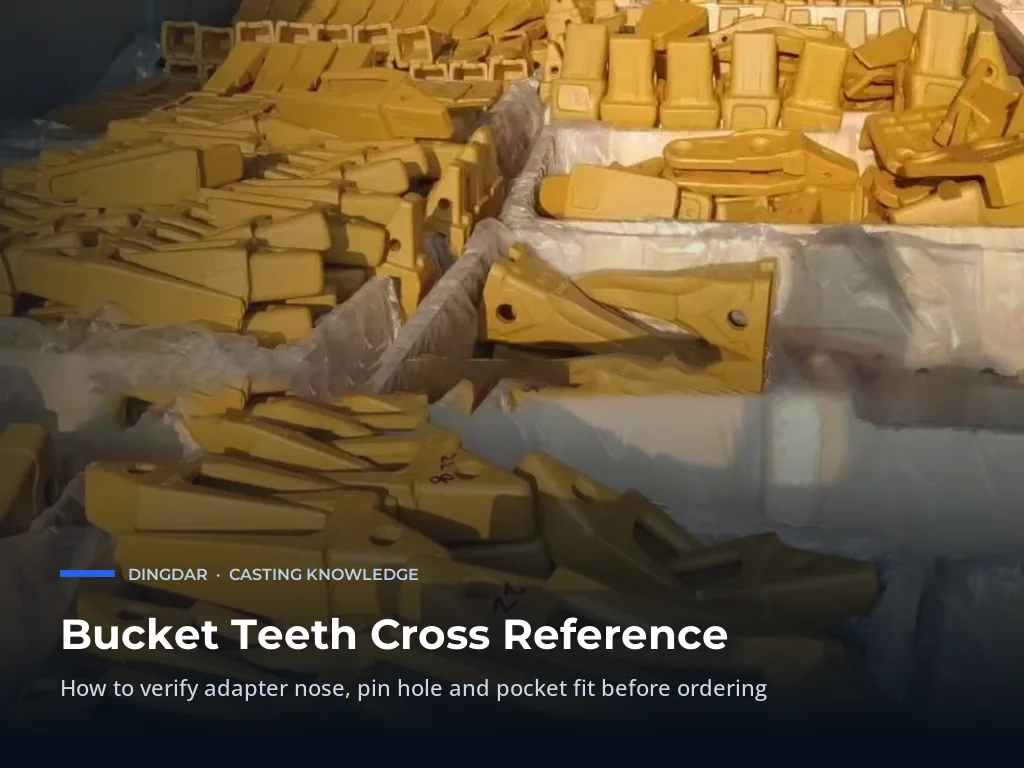
Bucket Teeth Cross Reference: How to Verify Adapter, Pin and Fit Before Ordering
A bucket teeth cross reference is a method for finding a replacement tooth from the information you already have, not a guarantee that the part will fit. Two teeth can look alike and share a similar overall length, yet one seats cleanly while the other sits loose or refuses to mount, because fit is decided by the adapter nose, the pin and retainer system and a small set of key dimensions. This guide gives you a six-step check to run before you order, an on-site photo and measurement checklist, a blank dimension sheet, and a troubleshooting table for the failures behind most wrong orders.
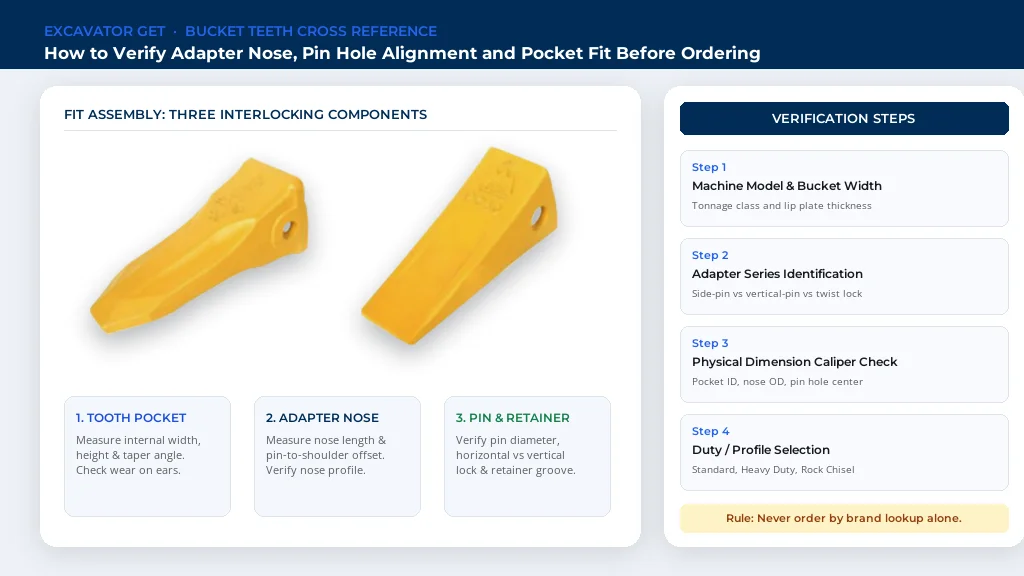
A model number is a starting point, not a fit check
Most wrong orders begin with a reasonable assumption: the machine model proves the fit. It does not. The model tells you the size class the bucket was built around and nothing more, because one machine model can be delivered with different buckets, adapters and tooth generations over its production life.
A second assumption is just as common and just as costly: that a catalog number is an OEM number. Catalog references are internal labels a supplier uses to organise its own range. They point to an entry in a catalog; they do not state who made the original part, and they do not prove that a part will mount.
DINGDAR states the same caution on its product pages: "Brand names identify catalog references and do not imply affiliation. Model references alone do not confirm compatibility. Numbered references distinguish source entries and do not establish different geometries." Every number on a tooth or in a catalog is a lead to verify, not a conclusion to trust.
Fact: DINGDAR publishes around 100 bucket teeth and adapter references across multiple source brands, including the BT-001 to BT-076 excavator series and the LT loader series, grouped by tooth type (bucket, rock, sharp/tiger) and by adapters, and states on those pages that brand names identify catalog references and do not imply affiliation.
The six-step cross reference check
Run these steps in order. Each one closes off a way for the part to be wrong, and each one produces evidence you can attach to an enquiry instead of describing over the phone.
| Step | What you are confirming | Best evidence |
|---|---|---|
| 1 | Machine class and the original part number | Readable part number, machine plate, bucket photo |
| 2 | The tooth-to-adapter connection | Adapter nose shape, tooth pocket, adapter number |
| 3 | The pin and retainer system | Pin type, pin hole location, retainer |
| 4 | The key fit dimensions | Measured pocket, pin hole and overall length |
| 5 | How wear distorts the reading | A less-worn tooth or a direct adapter measurement |
| 6 | Confirmation from a drawing or sample | Drawing, sample or agreed mounting dimensions |
Step 1: Machine class and the original part number
Start with the number cast or stamped into the part. On most teeth it sits on the interior wall or the rear edge of the tooth pocket, and sometimes on the side or top of the body [2]. If it is readable, it is the fastest route to a correct match, so photograph it and record it exactly as it appears.
If the number is gone, fall back to the machine class. A five to eight tonne excavator uses a smaller fitment range than a thirty tonne class machine, so the tonnage narrows the possible sizes considerably [2]. It cannot finish the job alone, though, so record the machine model, the bucket type and anything still legible on the adapter too.
Step 2: The tooth-to-adapter connection
A tooth does not work alone. It fits over the adapter, the nose welded or bolted to the bucket edge, and the two parts form a single joint. The tooth pocket and the adapter nose have to match in shape and in the position of the pin hole, or the tooth cannot be installed safely. A tooth with a similar outside profile can still fail here, because the pocket that receives the nose decides the fit [4].
The adapter is the slower-wearing half of the pair, which makes it the better reference when the tooth is worn out. If the nose is rounded, shortened or visibly worn, or if a new tooth still moves with the correct pin fitted, the adapter is the problem. The adapter is then quoted with the tooth rather than replaced later, because a new tooth on a worn nose will come loose again.
Excavator and loader buckets use different tooth ranges, so the first check is which machine you are working on. A loader tooth works under the bucket and back-drags, so it wears on the underside, while an excavator tooth is loaded mainly through its point. The two ranges are separated in the excavator bucket teeth and adapters and loader bucket teeth and adapters catalogs, and a tooth of similar outside size cannot move between them unless the holder nose and the retaining system match.
Step 3: The pin and retainer system
The pin and retainer hold the tooth on the adapter, and they are the most common reason a tooth is lost in service. The systems are not interchangeable: common families include a side pin running horizontally through the tooth and adapter, a top or vertical pin, and a diagonal pin arrangement. Some use a separate pin and retainer, while others combine them in one piece.
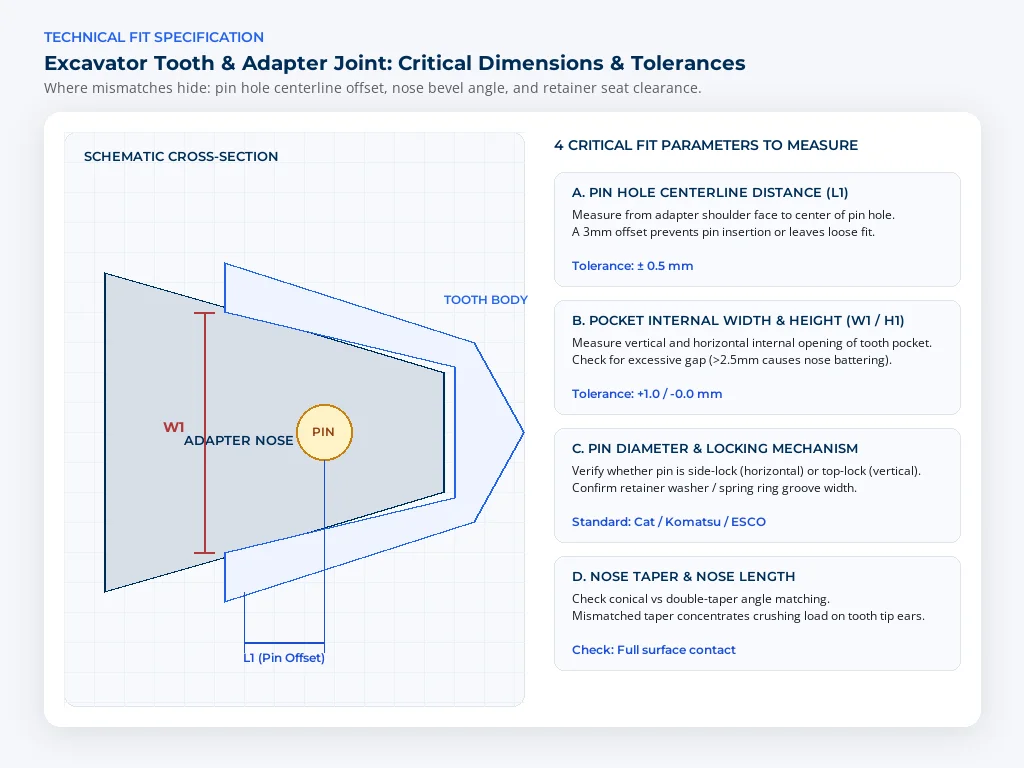
The part that fails is often not the tooth. A bent pin or an aged retainer will let even a correctly sized tooth work loose, so inspect all three parts together rather than the tooth alone [3]. Measure the pin diameter and record where the pin hole sits in the pocket, because a tooth can match on overall size and still be wrong on pin position.
It also pays to know what is in the box: the catalog lists teeth and adapters as separate references, and a pin or retainer is not included unless the quotation says so. State the retention system and whether a pin, retainer or fastening set is needed with each tooth, so missing locking parts are not found when the machine is already down.
Step 4: The key dimensions that decide fit
When the number is missing, measurement decides. Keep the method identical each time you record a reading, because small differences matter on a joint this tight. Six readings cover most cases.
| Measurement | Why it matters |
|---|---|
| Tooth overall length | Confirms size class and tooth form |
| Pocket width and height | Decides whether the tooth fits the adapter nose |
| Pin hole diameter | Confirms the matching pin size |
| Pin hole centre position | Prevents misalignment on installation |
| Adapter nose width and height | Confirms tooth and adapter compatibility |
| Pin and retainer dimensions | Confirms the locking system will hold |
The interior of the tooth pocket wears far less than the working end, so it is a reliable place to measure on an old tooth even after the point is gone [2].
Fact: DINGDAR confirms material grade, heat treatment, hardness and acceptance criteria during a single technical review, and backs the agreed specification with material and heat-treatment records on the confirmed inspection plan.
Step 5: How wear on the old part interferes
Reading a worn part as if it were new is the quiet error behind many wrong orders. A worn tooth is smaller than the drawing it was made to, so a measurement taken from the point will understate the true size and point you at the wrong reference. The same mistake on the adapter nose sends you hunting for a larger tooth to compensate for a nose that has simply worn down.
Two habits avoid the problem. Measure a less-worn tooth from the same bucket if one exists, and measure the adapter directly where you can, because the adapter wears more slowly than the teeth it carries. When only a worn part is available, say so on the enquiry with a photograph that shows the wear, so the figures are read as worn values rather than as nominal ones.
Step 6: Confirming from a drawing or sample
If the number, the adapter and the measurements still leave doubt, move to a drawing or a sample. This is where a cross reference stops being a lookup and becomes a manufacturing review. Send the worn part as a sample, or a drawing with the mounting dimensions that matter, and the fit can be confirmed before anything is cast.
The same route covers parts that never appear in any catalog. When a machine is old, modified or unusual, a part produced to drawing or sample is the practical answer, and it is normal foundry work rather than an exception. DINGDAR builds custom castings produced to drawing from drawings, samples or part numbers.
Fact: DINGDAR builds bucket teeth, adapters, loader teeth and custom castings to drawing, sample or part number, and reviews the whole requirement in one technical review with a 12-24 hour reply time on enquiries.
Checklist before you order: photos and measurements
Take the photos and readings below in one pass while the machine is stopped. This set resolves most enquiries quickly and removes the back-and-forth that delays a replacement.
Photographs:
- the whole bucket front, showing every tooth position, including the two corner positions
- one tooth from the front, the side and below
- the tooth pocket and its rear opening, cleaned enough to show the shape
- the adapter nose with the tooth removed
- the pin and retainer, both assembled and apart
- a close-up of any readable part number on the tooth or adapter
- one photo of each measurement with a ruler or tape held in the frame
Measurements to record:
- overall tooth length and working-end width
- pocket width and height at the rear opening
- pin hole diameter and its centre position
- adapter nose width and height
- pin and retainer dimensions
- machine model, bucket type and the number of tooth positions
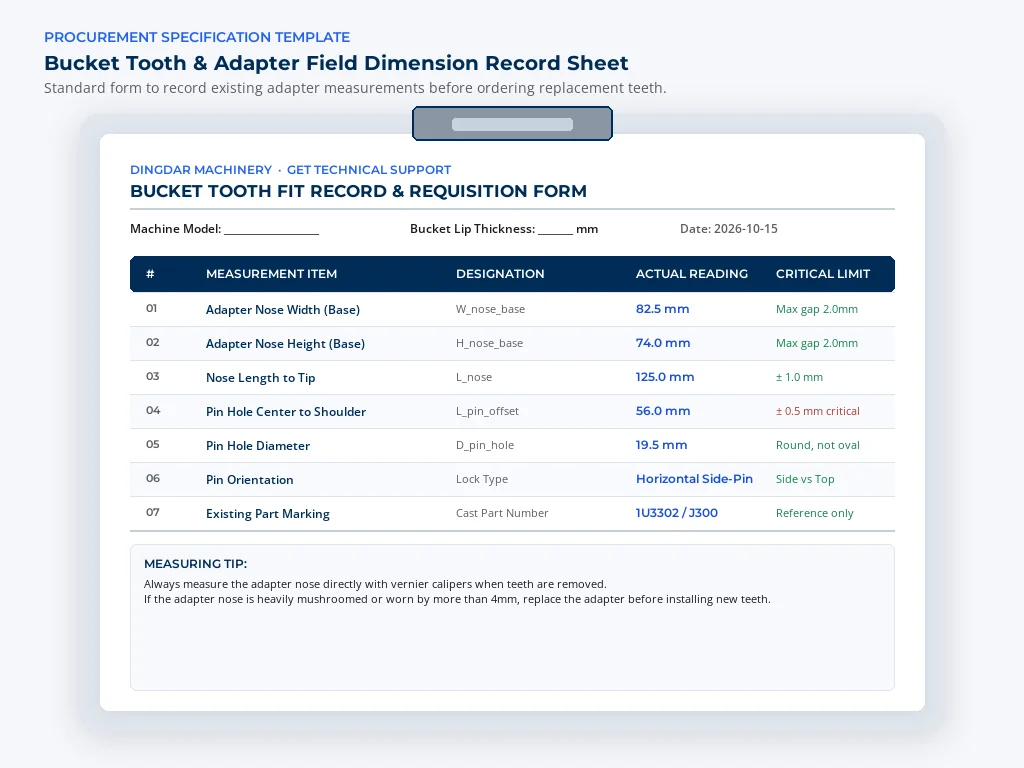
Blank dimension record sheet
Print this sheet and fill one column per tooth or adapter. Leave a field blank rather than guessing: a blank field is a question to answer, not a value to assume.
| Item | How to measure | Unit | Reading |
|---|---|---|---|
| Machine model | From the machine plate | text | |
| Machine class | Tonnage or size class | text | |
| Bucket type | Excavator or loader, and profile | text | |
| Number of positions | Count along the bucket edge | count | |
| Tooth overall length | Tip to rear edge | mm | |
| Pocket width | Rear opening, across | mm | |
| Pocket height | Rear opening, front to back | mm | |
| Pin hole diameter | Inside the hole | mm | |
| Pin hole centre position | From the pocket edge | mm | |
| Adapter nose width | With the tooth removed | mm | |
| Adapter nose height | With the tooth removed | mm | |
| Pin diameter | On the pin body | mm | |
| Retainer type | Side, top or diagonal | text | |
| Part number | Exactly as read on the part | text |
Common mismatch problems and what they usually mean
| Symptom | Likely cause | What to check first |
|---|---|---|
| New tooth will not seat on the nose | Different system or wrong size class | Adapter nose shape and pocket match |
| Tooth fits but moves when digging | Worn adapter nose or wrong pin | Nose wear, pin diameter, retainer condition |
| Correct size but the pin will not enter | Pin hole position differs | Pin hole centre position on both parts |
| Tooth lost in service | Failed pin or retainer | Pin and retainer condition, and whether they were supplied |
| One side wears or loosens faster | Position or installation clearance | Corner position, left or right part, seating on the nose |
| Similar-looking tooth does not fit | Lookalike with a different pocket | Measure the pocket and pin hole, do not judge by eye |
Most mismatches are about the connection or the lock, not the tooth's outer size, so price the tooth and the adapter together when the nose is worn.
What to send a supplier to get the fit confirmed
Send the following and a reference can be matched rather than guessed [1]:
- machine model, bucket type and tooth position count
- the part number, exactly as read, plus a photo of it
- photos of the tooth, pocket, adapter nose and pin assembly
- the filled dimension sheet
- the retention system and whether pins and retainers are needed
- the working condition: what material is dug, and whether the teeth wear away or break off
- quantity, and whether the adapter will be replaced at the same time
A supplier that asks for the connection details, not just the model, is more likely to get the fit right. Our guide to evaluating a casting supplier covers what to look for in inspection and traceability. If you are replacing a part that matches no reference at all, the construction machinery castings line shows the wear parts this work covers.
FAQ
Is a bucket teeth cross reference the same as a compatibility guarantee?
No. A cross reference points you to a likely replacement; it does not confirm that the part will fit. Compatibility is decided by the adapter nose, the pin and retainer system and a small set of key dimensions, and any one of those can differ between two teeth that look alike. Treat the reference as a lead to verify, not a result. Confirm the connection from your own part number, a photograph of the nose with the tooth removed, and measured pocket and pin hole dimensions before the order is released.
Can I order a bucket tooth using only the machine model?
The model is a starting point, not a decision. One machine model can be delivered with more than one bucket, adapter or tooth generation over its production life, so the same model may carry different tooth systems. Use the model to narrow the size class, then confirm the adapter connection, the pin system and the key dimensions. If the original part number is still readable, it will do more to fix the fit than the model alone ever can.
Do new teeth come with pins and retainers?
Usually not. The catalog lists teeth and adapters as separate references, and a pin or retainer is treated as its own item unless the quotation says otherwise. State which retention system your machine uses, such as a side pin, a top pin or a diagonal pin, and whether a pin, retainer or fastening set is needed with each tooth. A failed pin or retainer is a common reason a tooth is lost during work, so order the locking parts at the same time if they are worn.
The new tooth fits loosely on the adapter. Is the tooth wrong or the adapter worn?
A loose tooth can come from the tooth, the adapter nose, the pin or the retainer, so review the whole connection rather than the tooth alone. Send a photograph of the adapter nose, the mounting area and the worn tooth, plus the part number if it is readable. Where the nose is rounded, shortened or visibly worn, or where a new tooth still moves with the correct pin fitted, the adapter is the cause and should be quoted together with the tooth rather than replaced later.
Should I replace the adapter at the same time as the teeth?
Only if the adapter nose is worn, but check that condition rather than assuming it. The adapter wears more slowly than the teeth it carries, which makes it the better reference when the tooth is worn out. Measure the nose with the tooth removed and compare it with a new part if you can. If the nose is rounded or shortened, a new tooth on it will come loose again, so quoting the adapter and the tooth together avoids a second failure and a second order.
How do I identify a tooth when the part number has worn away?
Measure what is left of the worn tooth and photograph it with the bucket: overall length and width, its position along the lip, and a close view of the pin or retainer. The machine model and any readable number on the adapter also help, because the adapter wears more slowly than the tooth. The interior of the tooth pocket wears far less than the working end, so it is a reliable place to measure on an old part. These details are enough to start a drawing-based replacement if nothing matches.
Conclusion
A cross reference is a fast way to narrow a replacement part, but it is not a fit check. The machine gives you the size class, the catalog gives you a likely reference, and the adapter, the pin and the key dimensions confirm what will actually mount. Run the six steps, keep the photos and the filled sheet together, and the part you order will match the machine you are putting it on.
Start with what you have: a part number, a photograph of the worn tooth and its bucket, or a scan of the adapter nose. The DINGDAR team reviews the geometry, material and connection in one technical review and replies within 12-24 hours. You can contact the DINGDAR team to begin, or browse the excavator bucket teeth and adapters and loader bucket teeth and adapters ranges.
Sources
- SFSA (Steel Founders' Society of America). "Ordering Steel Castings." SFSA Purchasing Guidance. https://www.sfsa.org/subject-areas/education/ordering-steel-castings/ - Guidance that design, material and test requirements must be defined in the enquiry so that a supplier quotes on a common basis, the principle behind listing connection and dimension details up front.
- Real Steel Store. "Identify Your Bucket Tooth." https://store.realsteel.co.nz/pages/bucket-tooth-id-guide - Identification guide covering part number location, machine-class narrowing, pin and retainer measurement as the most accurate check, and the tooth pocket as a low-wear measuring point.
- MATSON MINING. "How to Identify Excavator Bucket Teeth: Part Numbers, Adapter Fit and Replacement Guide." https://matsonmining.com/identify-excavator-bucket-teeth/ - Adapter fit, pin and locking system checks, a measurement table and a list of common replacement mistakes.
- CN Machinery. "Excavator Bucket Teeth Buying Guide: Types, Materials and Fitment." https://cn-machinery.com/articles/excavator-bucket-teeth-buying-guide.html - Notes that bucket teeth are not universal, that the adapter system and pin size and spacing determine compatibility, and that ordering runs from a part number or a machine model plus bucket type.
Manufacturer specifications: DINGDAR company facts, production routes, plant area, part types, reference counts, inspection equipment and certifications are stated per manufacturer specifications on https://hndingdar.com/ (brand profile: companies/dingdar.yaml).