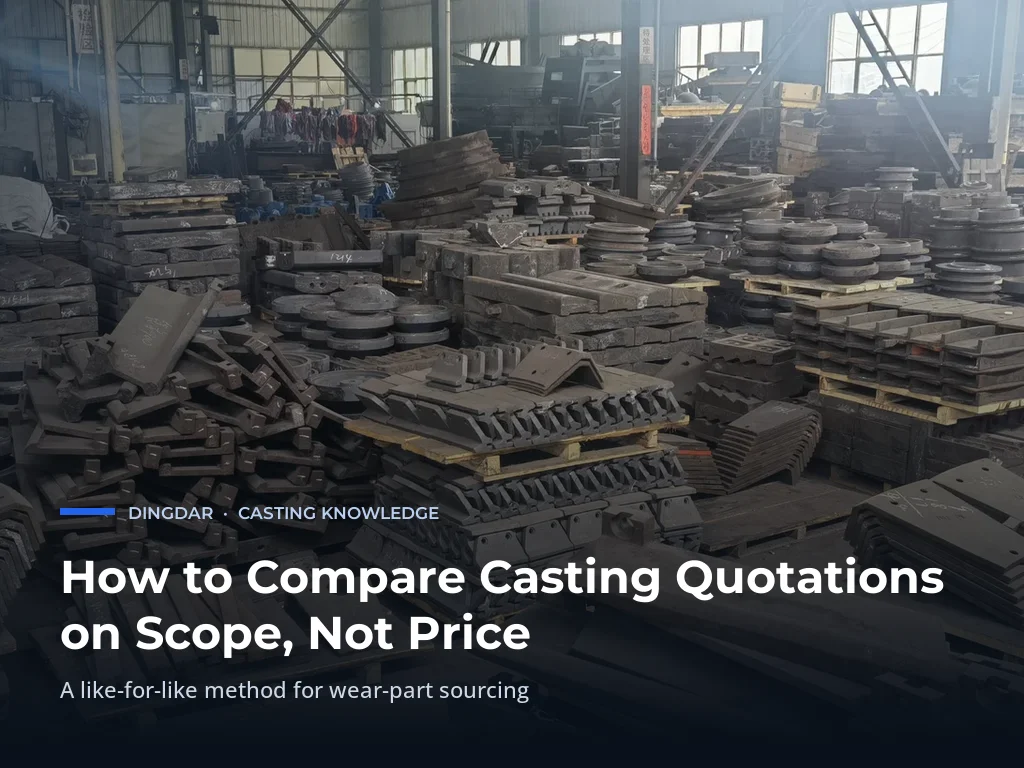
How to Compare Casting Quotations on Scope, Not Price
Two casting quotations land in your inbox for the same drawing. For illustration, one reads 0.90 U.S. dollars per kilogram and the other reads 1.40. The instinct is to assume the first supplier is cheaper. That instinct is usually wrong. A casting price is a number attached to a defined amount of work, and two suppliers rarely define that work the same way. One quote may cover an as-cast blank straight from the mould. The other may include heat treatment, full machining, hardness and dimension records, and export packing. Comparing the two on price alone compares a blank with a finished part.
This guide shows how to compare casting quotations on scope so that every number describes the same delivered component. It is written for buyers of custom castings and wear parts who need a decision they can defend, not the cheapest line on a spreadsheet.
Why two casting quotes for the same drawing rarely match
A casting quotation is an answer to a question. If two suppliers receive the same drawing but read the question differently, they will answer with different numbers. The unit price of a casting is not a property of the drawing. It is a property of the scope the supplier chose to include.
Common reasons two quotes for the same part diverge:
- one covers an as-cast part, the other a fully machined part
- one includes heat treatment, the other assumes the customer will arrange it
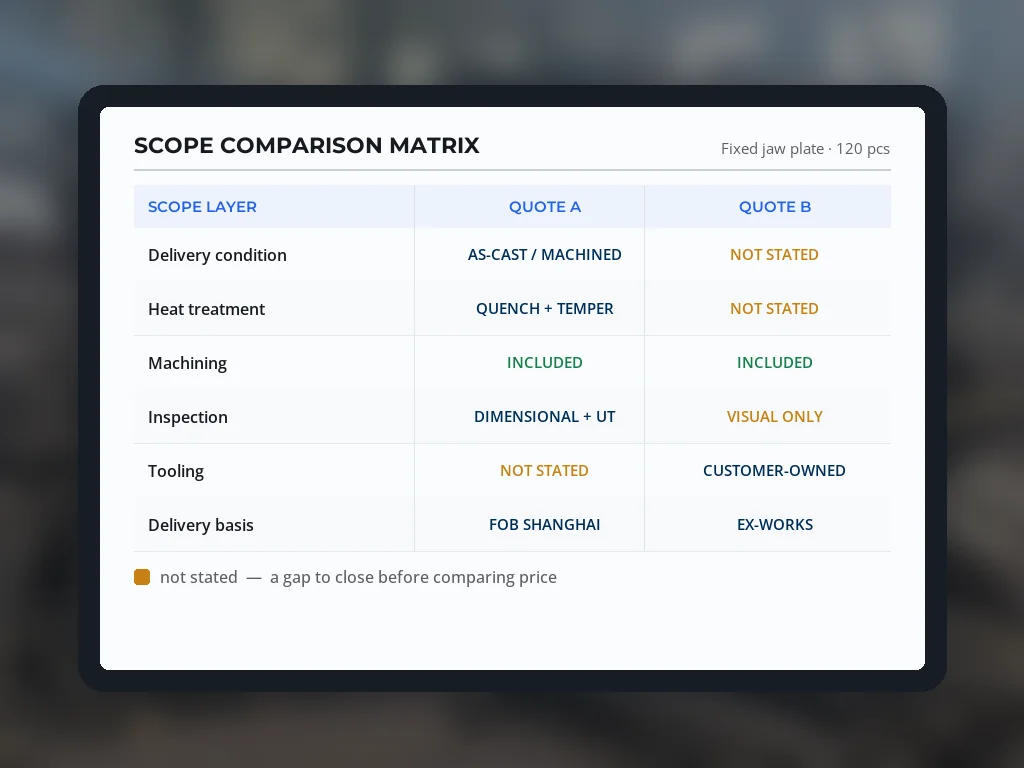
- one bundles material certification and dimensional records, the other prices visual inspection only
- pattern and fixture costs are treated differently, sometimes as a one-time charge, sometimes folded into the unit price
- packing and delivery basis differ, from a single pallet to an export crate, from ex-works to a delivered point
- the assumed order quantities and release schedule differ
None of these differences is dishonest. They are scope differences, and they are the first thing to resolve. A 1.40 quote that includes machining can be far better value than a 0.90 as-cast quote that leaves you to find a machine shop, arrange heat treatment and pay for inspection separately.
The fix is not to demand identical internal processes. Suppliers can reach the same delivered result by different routes. The fix is to agree first on what the buyer receives and how it will be accepted, then compare. Purchasing guidance from the Steel Founders' Society of America makes the same point: design, material and test requirements must be defined in the enquiry so that suppliers answer the same question [1].
Fact: DINGDAR (Henan Dingdar Machinery Equipment Manufacture Co., Ltd.) has produced castings since 1986, runs four in-house casting routes (green sand, shell moulding, lost foam and investment casting) across a 180,000 m² plant, and has worked across 5,400+ part types.
The six scope layers to line up before you compare price
A scope matrix is just a list of the things a quotation can include or exclude. Line up six layers and the numbers become comparable.
1. Delivery condition: as-cast or machined
Define what leaves the supplier's gate. As-cast means the part arrives with its mould finish, parting lines removed and gates and risers cut, but no machined features. Machined means specified faces, bores or threads are cut to tolerance. The gap between the two can be most of the price difference.
Ask each supplier to state the delivery condition in words, and to list which features are machined and which remain as-cast. If the drawing has general tolerances plus a handful of tight machined dimensions, that split is where the cost sits. Buyers who leave it vague usually discover the meaning of the quote after the parts arrive.
For the design side of this, wall thickness and draft angle decide how much machining a casting needs, and our guide to wall thickness and draft rules for casting design covers the DFM basics.
2. Material grade and heat treatment
The material line on a quote should name a grade, not just a family. "Cast steel" says little; a named grade with a specified condition, such as normalized or quenched and tempered, says what you are buying. Heat treatment often appears as a separate line or is silently excluded, and its absence is one of the most common causes of a misleading low price.
Confirm three things: the exact grade, the heat-treatment condition and who performs it. A supplier with in-house heat treatment can hold the sequence in one place, which lowers the risk that a part is machined before it is properly treated. Material families used in wear parts include high-manganese steel, high-chromium cast iron, alloy and cast steel, ductile iron, grey iron and stainless steel, and each one carries different properties and costs.
3. Machining scope and tolerances
Two machined quotes can still differ. One supplier may machine every face it can reach; another may machine only the features the drawing calls out as critical. Ask for the list of machined features, the tolerance applied to each, and the datum scheme used to locate the part.
This is where a small tolerance change moves real money. A general tolerance is inexpensive. A tight positional tolerance on a bore that must align with a mounting face is not. Also check whether the quote assumes a design concession, such as leaving a surface as-cast or relaxing a tolerance to reduce cost. That can be a legitimate saving, but it should stay visible as an option until the responsible engineer approves it. Choosing the right route for a wear part is a related decision, covered in our guide to choosing a casting process for wear parts.
4. Inspection and documentation package
An offer that includes visual checks is not comparable with one that includes dimensional records, hardness results, chemical composition, mechanical testing or non-destructive examination. Normalize this layer before you compare, because removing inspection simply to reach a lower price shifts risk onto you.
State both the first-article requirement and the routine production requirement. A supplier may include a detailed sample report once and a different certificate for ongoing production, and the buyer needs to know that before the order. If a claim is about how the part will be accepted, the right question is which records come with it. Surface finish, dimensional control and the specification detail agreed at the quoting stage are what set casting cost, which is why an unclear inspection scope produces an unclear price [2]. Industry guidance on the same problem recommends normalizing inspection, tooling and delivery scope before prices are compared at all [3].
Fact: DINGDAR's in-house inspection covers six categories with a direct-reading spectrometer, coordinate measuring machine, Brinell hardness tester, universal testing machine, metallographic microscope and ultrasonic flaw detector, and the company is certified to ISO 9001, IATF 16949, ISO 14001 and ISO 45001.
5. Pattern, tooling and fixtures
Patterns, core boxes, machining fixtures and special inspection preparation are one-time costs, and suppliers handle them in different ways. Some quote them separately; some amortize them into the unit price; some reuse an existing pattern and charge nothing. A low tooling price means nothing if the fixtures it needs reappear later as additional charges.
For each quote, ask what the tooling charge includes, who owns the pattern, and how changes or replacement are priced. If you already own tooling, say so, and ask whether the supplier will run it. DINGDAR reviews customer-owned tooling before use and can sign an NDA where drawings are sensitive.
6. Packing, delivery basis and release quantities
The last layer is commercial. Confirm the packing standard, the delivery basis and the quantities the price assumes. A price based on one large consolidated release may not apply to frequent small shipments, because batch size drives setup and handling. If the program is uncertain, ask for clearly labelled scenarios instead of a single price that assumes the best case.
Also check what the quote excludes: freight, import costs, special packaging or drawing changes. These commercial assumptions can outweigh a small difference in casting conversion cost, and they belong in the comparison, not in an email thread three months later.
A scope-based comparison table
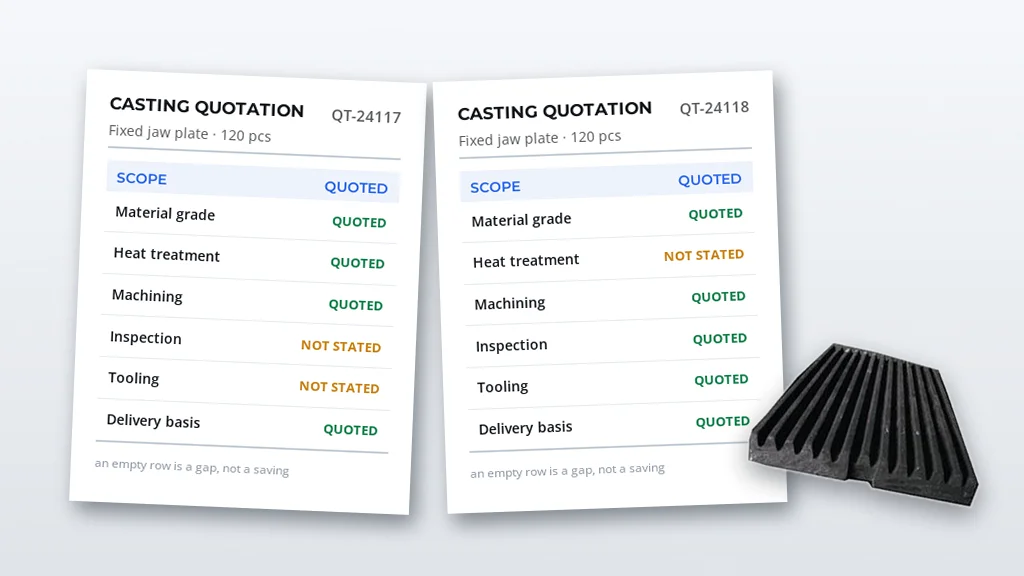
The cleanest way to see where a price comes from is one grid. Fill this format in for each supplier. The point is not to score suppliers but to make the scope visible, so the price can be read correctly.
| Scope layer | What to confirm | Quote A | Quote B |
|---|---|---|---|
| Drawing revision | Revision number and date | ||
| Material | Grade and condition | ||
| Delivery condition | As-cast, machined, or partly machined | ||
| Heat treatment | Included, in-house or subcontracted | ||
| Machining | Features and tolerances | ||
| Inspection | Methods, extent, reports | ||
| Documentation | Certificates and records | ||
| Tooling | Charge, ownership, change terms | ||
| Packing | Standard and protection | ||
| Delivery basis | Named delivery point | ||
| Quantity | Release sizes and schedule | ||
| Exclusions | What is not included |
Two quotes are comparable only when every row is filled for both, or marked "not stated". An empty row is a gap, not a saving. A supplier who cannot fill a row has told you something useful: that part of the scope is undefined.
Recurring versus non-recurring costs
Split every quote into two piles. Non-recurring costs happen once: patterns, fixtures, first-article inspection, setup. Recurring costs repeat with every part: metal, conversion, machining, treatment, routine inspection, packing.
This split matters because the two piles behave differently as volume changes. A one-time cost spread over a small first order produces a very different apparent unit price than the same cost spread over forecast annual demand. Neither calculation is wrong, but they answer different questions. If you compare a quote that amortizes tooling into the unit price against one that lists it separately, you are not comparing unit prices at all.
Ask each supplier to present the two piles separately, with the amortization assumption stated. Then you can move the same non-recurring cost onto a common basis and compare the recurring cost that actually scales with production.
Fact: DINGDAR reviews each requirement in a single technical review that fixes the casting route, material, as-cast and machining scope, inspection points and any sample or first-article confirmation, with a 12-24 hour reply time on enquiries.
How to read a quote that looks too low
A quote well below the others is not automatically a lie, but it is always a question. There are only a few honest ways it can be that low:
- the supplier has a genuine process advantage, such as running the right route in-house
- the scope is narrower than the others, for example an as-cast part or a missing inspection package
- the quote assumes an optimistic volume, fastest cycle or zero rework
- something has been left out and will surface later as a change, a fixture charge or a rework bill
The way to tell the difference is to compare the scope, not the number. If the low quote matches the others line for line and is still cheaper, you may have found an efficient supplier. If it is cheaper because three rows are blank, you have found a quote that has not finished being written. Clarify those three rows before you celebrate.
Build your comparison grid: a practical sequence
With the layers agreed, the comparison follows a fixed order:
- Fix a common baseline: one drawing revision, one material grade, one delivery condition, one set of quantities.
- Send the same RFQ package to every supplier. Differences in the questions create differences in the answers.
- Ask each supplier to confirm the scope matrix rather than a general statement of compliance.
- Split recurring and non-recurring costs, and state the amortization assumption.
- Mark missing rows as "not stated" instead of leaving them blank.
- Run one clarification round, and record the answers against the matrix.
- Ask for the final offer to incorporate the agreed assumptions, so the purchase order does not rest on scattered email explanations.
Do this and the price comparison becomes meaningful, because both sides now understand the work behind the number. Judging a new supplier is a separate skill, and you can read more in our guide to evaluating a casting supplier.
What to send with your RFQ so quotes come back comparable
The fastest way to make quotations comparable is to make the request comparable. Include:
- the drawing at a named revision, plus the 3D model if you have one
- the material grade and the required condition
- the delivery condition, as-cast or machined, with the machined features identified
- the inspection and documentation requirements, for both first article and production
- the target quantities, including release sizes and timing
- the packing and delivery basis
- any customer-owned tooling, and whether it may be used
- a note on which tolerances are critical and which are general
If some of this is still open, say so and ask for labelled scenarios. A supplier who understands the uncertainty can quote it. A supplier who guesses will hand you a number that costs money to correct.
For parts produced to drawing, the more of this you supply up front, the closer the first quote sits to the final one. DINGDAR builds custom castings produced to drawing from drawings, samples or part numbers, and reviews the whole requirement in one technical review, including the casting processes DINGDAR runs in-house.
FAQ
What should I compare first in two casting quotations?
Compare the delivery condition first: whether each price covers an as-cast blank or a machined part, and which features are machined. Then compare material grade and heat treatment. These two rows explain most of the gap between quotes for the same drawing. Only after they match does the unit price mean the same thing on both sides. If you compare price before scope, you risk choosing the cheaper quote that simply includes less work, then paying for the missing steps later.
Why are casting quotations for the same drawing so different?
Because suppliers price different scopes. One may include heat treatment, machining and inspection records; another may price an as-cast part with visual checks only. Tooling treatment, assumed order quantities, packing and delivery basis can all differ too. The metal cost is often a small part of the difference. None of this is necessarily wrong, but the quotes describe different products until the scope is lined up. Normalizing scope turns the comparison into a real price comparison rather than a guess about what each number hides.
Is the lowest casting price always the best deal?
No. The lowest headline price often reflects the narrowest scope, not the best value. A quote that excludes machining, heat treatment or inspection will look cheaper and then cost more once you add those steps yourself. The real test is the price for the same delivered component under the same terms. If a low quote matches the others line for line and is still cheaper, it may reflect a genuine process advantage. If it is cheaper because parts of the scope are missing, it is not comparable yet.
How do I compare an as-cast quote with a machined quote?
Convert both to the same delivery condition before comparing. Ask the as-cast supplier to price the machining as a separate line, or ask the machined supplier for an as-cast option. Then you can see the machining cost on its own and judge whether it is reasonable. If only one number is available, treat the two quotes as different products and do not rank them by price. The goal is one common reference point, not an average of two different scopes.
What documentation should a casting quotation include?
At minimum, the quote should state the material grade and condition, the inspection methods and extent, and the records supplied with each shipment, such as material certificates, hardness or mechanical results, dimensional records and a certificate of conformity. Ask for the first-article requirement and the routine production requirement separately, because they often differ. The documentation scope should be written into the quotation so it is fixed before the order, not negotiated after a problem appears. If documents matter to your acceptance process, price them in from the start.
How does tooling affect a casting quotation comparison?
Tooling is a one-time cost, so it changes the unit price depending on how a supplier treats it. Some list patterns and fixtures separately; some amortize them into the unit price; some reuse existing tooling at no charge. A low tooling price is only good news if the fixtures it needs are not charged later. Ask what the tooling charge includes, who owns the pattern, and how changes are priced. Compare tooling as its own line, not folded invisibly into a unit price.
Can I compare casting quotes from suppliers using different processes?
Yes, if you compare the delivered result rather than the process. Suppliers may reach the same specification by sand casting, shell moulding, lost foam or investment casting, and the buyer receives a part that meets the drawing either way. Compare the scope matrix, the tolerances achieved and the delivery condition, not the process name. A process only becomes a problem if it cannot hold the geometry, tolerance or volume you need, which is a capability question rather than a price question.
Conclusion
Comparing casting quotations on price alone rewards the supplier who includes the least. Comparing them on scope rewards the supplier who understood the job. Line up the six layers, split recurring from non-recurring cost, and mark every missing row as a gap rather than a saving. When two quotes describe the same delivered component, the price finally means something, and the decision becomes defensible.
If you have two or three quotes in front of you and want them normalized, send the drawing, material, delivery condition, quantities and packing requirements. The DINGDAR team reviews the full requirement in one technical review and replies within 12-24 hours. You can contact the DINGDAR team to start, or see the castings overview for wear parts and custom work.
Sources
- SFSA (Steel Founders' Society of America). "Ordering Steel Castings." SFSA Purchasing Guidance. https://www.sfsa.org/subject-areas/education/ordering-steel-castings/ - Guidance that design, material and test requirements must be defined in the enquiry so that suppliers quote on a common basis, the foundation for the scope matrix in this article.
- American Foundry Society. "Understanding Part Pricing." Casting Source. https://www.castingsource.com/articles/2014/09/01/understanding-part-pricing - Explains how surface finish, tooling assumptions and specification clarity at the quoting stage affect casting cost.
- Hengke Casting. "Comparing Casting Quotations: Normalize Machining, Testing and Delivery Scope." https://www.hengkecasting.com/compare-casting-quotes-delivery-scope/ - Industry discussion of normalizing inspection, tooling and delivery scope before comparing casting prices.
Manufacturer specifications: DINGDAR company facts, production routes, plant area, part types, inspection equipment and certifications are stated per manufacturer specifications on https://hndingdar.com/ (brand profile: companies/dingdar.yaml).