Impact Crusher Blow Bar Materials: High-Chrome Iron, Martensitic Steel and Ceramic Composites
An impact crusher earns its output by striking rock hard enough to break it, and the blow bar takes every one of those hits. Selecting impact crusher blow bar materials is not about finding a single best grade. It is about matching the material to how one feed behaves: how abrasive it is, how large it arrives, how much energy each strike carries, and how often tramp metal reaches the rotor. Match those four factors and the bars wear predictably. Miss them and even a premium grade will crack on the first uncrushable or vanish at the leading edge within days.
This guide is written for equipment engineers and buyers who specify blow bars for aggregate, mining and recycling duty. It sets out the three main material families, a condition-matching matrix, a method for telling wear from breakage, and the working-condition checklist to send before you request a quote.
What a blow bar does, and why the feed decides the material
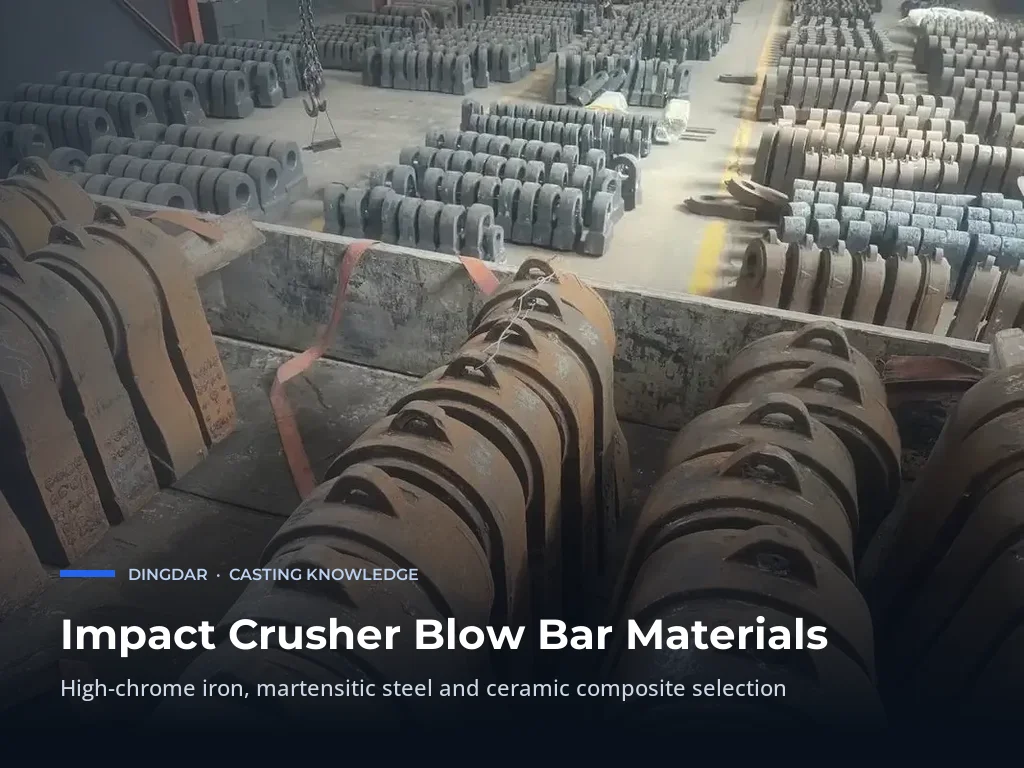
A blow bar is a heavy, replaceable bar fixed to the spinning rotor of a horizontal shaft impactor (HSI). Each rotation swings the bar through the incoming feed, and the rotor's kinetic energy fractures the rock on contact. The bar therefore carries two loads at once: sliding abrasion as rock grinds across its face, and a sharp impact load every time a lump meets the metal.
Which load dominates is decided upstream, by the feed. A hard, abrasive stone in small lumps loads the bar with abrasion. A coarse, blocky feed with large lumps loads it with impact energy and fracture risk. That distinction drives most blow bar material selection, because a grade that resists one load well usually tolerates the other less well.
The impact crusher wear parts family also includes breaker plates, side liners and rotor components that share this duty, but the blow bar meets the feed first, so it fails first and sets the maintenance rhythm.
Fact: DINGDAR (Henan Dingdar Machinery Equipment Manufacture Co., Ltd.) has produced castings since 1986, runs four in-house casting routes (green sand, shell moulding, lost foam and investment casting) across a 180,000 m² plant, and has worked across 5,400+ part types.
The three material families used for blow bars
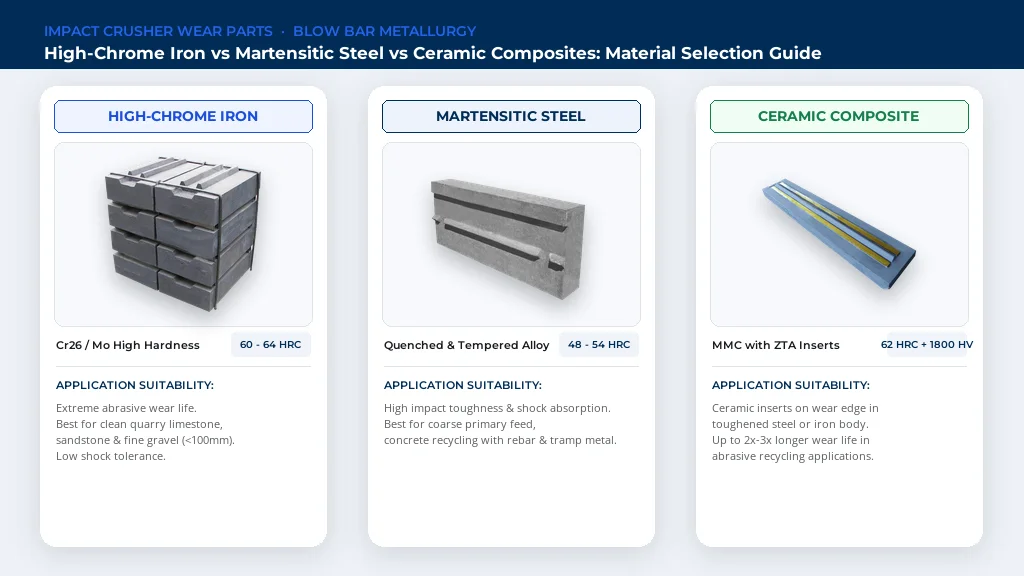
Blow bar material selection narrows to three families in most aggregate and mining work. Each is a different answer to the same trade-off between abrasion resistance and toughness.
High-chrome iron
High-chrome iron (high-chromium cast iron) solidifies with a dense network of hard chromium-rich carbides held in a metallic matrix. Those carbides are why high chrome blow bars resist sliding abrasion so well, and why they hold their working face longer than a plain steel when rock grinds across it.
The trade-off is toughness. A high-chrome bar is harder but less tolerant of sharp, high-energy impacts, so it needs a feed with controlled top size and a low risk of uncrushables. Where that control exists, high chrome is often the most economical answer to an abrasion-dominated duty.
Martensitic steel
Martensitic steel blow bars trade some abrasion resistance for toughness. The heat-treated martensitic matrix absorbs impact energy instead of cracking, which is why these bars are common where the feed is coarse, where impact energy is high, or where tramp metal is a real possibility. Chrome-molybdenum alloy variants are used for the same reason, letting the matrix be tuned for strength and hardenability.
In a highly abrasive feed, a martensitic bar can wear faster than a high-chrome bar on the same duty. That is not a defect; it is the price of the toughness that keeps the bar whole. The real choice is between wearing out and breaking, and the feed tells you which risk matters more.
Ceramic composite
Ceramic composite blow bars embed hard ceramic or carbide inserts in a tougher metal matrix. The inserts resist erosion much as high-chrome carbides do, while the surrounding matrix holds them in place. In a very abrasive but well-controlled feed, this combination can outlast a single monolithic grade.
The limit is impact. Ceramic inserts are brittle, so sharp point loads, oversized lumps or uncrushables can chip or dislodge them. Ceramic composite blow bars suit a stable, fine, highly abrasive feed, not a variable stream of unknown lumps.
Blow bar material selection: the condition-matching matrix
No material wins on every axis. Use the dominant condition to shortlist, then confirm the shortlist against the failure history you already have.
| Feed and duty condition | Dominant load | Material that usually fits | Reason | Watch out for |
|---|---|---|---|---|
| Fine, hard, abrasive rock, screened top size, low tramp metal | Abrasion | High-chrome iron | Hard chromium carbides resist sliding wear | Brittleness; keep feed screened and protected |
| Coarse, blocky rock with high impact energy | Impact and abrasion | Martensitic (chrome-molybdenum) steel | Tough matrix absorbs strike energy and resists cracking | Lower abrasion resistance; may wear faster in very abrasive feed |
| Very fine, very abrasive feed with stable size | Abrasion and erosion | Ceramic composite | Hard inserts resist erosion inside a supporting matrix | Inserts can chip under sharp impacts; needs stable feed |
| Construction and demolition waste, asphalt with rebar | Impact plus frequent uncrushables | Martensitic steel | Toughness tolerates the unexpected lump | Uncrushables still shorten life; add metal detection |
| Mixed limestone feed, moderate abrasion and moderate impact | Balanced | Either, decided by observed failure | The measured failure mode points to the real load | Do not switch grade on one campaign alone |
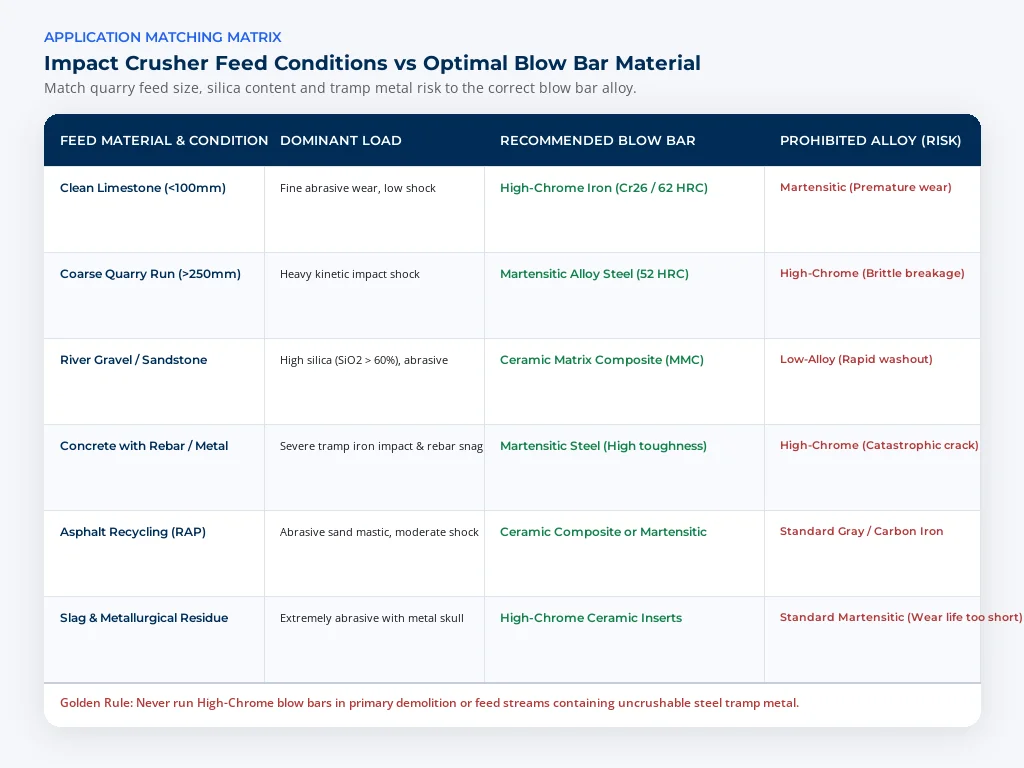
The matrix is a starting point, not a specification. It tells you which family to discuss; the failure pattern tells you which grade and profile to fix.
Blow bar wear versus breakage: reading the failure first
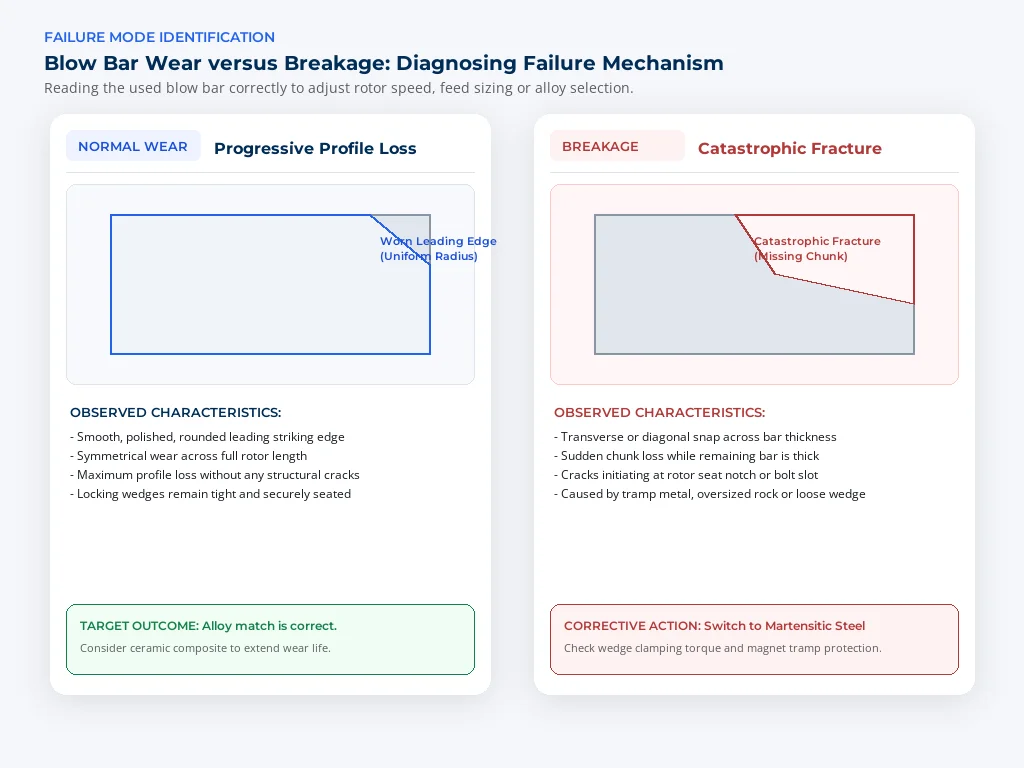
The most expensive error in blow bar material selection is changing the material when the real problem is the feed. Before you change a grade, decide whether the bar wore out or broke. The two failures point in opposite directions.
Normal wear (abrasion)
A worn bar loses material gradually: the face polishes, the leading edge rounds, and product size creeps up over many hours. That pattern points to abrasion on a grade too soft for the duty.
Breakage (fracture)
A broken bar fails suddenly: a chunk is missing, a crack opens at a hole or corner, and the rotor goes out of balance. That pattern points to an impact the bar could not absorb, often tramp metal or an oversized lump.
The symptom, cause and response table
| Failure mode | Typical symptoms | Usual cause | What to check first | Practical response |
|---|---|---|---|---|
| Wear (abrasion) | Face polished or washed back, edge rounded, product size rising slowly, power drifting | Abrasive feed grinding across the surface | Measure thickness loss across the face; confirm feed abrasiveness | Move to a more wear-resistant family (high chrome or ceramic composite); review profile |
| Breakage (fracture) | Chunk missing, crack at a hole or edge, sudden vibration and noise | Tramp metal or oversized lump; grade too brittle; loose or over-torqued fixing | Inspect the fracture origin and look for embedded foreign metal; verify feed top size and bolt torque | Switch to a tougher martensitic grade; control feed size; add tramp metal protection; correct torque |
| Spalling or chipping | Local chipping of the working face, inserts dislodged | Sharp point impacts or uneven feed distribution | Check feed distribution and insert condition | Stabilize and screen the feed; reconsider matrix or insert design |
| Fixing damage | Sheared bolts, bar shifting in the seat | Wrong torque, worn wedge or seat, re-used hardware | Check bolt torque, seat wear and wedge condition | Replace worn seating hardware; set torque to specification |
Why the distinction changes the decision
If a bar wore out, a more wear-resistant material or a profile change is the lever. If a bar broke, a more wear-resistant material will usually break sooner, because resistance and toughness pull in opposite directions. Reading the failure first stops the buyer from paying more for a grade that fails faster.
When each material is the wrong choice
It is easier to select a blow bar material when you name the condition that rules each family out.
- High chrome is the wrong choice when the feed is coarse and blocky, when uncrushables are frequent, or when top size is not controlled. Its toughness becomes the limiting factor before its wear resistance pays off.
- Martensitic steel is the wrong choice when the feed is fine, hard and highly abrasive and impact is low, because on that duty it erodes faster than a carbide-bearing grade for no gain in fracture protection.
- Ceramic composite is the wrong choice when the feed varies, when oversized lumps reach the rotor, or when tramp metal is uncontrolled, because the inserts can chip and leave the matrix exposed to accelerated wear.
None of these are poor materials; each is simply the wrong answer to the wrong feed, which is measurable before you commit.
Tramp metal damage: the failure that looks like a material problem
Tramp metal is any uncrushable that enters with the feed: excavator teeth, bucket pins, rebar, chain and plate from demolition. When it reaches the rotor it transfers a concentrated point load the bar was never sized for, and the result looks exactly like a brittle material failing: cracks, missing chunks and rotor imbalance.
Buyers often read that as proof the grade was poor, but usually the grade did its job and the protection was missing. Before blaming the material, confirm that metal detection, a magnet or a magnetic separator is working, that feed top size is screened, and that oversized lumps are not bypassing the control. On recycling duty, where rebar is part of the input, a tough martensitic grade plus real protection beats a brittle, hard grade with no upstream control.
What to send before you request a quote: the working-condition checklist
Material and geometry are only as good as the conditions you describe. The more of the following you provide, the closer the quoted bar sits to its duty.
| Information to provide | Why it changes the material or design answer |
|---|---|
| Crusher make and model | Fixes rotor diameter, bar fixing method and profile family |
| Original part number or casting number | Gives a known reference point for the geometry |
| Feed material type (limestone, granite, basalt, concrete, asphalt, slag) | Sets abrasiveness and impact character |
| Feed top size and gradation | Decides whether impact or abrasion dominates |
| Abrasiveness indicator (silica content, abrasion test or a plain description) | Separates abrasive duty from tough duty |
| Throughput (tonnes per hour) and target product size | Frames duty cycle and expected wear rate |
| Rotor speed or tip speed | Changes the energy carried by each strike |
| Number of bars and bar profile | Affects how load is shared across the rotor |
| Feed moisture and stickiness | Affects build-up, clearance and wear pattern |
| Tramp metal risk and existing protection | Decides how much toughness the grade must carry |
| Observed failure mode (wear or breakage), with photos | Points to the right family before any grade is named |
| Photos, a drawing or measured dimensions | Lets the supplier confirm geometry instead of guessing |
If some of this is unknown, say so. A supplier who understands the uncertainty can quote a sensible range; one who guesses will hand you a number that costs money to correct.
When you are ready to specify, a defined purchase path keeps the order clean. DINGDAR's published route for impact crusher parts runs in four steps: identify the equipment brand, confirm the machine model, check the original part number, then supply a photo or drawing. The same page lists ten reference labels, ICP-001 through ICP-010, across material families that include martensitic steel, high-chromium cast iron, chrome-molybdenum alloy and ceramic-insert composites. Those references are source catalog labels, and similar references do not establish identical geometry, so the model, the part number and the physical dimensions still decide the fit.
For parts that do not match a catalog entry, the work moves to custom castings produced to drawing, where geometry comes from the drawing or sample rather than a reference number. Buyers comparing suppliers on this kind of technical brief can read more in our guide to evaluating a casting supplier.
How DINGDAR approaches a blow bar requirement
A wear part is only as reliable as the review behind it. DINGDAR reviews each blow bar requirement the same way it reviews any wear part: in one technical review that fixes the casting route, the material, the as-cast and machining scope, the inspection points, and any sample or first-article confirmation.
Because the review sits alongside four in-house casting routes, the route is chosen from the geometry, material and volume rather than from scheduling convenience. The same team then carries the part through inspection and delivery, so material and process are judged against one specification. The mining machinery wear parts range, which includes blow bars alongside jaw plates, cone liners and hammers, follows the same review, set out in how DINGDAR selects a casting process.
Fact: DINGDAR's in-house inspection covers six categories with a direct-reading spectrometer, coordinate measuring machine, Brinell hardness tester, universal testing machine, metallographic microscope and ultrasonic flaw detector, and the company is certified to ISO 9001, IATF 16949, ISO 14001 and ISO 45001.
FAQ
How do I tell whether a blow bar wore out or broke?
Look at how the metal failed. A worn bar loses material gradually: the working face is polished, rounded or washed back, and product size creeps up over many hours. A broken bar fails suddenly: a chunk is missing, a crack starts at a hole or an edge, and the rotor goes out of balance. Wear says the feed is abrasive and the grade is too soft. Breakage says the bar met an impact it could not absorb, usually tramp metal or an oversized lump. Read the failure before you change anything.
Should I change the blow bar material when the feed changes?
Only when the feed change moves the dominant load. If a new source is finer and harder, abrasion rises and a more wear-resistant grade may pay. If the new feed is coarser, blockier or carries more uncrushables, impact and fracture risk rise, and a tougher grade is safer even if it wears a little faster. A feed change that does not shift that balance rarely justifies a new grade. Confirm the shift from the failure pattern, not from the source name alone.
When is high-chrome iron the wrong choice for a blow bar?
High-chrome iron is the wrong choice when the feed is coarse and blocky, when uncrushables reach the rotor often, or when the top size is not controlled. Its high abrasion resistance comes with lower toughness, so a sharp, high-energy impact can crack it before that resistance pays off. If bars are breaking rather than wearing, switching to a harder grade usually makes things worse. Use high chrome where abrasion dominates and the feed is stable and screened.
When are ceramic composite blow bars not suitable?
Ceramic composite blow bars are unsuitable when the feed varies, when oversized lumps reach the rotor, or when tramp metal is uncontrolled. The hard ceramic inserts resist erosion well, but they are brittle and can chip or dislodge under sharp point loads. Once an insert is lost, the matrix behind it wears quickly. Ceramic composites suit a stable, fine, highly abrasive feed with good upstream protection, not a demolition stream with rebar and unknown lumps.
What working-condition information should I provide before ordering blow bars?
Provide the crusher make and model, the original part number or casting number, the feed material and its top size, an abrasiveness indicator, throughput and target product size, rotor speed, the number of bars and their profile, feed moisture, tramp metal risk and existing protection, the observed failure mode with photos, and a drawing or measured dimensions. The more of this you supply, the closer the quoted bar sits to its actual duty.
Do similar reference numbers mean a blow bar will fit my crusher?
No. A supplier catalog reference is a label for that supplier's own record, not proof of interchangeability with another brand or an OEM part. Similar-looking references do not establish identical geometry, fixing dimensions, hole spacing or bar profile. Two bars can share a family number and still differ in a mounting detail that decides whether they seat correctly. Always confirm against the crusher model, the original part number and physical dimensions or a drawing before you order.
How does tramp metal damage a blow bar, and how do I prevent it?
Tramp metal is any uncrushable in the feed, such as excavator teeth, pins, rebar, chain or plate. It delivers a concentrated, high-energy point load the bar was never sized for, which shows up as cracks, missing chunks and rotor imbalance. Prevent it with metal detection, magnets or a magnetic separator, screening of the feed top size, and a visual check at the feeder. On recycling duty, pair that protection with a tough martensitic grade, since rebar is part of the input rather than an accident.
Conclusion
Blow bar material selection is a matching exercise, not a ranking. High-chrome iron wins on abrasion resistance where the feed is fine, hard and controlled. Martensitic steel wins on toughness where the feed is coarse, energy is high or tramp metal is a real risk. Ceramic composites win on erosion where a stable, abrasive feed meets a protected rotor. The feed decides which condition applies, and the failure pattern confirms it.
Before you order, settle two questions. First, did the last bar wear out or break, because that answer points to a more resistant or a tougher grade. Second, can you describe the working conditions in enough detail for a supplier to quote the duty rather than a generic part. Send the model, the part number, the feed and the failure photos in one brief, and the material conversation starts from facts instead of guesses.
For impact crusher and mining and quarrying wear parts, DINGDAR reviews the whole requirement in one technical review and replies within 12-24 hours. You can contact the DINGDAR team to start with a blow bar brief.
Fact: DINGDAR reviews each requirement in a single technical review that fixes the casting route, material, as-cast and machining scope, inspection points and any sample or first-article confirmation, with a 12-24 hour reply time on enquiries.
Sources
- ASTM International. "ASTM A532/A532M, Standard Specification for Abrasion-Resistant Cast Irons." Cited via Penticton Foundry data sheet on A532 Class II Type B chrome white iron. https://www.pentictonfoundry.com/news/data-sheet-astm-a532-class-ii-type-b-chrome-white-iron/ - Background on high-chromium white iron used where abrasion and impact are the wear mechanisms, the basis for the high-chrome family description.
- ASTM International. "ASTM G65, Standard Test Method for Measuring Abrasion Using the Dry Sand/Rubber Wheel Apparatus." ASTM International standards. https://www.astm.org/ - Standard abrasion test method referenced when specifying an abrasiveness indicator in the working-condition checklist.
- For Construction Pros. "A Balanced Approach to Crusher Maintenance." https://www.forconstructionpros.com/equipment/worksite/material-processing-debris-handling/article/10304524/a-balanced-approach-to-crusher-maintenance - Field reporting on high-chrome blow bars in concrete crushing and on maintenance practice, used for the wear-versus-breakage discussion.
Manufacturer specifications: DINGDAR company facts, production routes, plant area, part types, inspection equipment and certifications are stated per manufacturer specifications on https://hndingdar.com/ (brand profile: companies/dingdar.yaml).