Casting Pattern Cost: How Tooling Drives the Route Decision
Two foundries quote the same drawing. One returns a lower piece price; the other returns a higher one plus a tooling line that widens the gap. Most buyers pick the first, then discover that the cheaper quote cost more, because the offers never described the same one time work.
Tooling is the one major cost in a casting that does not repeat with the parts. Metal, labour, fettling, heat treatment and inspection all scale with pieces bought. The pattern, core box, foam cavity or wax die is paid for once, then sits inside the cost of every part that follows.
This guide takes the bundle apart. It quotes no prices: a real figure depends on part size, geometry, tolerance, core count, tool material and the supplier's capacity, and is calculated per part and per process.
Why tooling is the line item buyers read last
Tooling usually appears as one row near the bottom of a quotation, or is folded into the piece price where it cannot be seen. Buyers read the unit price first, so a decision about process capability gets made on the least examined line.
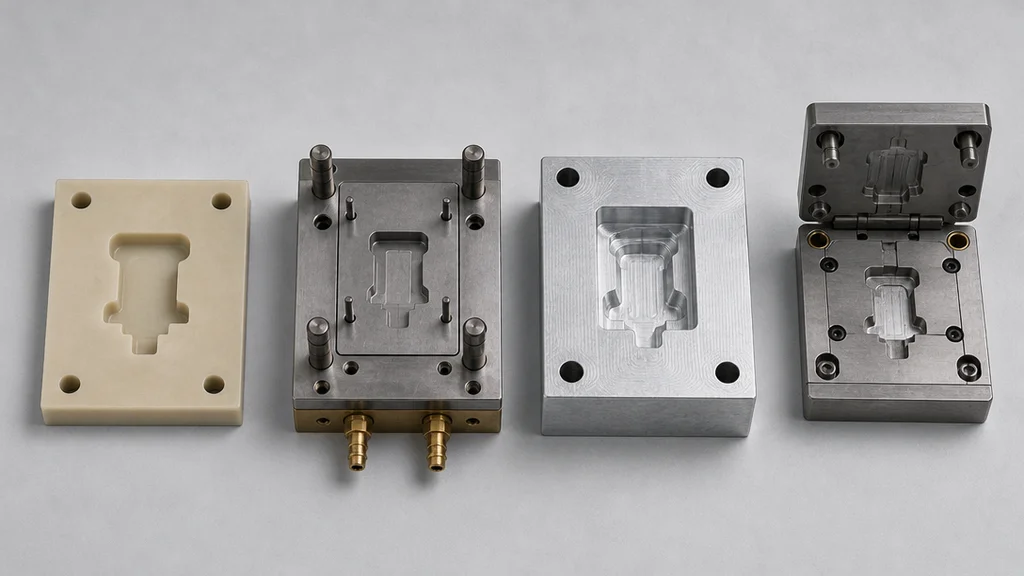
Tooling is not a fee attached to a process. It is the process, made physical: no heated metal pattern, no shell moulding line; no wax die, no investment casting. The tooling line is the cheapest evidence of which route a supplier actually intends to use. Supplier guidance says the same: pattern requirements must be defined in the enquiry [1].
The two costs move in opposite directions. Tooling is fixed and paid early; conversion is variable and paid per piece. A route that minimises conversion invests in tooling, while a route that minimises tooling accepts more per piece work: more allowance, more fettling, more scrap risk. Neither is wrong, and a quote showing one number hides the choice inside the other.
Fact: DINGDAR (Henan Dingdar Machinery Equipment Manufacture Co., Ltd.) has cast parts since 1986, runs four in-house routes (green sand, shell moulding, lost foam and investment casting) on a 180,000 m² site with 720+ employees, and has worked across 5,400+ part types.
Route selection has its own guide in how casting routes are selected in practice; the tooling view is the one that reaches the purchase order.
Four routes, four kinds of tooling
These four routes dominate custom casting supply, and their tooling differs less in quality than in kind.
Green sand: a pattern and a box to pack it in
In green sand the sand is the mould, so the tooling is only the negative shape plus gating. A pattern, usually a match plate carrying both halves, is mounted in a flask, packed with sand, and withdrawn. It can be wood, resin or aluminium, and its geometry is forgiving. Changes are often local: a boss added, a rib moved, a fillet thickened. Cores add core boxes, each its own tool. Cost follows pattern size, core count and whether the plate fits existing flasks. More on the route is on the green sand casting page.
Shell moulding: a heated metal pattern and a core shooter
Shell moulding replaces the sand box with a thin resin bonded shell formed against a heated metal pattern. That pattern is a machined metal part with mounting features, heating provision and ejector pins, and cores are shot in a separate core box. It is a heavier tool than a green sand pattern, which is the main reason shell tooling costs more up front. What it buys is repeatability: the pattern holds dimensions over a long life, the shell face is smoother, and thinner sections become practical. Thermal uniformity matters, because an unevenly heated plate makes an uneven shell.
Lost foam: a cavity for foam, not for metal
In lost foam casting the pattern is the foam, and the foam is consumed. The tool is an aluminium block machined into a cavity, into which beads are injected and fused; the pattern is glued into a cluster, coated and buried in unbonded sand. The cavity only has to produce a foam shape, so it can be lighter than a die that holds liquid metal, and internal passages are moulded rather than cored. The complexity moves into process control instead.
Investment casting: a die for wax, and a shell that is thrown away
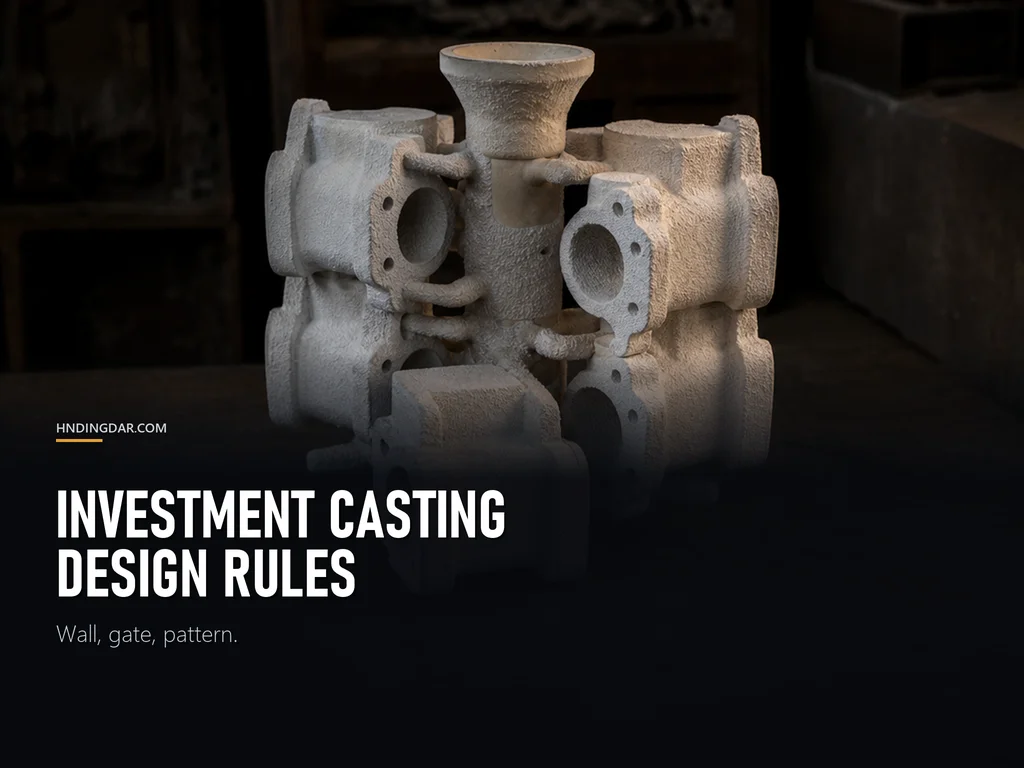
Investment casting starts with a wax pattern injected into a machined die, usually aluminium or steel and often multi cavity. Patterns are assembled onto a tree, dipped in ceramic slurry and stuccoed until a shell forms, and the wax is melted out. The die is the most demanding tool of the four: cut to a shrink allowance for wax and alloy, able to release a fragile pattern without distortion, fine enough that the shell reproduces detail. Lead time is longest here, because the die must be proven in wax before metal is poured.
What a tooling quotation is actually made of
A tooling charge is rarely one activity. It bundles five, and how they are bundled decides what happens when something changes.
Design and process layout
Someone decides the parting line, draft, gating and feeding, core strategy and shrink allowance. Your drawing becomes a tooling drawing, and ambiguity is resolved here, usually without you noticing. Errors at this stage surface only at trial, which is what makes them expensive.
Pattern frame and cavity machining
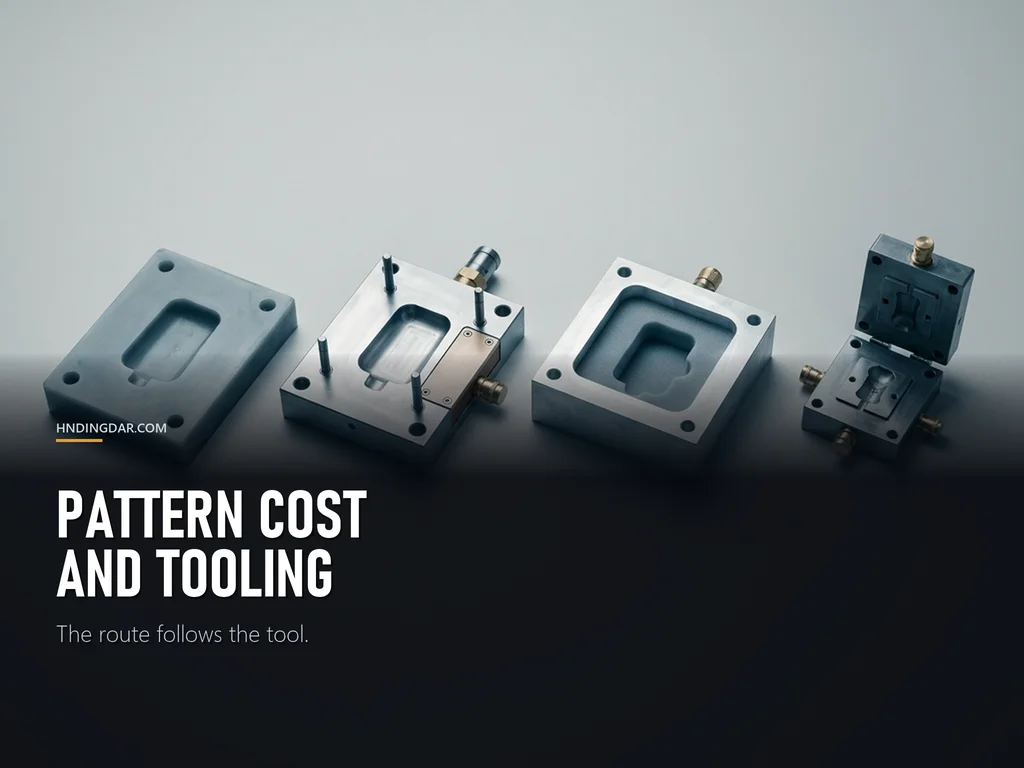
This is the physical tool: pattern plate, cavity block, ejectors, heating, and the interfaces that mount it on a specific moulding line. Cost follows size, cavity count, tolerance, surface requirement, tool material and how much work needs EDM rather than milling. Interchangeability counts too: a tool built around the supplier's existing flask is cheaper than one needing new handling equipment.
Trial and first off validation
Every new tool is proven by casting with it, then checked against the drawing. A quote that omits the trial is not cheaper than one that includes it. It is unfinished, and the trial reappears as a separate charge later.
Correction allowance
No tool is right the first time. Shrink compensation is adjusted, distortion corrected, a gate moved. The commercial question is how many rounds the quotation includes. A supplier who names a number and prices further rounds separately is easier to manage than one implying unlimited revisions.
Storage, maintenance and requalification
Patterns and dies live for years: they are handled, they wear, they corrode, and they need requalification before a repeat order. This small recurring cost stays invisible until a pattern is pulled out after a long gap and cannot hold tolerance.
Amortization: the direction of the effect, not the size of the number
A one time cost does not belong in a unit price until someone decides what to divide it by. Two suppliers with identical conversion costs can report different piece prices because one divides tooling across the first order and the other across a forecast year. Foundry pricing guidance makes the same point about tooling assumptions at the quoting stage [2].
Once the cost is separated, the shape of the decision appears. There is a volume at which two routes cost the same in total. Below it, the route with the smaller tooling burden usually wins even when its piece price is higher, because the expensive route has not earned back its tool. Above it, the lower piece price wins, because the difference repeats on every part.
The penalty of a low tooling route is easy to underestimate, because it is not only price. A simpler tool may need more allowance, more fettling, more checks and a higher scrap allowance, all of them recurring.
Fact: DINGDAR fixes the casting route, material, as-cast and machining scope, inspection points and any sample or first-article confirmation in a single technical review, and answers enquiries within 12-24 hours.
How to find your own volume threshold
No universal batch size exists. The crossover depends on part weight, wall section, core count, tolerance, cavity count and the supplier's capacity, so any published threshold describes someone else's part. The method transfers.
- Fix the comparison on one drawing revision and one delivery condition.
- Ask every route for two numbers: total tooling, and piece price excluding tooling.
- Multiply piece price by realistic annual volume, add tooling, then add penalties for machining, fettling, inspection and scrap.
- Run the sum twice, for the first order and for the programme life. The first order is what gets approved.
- Halve the volume and rerun. If the ranking flips, the decision is volume sensitive, and a staged decision is the honest one.
- Check the release pattern, not only the annual total. Frequent small releases carry repeated setups.
- Ask for the scenarios to be quoted explicitly, so the volume assumption is written down.
What a change after approval actually costs
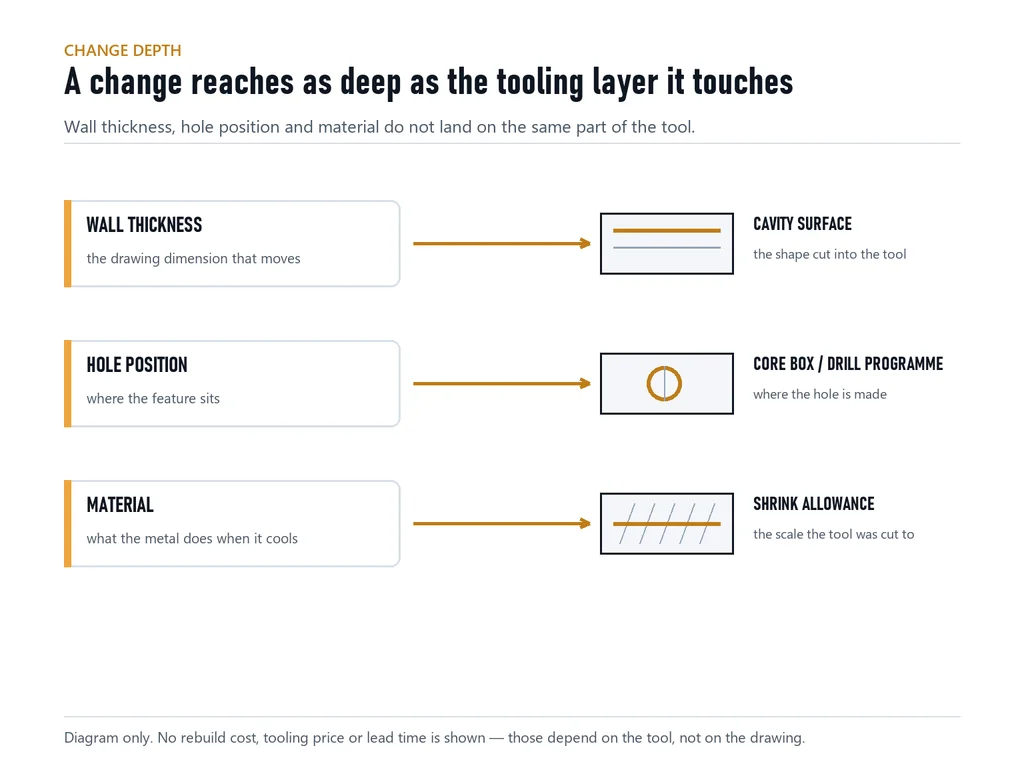
A pattern is a fixed asset tied to one geometry, so the cost of changing the part later depends on which layer of the tool the change reaches.
A wall thickness change
This is the deepest kind, because the wall is the cavity. Moving a section moves the tool surface and usually the feeding logic with it, since a riser sized for one section is wrong for another. Green sand may take a pattern insert; shell and investment mean re machining the cavity or cutting a new block; lost foam means a new cavity plus fresh bead and coating trials. Our guide to wall thickness and draft DFM rules covers the design side.
A hole or slot position change
This is usually shallower, and often avoidable. On sand routes a hole is cored or drilled. If cored, moving it alters a core box; if drilled, it may only change the machining programme. On investment casting small holes are commonly formed in the wax die, so a move is a die change. Whether a feature is cast or machined is therefore itself a tooling decision.
A material change
This is the one buyers underestimate, because the geometry does not move. Pattern and die dimensions are cut to a shrink allowance that belongs to a specific alloy. Move from grey iron to cast steel, and the allowance that was correct is now slightly wrong, so a tool that made a conforming part makes one that drifts. A material change can also push the part onto another route, with a new tool behind it.
Who owns the tooling, and what you keep when you leave
Ownership is a contract question with physical consequences, and it is usually settled by default. Three arrangements are common: the supplier owns the tool and recovers its cost in the piece price, the buyer pays in full and owns it, or the buyer consigns an existing tool for a programme.
Whatever the arrangement, six things belong in writing before the first casting is poured. Who owns the pattern and the CAD data behind it. Where it is stored and in what condition. That it will not be used for another customer's parts. Who pays for maintenance. What happens at the end of the programme. And who holds the drawings if the relationship ends.
Transferability is the part buyers assume and later regret. Ownership does not make a tool portable. A pattern is built around a specific flask, a core box around a specific shooter, a die around a specific machine. Moving it may need adapters, a new pattern plate, gating redesigned for the new process, and always a fresh first article approval.
The consequence is simple. If you never own the tooling, dual sourcing that part is effectively impossible, because no second supplier can quote it without building a tool.
Fact: DINGDAR reviews customer-owned tooling before use, can sign an NDA for sensitive drawings, and holds ISO 9001, IATF 16949, ISO 14001 and ISO 45001 certification.
All four routes sit in one plant of 180,000 m² with a 12,000 m² office and R&D building, which is why one review can move a part between routes without restarting the tooling conversation. The DINGDAR plant and its four routes page describes those facilities.
How tooling should appear in the commercial conversation
Three questions decide whether a tooling charge can be compared. Is it a separate line or inside the piece price? Is the trial included, and how many correction rounds come with it? At what point does a change become a new tool?
The tooling line should describe what is being made, not only what it costs: pattern or die, core boxes, gauges, trial, corrections, storage. It should also state the material and shrink allowance the tool was designed around.
Payment staging is a commercial term agreed per order. What matters is that money is tied to milestones you can inspect: tooling drawing approval, trial casting, dimensional report, first article acceptance. DINGDAR's technical review fixes route, material, scope, inspection points and any first article confirmation in one pass, and later revisions are priced before they are produced.
Tooling is one row of the offer comparison, and the method for the rest is set out in comparing casting quotations on scope.
Tooling cost map by route
The table below maps where tooling cost lives on each route. It is not a price list: each entry is calculated per part and process.
| Route | Tooling type | Main cost drivers | Change sensitivity | Where the burden sits |
|---|---|---|---|---|
| Green sand | Pattern or match plate, core boxes, flasks | Pattern size, core count, flask compatibility | Moderate and mostly local, inserts often possible | Low tooling, more per piece work |
| Shell moulding | Machined metal pattern with heating and ejection, core boxes | Metal pattern, cavity count, thermal uniformity, machine interface | Moderate, cavity work plus shell revalidation | Higher tooling, lower per piece variation |
| Lost foam | Aluminium cavity for foam beads, gluing and coating fixtures | Cavity machining, bead and coating development | Geometry easy to alter, process trials must repeat | Moderate tooling, process control carries the risk |
| Investment casting | Wax injection die, injection and assembly fixtures | Die cavities, wax and alloy shrink allowance, fine detail | High, a cavity change is a die change | Highest tooling, least per piece finishing |
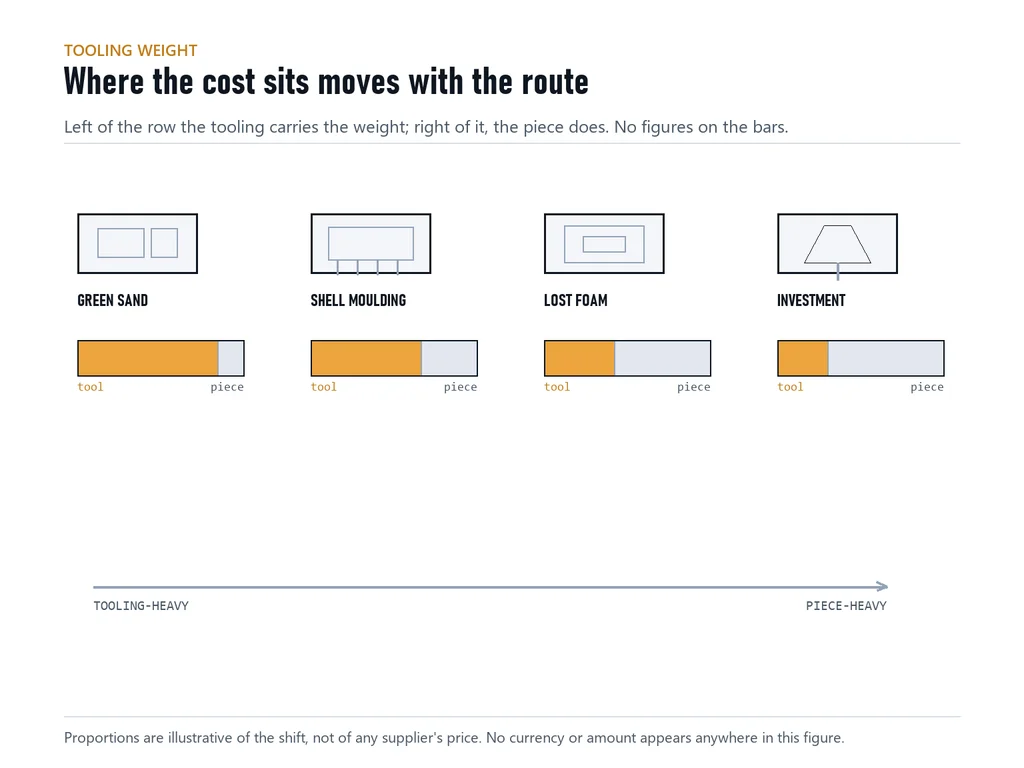
The route with the most expensive tool is not the most expensive route; it is the route whose cost is most front loaded. Change sensitivity does not follow tool cost either. A foam cavity is easier to alter than a die, yet altering it restarts a validation the die does not need.
FAQ
Which casting route is best for small batch sizes?
There is no single answer, but the direction is consistent. At low volume tooling dominates the total, so a route with a modest tool and a higher piece price often wins: green sand for general shapes, lost foam where the geometry suits it. Shell moulding and investment casting earn their tooling through volume or tolerance.
Why is pattern cost higher for investment casting than for green sand casting?
Because the tool does a harder job. A green sand pattern only shapes a mould that is packed and withdrawn. A wax die must hold a fragile pattern to fine tolerance, release it without distortion, compensate for wax and alloy contraction, and survive injection pressure. It is usually multi cavity, and it must be proven in wax before any metal is poured.
Can the tooling cost be refunded if the part is discontinued?
That depends on the order, so settle it before the tool is built. The tool may be owned by the buyer and held by the supplier, owned by the supplier with its cost recovered in the piece price, or amortized over an agreed quantity. Only the first leaves you an asset to take away.
Can I take the pattern to another foundry if I change supplier?
Only if you own it, and even then it is not a straight transfer. Ownership gives you the right to move the tool; it does not make the tool portable. A pattern fits a specific flask, a core box a specific machine, a die a specific press. Expect adapters, possibly a new pattern plate, and always a fresh first article approval.
What happens if the first trial casting does not meet the drawing?
The trial exists to find that out, so the first question is why it failed. If the tool matched an approved tooling drawing and the drawing was wrong, the correction is a design change and normally your cost. If the tool departed from the drawing, or the process was not capable, it is the supplier's. Ambiguity turns it into a negotiation.
How do design changes affect casting pattern cost?
According to which layer of the tool they reach. A wall thickness change moves the cavity and usually the feeding, and is the most expensive kind. A hole move may mean a core box change, a die change or only a machining programme change. A material change can leave geometry untouched and still invalidate the tool.
Do I own the pattern if I pay for the tooling charge?
Not automatically. Paying a tooling charge and owning the tool are different things, and ownership exists only if the order says so. Some quotations charge for tooling while the supplier retains the tool, which is legitimate if stated. Ask for a clause naming the tool, confirming your property, and recording where it is held.
Conclusion
Pattern cost is the part of a casting quotation that decides the route, and the part most buyers read last. It is fixed where everything else is variable, and it reverses the ranking between routes as volume changes.
The sequence is short. Ask for tooling and piece price separately. Establish what the tooling includes. Find the volume where the two routes meet, and test that answer against a halved forecast. Then write down who owns the tool, how many correction rounds are included, and what a later change costs.
If you are weighing two routes for the same drawing, send the drawing, material, annual volume and release pattern. DINGDAR runs four casting routes in-house and replies within 12-24 hours. You can contact the DINGDAR team to start.
Sources
- SFSA (Steel Founders' Society of America). "Ordering Steel Castings." SFSA Purchasing Guidance. https://www.sfsa.org/subject-areas/education/ordering-steel-castings/ - Guidance that pattern, material and test requirements are defined in the enquiry so suppliers quote the same scope.
- American Foundry Society. "Understanding Part Pricing." Casting Source. https://www.castingsource.com/articles/2014/09/01/understanding-part-pricing - Explains how tooling assumptions and specification clarity at the quoting stage drive casting cost.