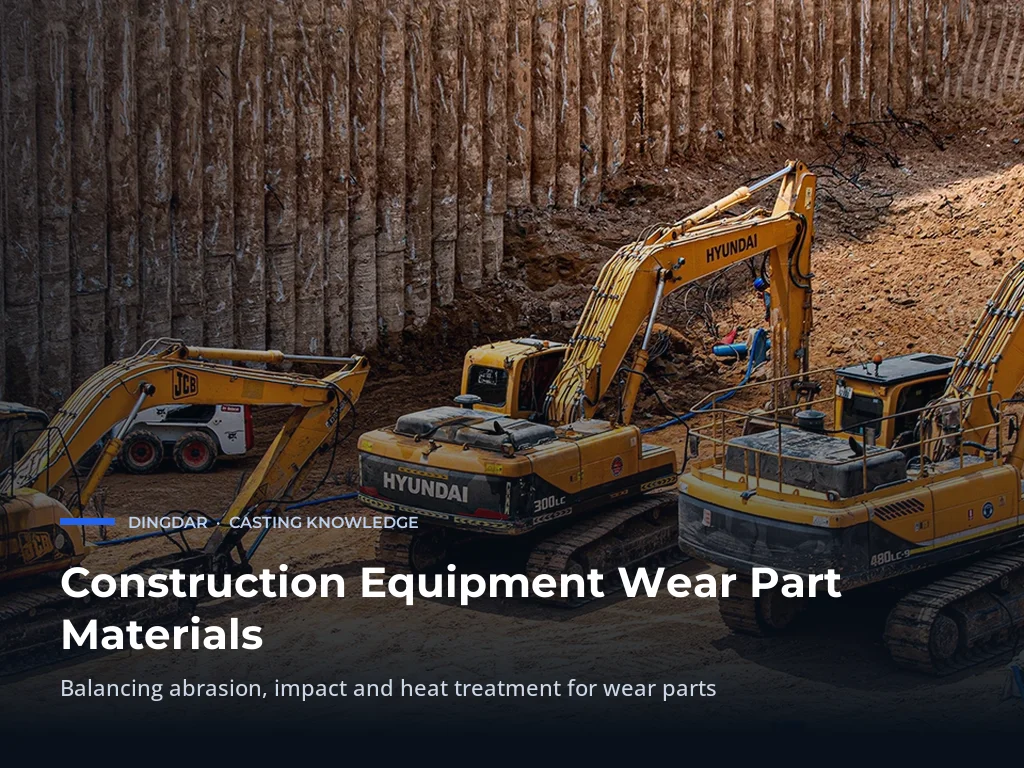
Construction Equipment Wear Part Materials: Balancing Abrasion, Impact and Heat Treatment
Two bucket teeth come off the same machine in the same shift. One is worn down to a thin, polished edge. The other has a corner sheared off in a single break. Both were sold as construction equipment wear part materials, and both failed, but they failed by different mechanisms. That difference is the entire problem of material selection, because a wear part does not have one failure mode. It has two, and they demand opposite things from the metal.
This guide is written for OEM procurement managers, equipment engineers and wear-part distributors who have to name a material on a drawing and defend it later. It shows how to read a service condition, narrow the choice to a material family, set the heat treatment, and specify the inspection that proves the material is what the drawing asked for. It also shows how to tell abrasion from fracture on a part that has already come back.
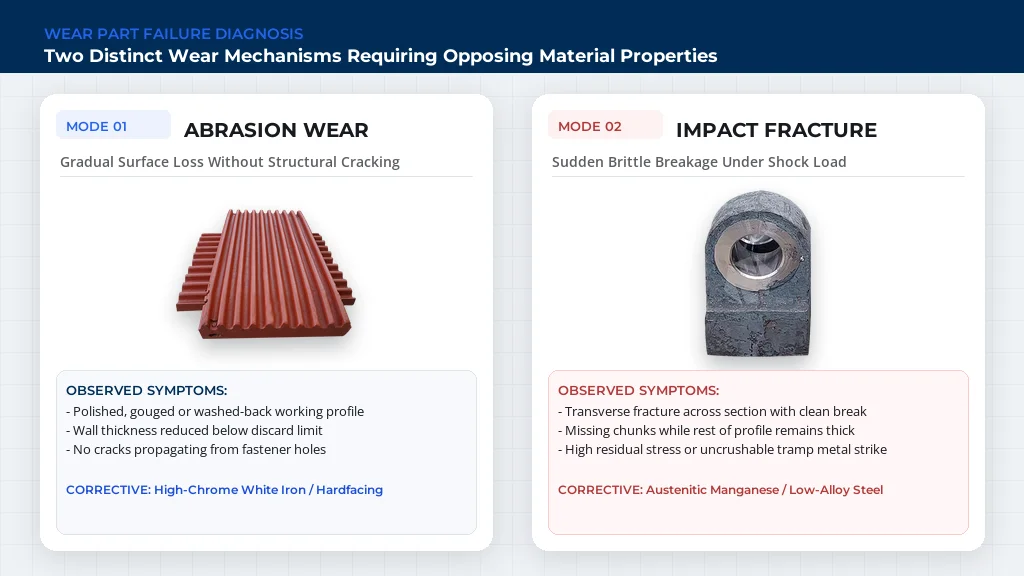
Abrasion and impact are two different failures, not one
Abrasive wear removes metal slowly. Sand, gravel, crushed rock and ore slide and scrape across the surface, cutting away a little material on every pass until the part is undersized, rounded off or worn through. The part keeps working the whole time; it simply gets smaller.
Impact failure is the opposite. A rock too big for the bite, a dropped load or a badly placed strike loads the part faster than it can deform, and a crack starts and runs. The part does not wear out. It breaks, often without warning, and it can take the adapter or the machine with it.
Fact: DINGDAR (Henan Dingdar Machinery Equipment Manufacture Co., Ltd.) has produced castings since 1986, runs four in-house casting routes (green sand, shell moulding, lost foam and investment casting) across a 180,000 m² plant, and has worked across 5,400+ part types (per company data).
The two mechanisms are not equally served by the same metal. Abrasion rewards a hard surface that resists scratching. Impact rewards a tough core that can bend and absorb energy before it cracks. When a buyer asks only for the hardest material available, the answer solves the first problem and quietly creates the second.
The three properties you are balancing
Three properties sit behind every wear part decision, and they interact.
Hardness is resistance to indentation and scratching. Up to a point, a harder surface resists abrasive particles better, because the particles cannot press in and cut as deeply.
Toughness is resistance to cracking. It is measured by the energy the metal absorbs before it fractures, and it is what keeps a part whole under a shock load.
Wear resistance is not a single number. It is the outcome of hardness and toughness working together inside a given microstructure, under a given load. Two parts with the same hardness can wear at very different rates if their carbides, grain size or matrix differ.
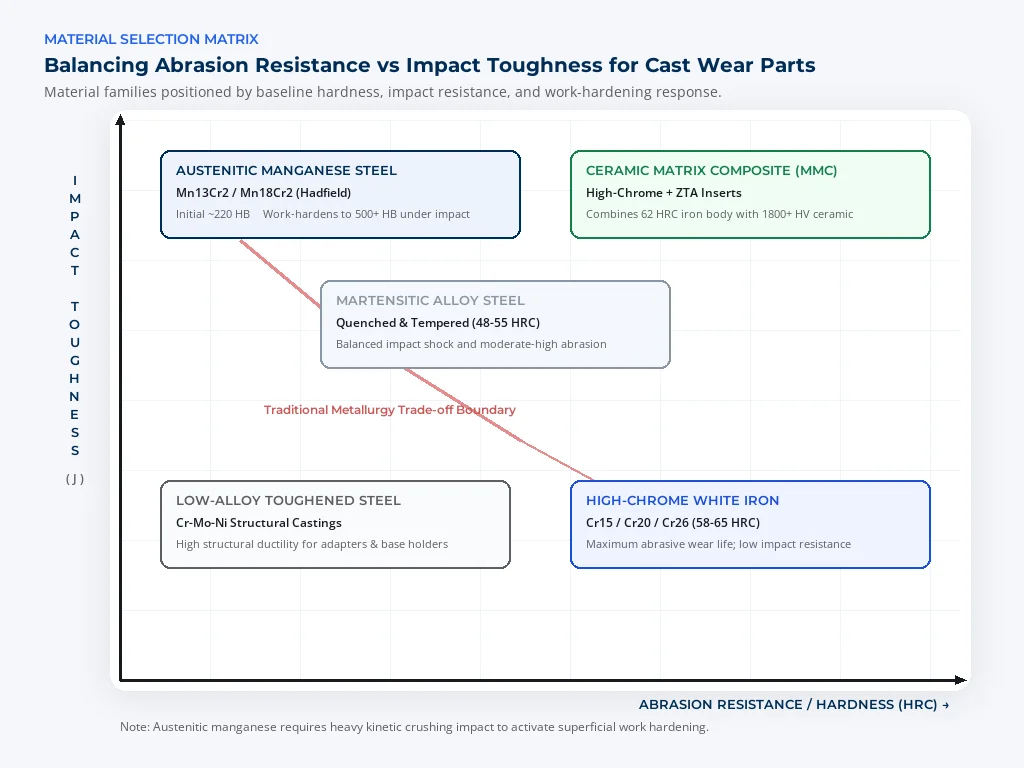
Because hardness and toughness trade off against each other, a material requirement is never "as hard as possible". It is a balanced pair chosen for the mechanism that dominates the job. Heat treatment is the main lever that sets where that balance lands, which is why the same alloy can behave like two different materials depending on how it is treated.
Read the service condition before you name a material
The mistake that causes most premature failures is choosing a material from the part name instead of the job. A bucket tooth on a compact loader in sandy soil and a bucket tooth on a large excavator in blasted granite share a name and almost nothing else. Write down the service condition first, then select.
- What material is being handled: soil, sand, gravel, crushed rock, ore, or a mix, and how abrasive it is
- How hard the material is and how big the largest pieces get, because size drives impact energy
- Whether the part strikes, scrapes, or does both, since sliding favours hardness and striking favours toughness
- The speed and cycle: faster contact and more cycles per hour raise both wear and shock
- Moisture and temperature, which change how the metal and the abrasive behave
- Whether the failure you have seen before was gradual wear, sudden breakage, or both
Answering these six questions usually points to one dominant mechanism. Everything that follows depends on naming it clearly.
A fillable service-condition to material selection table
The table below turns the service condition into a material direction. Treat it as a working template: fill the left column from the job, then use the middle columns to shortlist a family and the review the foundry must confirm. It is a starting point for a technical review, not a substitute for one.
| Service condition signals | Wear mechanism expected | Candidate material family | What to confirm before ordering |
|---|---|---|---|
| Fine, hard, dry abrasive sliding over the face | Abrasion | High-chromium cast iron | Carbide structure, hardness target and toughness for any shock |
| Larger rock, repeated gouging and strikes | Impact and abrasion | High-manganese steel | Heat treatment that keeps the structure tough and work hardenable |
| Mixed load with moderate shock and abrasion | Both | Alloy or cast steel | Grade, heat-treatment condition and target hardness |
| Support or structural position with light wear | Low wear, load bearing | Ductile iron | Strength, section size and machined interfaces |
| Wide scraping face, high sliding load | Abrasion | Alloy steel or cast steel | Through-hardness, section thickness and edge support |
| Corrosive or wet abrasive service | Abrasion plus corrosion | Stainless steel or coated option | Chemistry for the environment and confirmed service data |
An empty row is a question the foundry still needs answered. A row filled with a guess is worse than an empty one, because it sends the order in the wrong direction.
Where each material family fits on construction equipment
The material families DINGDAR casts behave differently, and the difference decides which parts they suit.
High-manganese steel is the classic choice for parts that take heavy impact. Its chemistry follows ASTM A128, which covers austenitic manganese steel castings and requires a heat treatment that achieves toughness and ductility [1]. It starts relatively soft and work hardens as it is struck, so its surface resists abrasion once it has absorbed the load [3]. That is why it appears on excavator bucket teeth and adapters, where breaking ground concentrates impact. It is the wrong choice where fine abrasive slides across a part without enough force to harden it.
High-chromium cast iron is built around hard carbides, and those carbides resist the cutting action of fine, hard abrasives. ASTM A532 groups these alloyed white irons for mining, milling and earth-handling service [2], and they are selected where high-chromium content resists abrasive wear [4]. It suits parts that mostly wear rather than break, provided the shock level is controlled.
Alloy and cast steel sit in the middle. They can be heat treated to a chosen balance of hardness and toughness, which suits parts that face both mechanisms and resist a single extreme. Cutting edges and blade plates often land here, since a wide edge has to resist sliding wear without becoming brittle. You can see the range on the cutting edges and blade plates page.
Ductile iron is used where the part carries load and interfaces with the machine rather than wearing against rock, such as housings and adapters that need strength and machinability.
Failure diagnosis: is the part worn or broken?
Before changing a material, identify how the returned part failed. The two patterns point in opposite directions.
| What you see on the part | Likely mechanism | What to review next |
|---|---|---|
| Uniform thinning, rounded or polished edge | Abrasion | Increase surface hardness or carbide content; check abrasive size |
| Deep grooves in the working direction | Abrasion | Abrasive is harder than the surface; review material hardness |
| Crack running from a stress point | Impact | Increase toughness; review geometry and heat treatment |
| Corner or section sheared off | Impact overload | Reduce shock or increase toughness and section support |
| Bright, rough fracture surface | Sudden fracture | Check for brittle structure or a heat-treatment problem |
| Worn area plus a crack behind it | Abrasion then fracture | Thin section grew weak; address both wear and toughness |
A part that arrives thin and polished did its job and reached the end of its life. A part that arrives in two pieces has told you the material or the heat treatment was wrong for the load. Sorting the two cases stops you from fixing the wrong problem.
Heat treatment for wear parts: what to specify and why
Heat treatment is where a chosen material family becomes a specific part. Two parts cast from the same alloy can end up hard and brittle or softer and tough, depending on the treatment, so the requirement has to name the condition and not leave it to chance.
High-manganese steel needs a controlled high-temperature treatment that keeps its structure austenitic and tough [1]. If that treatment is wrong, carbides form at the grain boundaries and the part turns brittle, which is the failure the material was chosen to avoid.
Alloy and cast steels are commonly quenched and tempered to hit a target hardness while keeping enough ductility to survive shock. The tempering step is not optional; it is what converts a hard, brittle part into a usable one.
High-chromium cast iron usually works in the as-cast condition, because its wear resistance comes from hard carbides in the structure rather than from a hardening treatment. Changing the cooling can change the carbide size, which changes the outcome.
When you can, ask the foundry to state the treatment in the requirement and to confirm hardness and structure by test, rather than promising a number in words alone.
Fact: DINGDAR's material families include grey iron, ductile iron, alloy and cast steel, stainless steel, high-manganese steel and high-chromium cast iron, and each requirement is fixed in a single technical review that sets the material, heat treatment, as-cast and machining scope, and inspection points (per company data).
Inspection that verifies the material, not just the shape
A part can match the drawing's dimensions and still be the wrong material. Inspection has to prove the material and its condition, not only the geometry.
The checklist below maps each requirement to the check that verifies it. It matches the six inspection capabilities DINGDAR keeps in house.
| Requirement on the drawing | How it is verified | Records to expect |
|---|---|---|
| Material family and chemistry | Direct-reading spectrometer | Chemical composition report |
| Heat-treatment result | Brinell hardness tester | Hardness result per part or batch |
| Strength and ductility | Universal testing machine | Tensile and mechanical results |
| Structure behind the hardness | Metallographic microscope | Microstructure assessment |
| Dimensions and machined interfaces | Coordinate measuring machine | Dimensional record |
| Internal soundness of critical parts | Ultrasonic flaw detector | Non-destructive test result |
Which of these apply is agreed at the order stage, so the records arrive with the parts instead of being argued over later. For high-risk parts, ultrasonic screening catches internal shrinkage or cracks that no surface check can find.
Fact: DINGDAR's in-house inspection covers six categories with a direct-reading spectrometer, coordinate measuring machine, Brinell hardness tester, universal testing machine, metallographic microscope and ultrasonic flaw detector, and the company is certified to ISO 9001, IATF 16949, ISO 14001 and ISO 45001 (per company data).
How to write the material requirement into the drawing and the RFQ
A material requirement only works if it is complete enough for a foundry to quote against. Include:
- The material family, and the grade or an equivalent reference if one applies
- The heat-treatment condition, stated in words rather than assumed
- The hardness or toughness target and the test that proves it
- The delivery condition: as-cast, heat treated, or machined, and which surfaces are finished
- The inspection and documentation scope, for both first article and routine production
- The service condition the material must survive, in plain terms
- Critical features and tolerances, separated from general ones
If the part is new, say so and ask the foundry to review the material against the job. The DINGDAR team produces custom castings produced to drawing and treats the geometry, material and treatment as one requirement rather than three separate decisions.
How DINGDAR reviews a wear-part material requirement
The material cannot be chosen in isolation from the casting route, because the route affects density, structure and how well the heat treatment takes. That is why DINGDAR fixes the material, the route and the inspection in one technical review.
For construction equipment, that review usually starts from the part family: excavator bucket teeth and adapters and loader bucket teeth and adapters take concentrated impact, while cutting edges and blade plates spread the load across a wide face. The industry context sits on the construction machinery castings page.
When a part is described only by its failure, the review works backwards from the service condition to the material, then to the process. Route selection is a separate, related decision, covered in our guide to choosing a casting process for wear parts. If the material requirement is set but the route is still open, send both questions in the same enquiry and let them be answered together.
FAQ
What material makes the best construction equipment wear part?
There is no single best material, because the right choice follows the dominant wear mechanism rather than the part name. Where fine rock and soil slide across the surface, a hard, abrasion-resistant material such as high-chromium cast iron earns its place. Where a part takes heavy shocks and gouging, high-manganese steel, which work hardens under impact, usually survives better. Where both mechanisms are present, an alloy or cast steel with a controlled heat treatment often balances the two.
Is a harder wear part always better?
No. Hardness resists abrasion, but it usually comes with lower toughness, and a hard part that cracks under impact fails faster than a softer part that wears. The useful question is which mechanism dominates. If the part wears gradually and arrives undersized, more hardness helps. If it breaks in large pieces or shears at a corner, more hardness is the wrong direction and toughness matters more.
How do I tell whether a wear part failed by abrasion or by impact?
Look at how the metal left the part. Abrasion removes material gradually, so the part is worn thin, rounded or polished, with the loss spread across the working face. Impact failure happens suddenly, so you see cracks, a sheared corner or a chunk broken out, often with a bright or rough fracture surface. A part can show both, with worn areas and a crack that started at a stress point.
What heat treatment should I ask for on a wear part?
Ask for the treatment the material family needs to reach its intended balance of hardness and toughness, and write it into the requirement. High-manganese steel needs a controlled high-temperature treatment that keeps its structure austenitic and tough. Alloy and cast steels are commonly quenched and tempered. High-chromium cast iron is usually used in the as-cast condition. Name the condition, not just the material.
What should the drawing specify for a wear part material?
A usable requirement names the material family and condition, the hardness or toughness target and the test that proves it, the delivery condition, the surfaces that matter and the inspection records that travel with the parts. It should also state the service condition the material is expected to survive, because a foundry cannot select a sensible material from a drawing that shows geometry alone.
How is a wear part material verified before shipment?
Verification starts with chemistry, so the alloy is confirmed by spectrometer. Hardness checks confirm the heat treatment reached its target, and mechanical or metallographic checks confirm the structure behind that hardness. Dimensional checks confirm the part matches the drawing, and ultrasonic inspection screens critical parts for internal defects. The set of records agreed at the order stage is what lets you accept the parts on facts.
Which material suits bucket teeth compared with cutting edges?
Bucket teeth and their adapters usually take concentrated, repeated impact as they break ground, so a material that work hardens under load, such as high-manganese steel, is a common starting point. Cutting edges and blade plates often face more sliding abrasion across a wider face, where a harder, more abrasion-resistant material can last longer. These are starting points, not rules, so confirm the material per application.
Conclusion
Choosing construction equipment wear part materials comes down to one discipline: name the failure you are trying to prevent before you name the metal. Abrasion and impact are different problems, hardness and toughness pull against each other, and heat treatment decides which way the balance lands. Read the service condition, pick the family that matches the dominant mechanism, write the treatment and the inspection into the requirement, and check a returned part against both failure patterns. Do that and the material on the drawing is one you can defend, not one you inherited.
If you have a part that keeps failing, send the drawing, the service condition and the records from the last failure. The DINGDAR team reviews the material, route and inspection in one technical review and replies within 12-24 hours. You can contact the DINGDAR team to start.
Sources
- ASTM International. "ASTM A128/A128M, Standard Specification for Steel Castings, Austenitic Manganese." https://store.astm.org/a0128_a0128m-19.html - Defines austenitic manganese steel castings and the heat treatment required to achieve toughness and ductility, the basis for the high-manganese discussion in this article.
- ASTM International. "ASTM A532/A532M, Standard Specification for Abrasion-Resistant Cast Irons." https://store.astm.org/a0532_a0532m-10r23.html - Covers alloyed white cast irons for abrasion resistance in mining, milling and earth-handling service, the basis for the high-chromium cast iron discussion.
- ScienceDirect. "Manganese Steel - an overview." https://www.sciencedirect.com/topics/chemistry/manganese-steel - Explains that manganese steel work hardens rapidly under gouging and high-stress abrasion, and wears quickly under fine sliding abrasion.
- Penticton Foundry. "Abrasion Resistant Cast Irons to ASTM A532." https://www.pentictonfoundry.com/alloys/abrasion-resistant-cast-irons/ - Industry discussion of how high-chromium cast irons resist abrasive wear in earth-handling components.
- MDPI / Coatings. "Effect of Surface Impacting Parameters on Wear Resistance of High Manganese Steel." https://www.mdpi.com/2079-6412/13/3/539 - Research on how impact parameters change the hardening and wear behaviour of high-manganese steel.
Manufacturer specifications: DINGDAR company facts, material families, production routes, plant area, part types, inspection equipment and certifications are stated per manufacturer specifications on https://hndingdar.com/ (brand profile: companies/dingdar.yaml).