How to Choose a Casting Process for Wear Parts
Wear parts do not fail because one heavy load snapped them. They fail because abrasive and impact service grinds them down over time. A jaw plate, a bucket tooth, a mill liner, or a crusher hammer lives against rock, ore, and slag, and that service condition decides two things at once: which alloy can survive it, and which casting route can produce the shape at a cost the job can justify.
Most buyers pick the material first and treat the casting method as an afterthought. It works the other way around: the casting route fixes the as-cast tolerance, the surface finish, the minimum wall thickness, the tooling cost, and how the batch is priced.
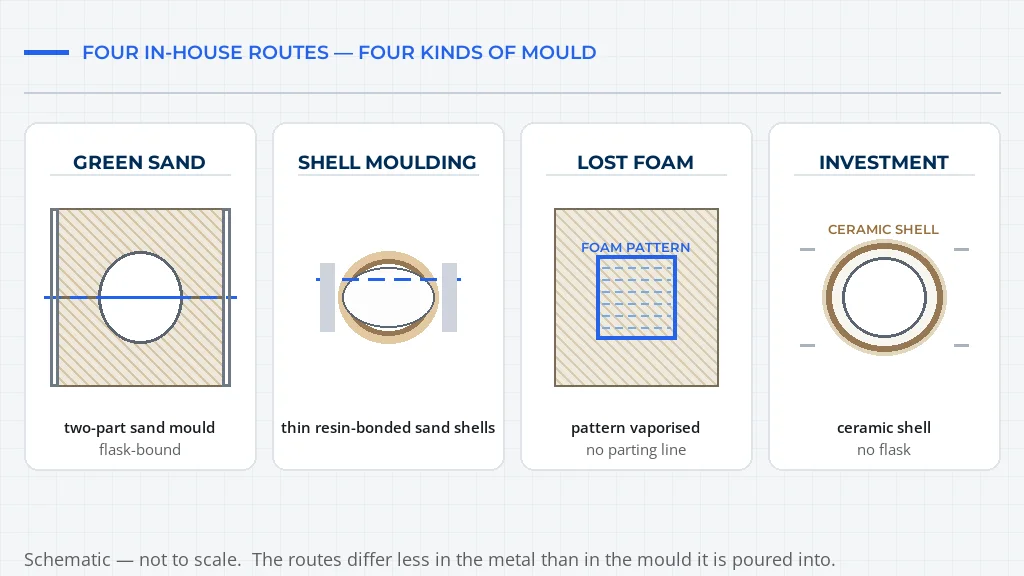
This guide compares four routes you can run in-house: green sand, shell moulding (resin-coated sand), lost foam, and investment casting. It covers the criteria that decide the route, a comparison table, a selection workflow, and the mistakes that push wear parts onto the wrong line.
1. Why wear parts are a different casting problem
A wear part is a part that is expected to be consumed.
For a structural casting, the goal is a sound part that meets a tolerance. For a wear part, the goal is a part that survives a known abrasive load for a predictable number of hours per dollar spent. High-manganese steel work hardens under impact, so the alloy only performs if the casting is sound and the section thickness is right, and manganese grades need a controlled heat treatment, because a bad quench leaves carbides at the grain boundaries.
Geometry also tends to be bulky rather than delicate, and what wear parts need most is dimensional repeatability, so a replacement liner bolts into the same seat as the one it replaces. Volume is the other complication: the right route for ten heavy liners is rarely the right route for ten thousand bucket teeth.
Fact: DINGDAR runs all four casting routes in its own 180,000 m² plant, so the route is selected by geometry, material, tolerance, and batch size rather than by whichever line is easiest to schedule (per company data).
2. The four routes, side by side
| Criterion | Green sand | Shell moulding (resin-coated sand) | Lost foam | Investment casting |
|---|---|---|---|---|
| Geometry complexity | Low to moderate, simple parting lines | Moderate, finer detail than green sand | High, no draft needed and cores eliminated | High, thin walls and fine features |
| Typical as-cast tolerance (ISO 8062-3) | DCTG 8 to 12 | DCTG 6 to 9 | DCTG 7 to 9 | DCTG 4 to 6 |
| Typical surface finish | Ra 12.5 to 25 µm | Ra 3.2 to 12.5 µm | Ra 6.3 to 12.5 µm | Ra 1.6 to 6.3 µm |
| Best batch size | Small to very large, 1 to 100,000+ | Medium, 500 to 20,000 | Medium, 100 to 5,000 | Small to medium, 100 to 10,000 |
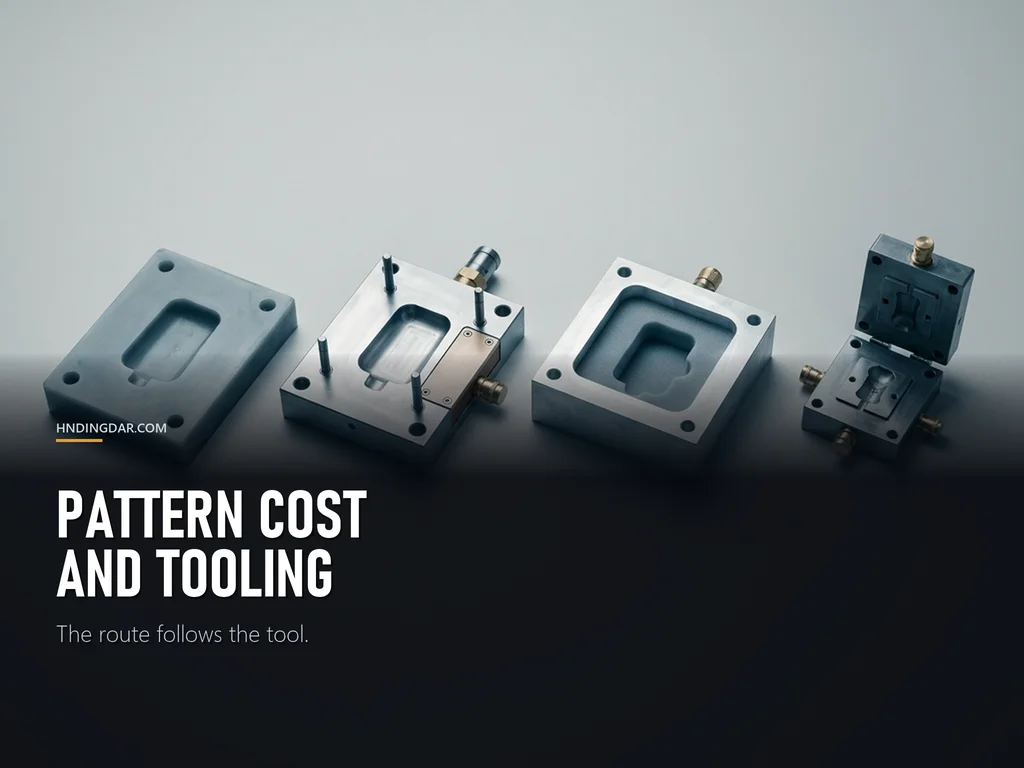
| Pattern or tooling cost | Low, wood or metal patterns | Medium, metal pattern plus shell tooling | Medium, one foam pattern per part | High, wax die per part |
| Draft and cores | Needs draft, cores for internal cavities | Minimal draft, fewer cores | No draft, complex internal passages possible | No draft, complex cores cast in |
| Common wear parts | Large mill liners, heavy housings, wear plates | Jaw plates, cone liners, crusher hammers | Complex wear geometry, cast-in passages | Valve trim, small precise wear inserts |
Tolerance grades follow ISO 8062-3 DCTG; finish and batch ranges are typical values reported across casting references [1][2][4]. The table is a starting point, not a verdict. When a part sits between two rows, the decision moves to the specific geometry and the annual quantity.
3. The six criteria that decide the route
3.1 Geometry and complexity
The mould has to come apart to release the casting, so geometry sets the ceiling on the route. Simple planes and a single parting line fit green sand. Fine ribs or a smooth curved surface benefit from the finer sand of shell moulding. Internal passages or undercuts fit lost foam, where the pattern is consumed and no core has to be extracted. A small part with thin walls and tight features leans toward investment casting.
If a drawing was made for one route and you switch to another, revisit the draft angle and fillets first: the wall thickness and draft DFM rules that make a casting manufacturable change from one route to the next.
3.2 As-cast tolerance and machining allowance
Tolerance drives cost because it drives how much finishing the part needs. A loose as-cast tolerance leaves more material for a machining pass to remove; a tight one can cut or eliminate that pass. What matters is the repeatable tolerance a process holds across the batch, because the machining fixture and the mating part are built around that number.
Green sand gives the widest band and the largest machining allowance. Shell, lost foam, and investment tighten the band in that order. Where only one face must fit a machine seat, you may only need tight control on that face, and saying so in the drawing is cheaper than tightening the whole part.
3.3 Production volume and tooling economics
Tooling is a fixed cost that has to be amortised. A $ 1,200 pattern spread over ten parts adds $ 120 per part; over ten thousand parts it adds $ 0.12. Investment casting and shell moulding carry higher tooling because each part needs its own wax die or shell pattern. Green sand pattern work is cheaper to start, which suits one-off heavy liners and prototype runs.
This is where the how to compare casting quotations question lives. Two quotes with the same unit price can hide different amortisation of tooling, and the cheaper looking quote on the first order can be the expensive one by the third.
3.4 Surface finish and as-cast detail
Most wear parts do not need a fine finish. A mill liner that will be buried under ore does not care whether the as-cast surface is Ra 6 or Ra 25.
Finish matters where the surface is a functional sealing or flow face, or where a smoother as-cast surface removes a cleaning step. If neither applies, let the finish be as rough as the route allows and spend the money on section thickness and heat treatment.
3.5 Material and section thickness
The alloy constrains the route as much as the shape does. High-manganese steel and high-chromium cast iron are the workhorses of impact and abrasion wear, and both behave better in some moulds than others. A very heavy section needs a mould that can feed and cool it predictably, which favours green sand; a thin, intricate section favours a route that can fill it before the metal freezes.
Section thickness also drives the heat treatment plan. A thick manganese section that quenches unevenly can develop internal defects, so the route and the heat treatment are chosen together.
3.6 Total cost per good part
Add up pattern or wax die cost divided by the batch, the metal cost, the yield loss, the finishing cost, and the freight, then divide by the good parts that clear inspection. The lowest unit price on the first order often belongs to the route with the worst yield or the highest rework. Cost per good part is the only number that compares routes fairly.
Fact: DINGDAR's 52 engineers and R&D staff review each requirement in a single technical review that fixes the casting route, the material, the as-cast and machining scope, and the inspection points before production starts (per company data).
4. Route 1: green sand casting
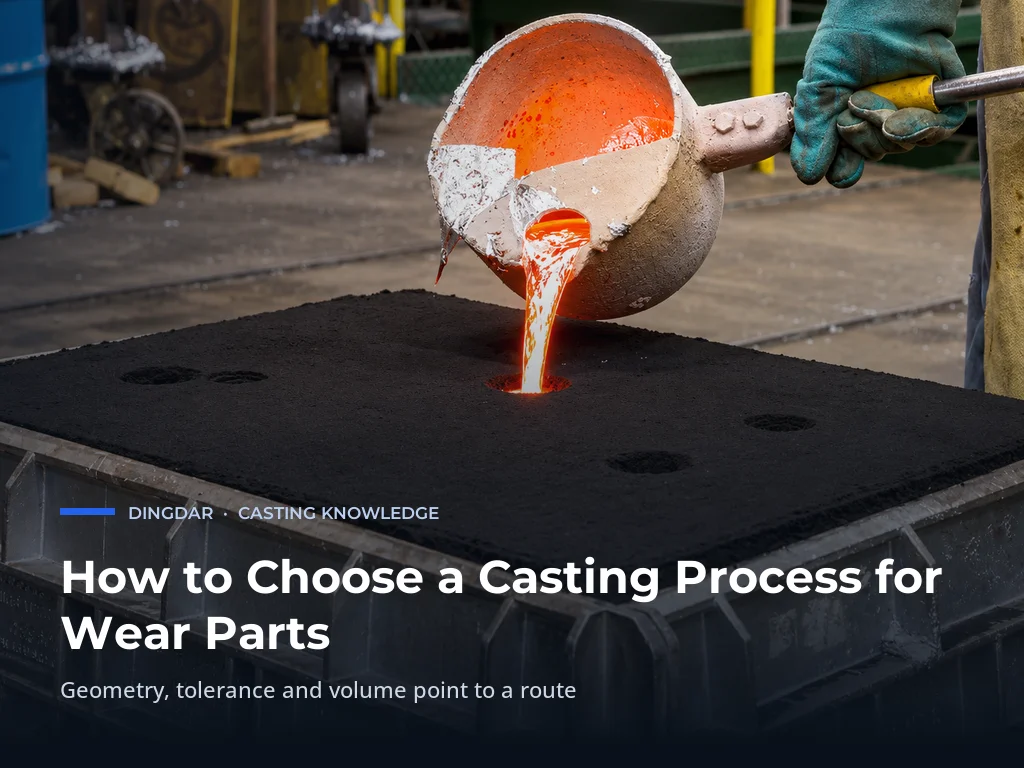
Green sand is the default route for large, heavy wear castings, and it usually wins on cost for anything with a simple shape and a large section. The name refers to the moist, clay bonded sand, not to a colour. A pattern is packed in sand, the mould is closed, metal is poured, and the sand is shaken out and recycled.
It handles large parts cheaply, with low pattern cost, high throughput on simple work, and batch sizes from one part to tens of thousands.
Its limits are the looser as-cast tolerance and rougher finish, which mean more machining allowance, and the difficulty of reproducing fine detail. Internal cavities need cores, adding labour and defect risk. For a large mill liner on the green sand casting route, none of that matters; for a delicate thin-wall part, it is the wrong tool.
5. Route 2: shell moulding (resin-coated sand)
Shell moulding upgrades the sand. The mould is a thin, resin coated sand shell cured around a heated metal pattern, and because the sand is finer and bonded, the shell reproduces detail that green sand cannot. The pattern is reused and the shell is broken out after pouring.
It gives a better surface finish and tighter tolerance than green sand, reproduces finer detail, and needs less draft to release the pattern, making it a strong middle option.
Its limit is tooling: the metal pattern costs more than a green sand pattern, and very large parts are difficult because the shell must support the metal. For jaw plates and cone liners made by shell moulding, it is a common compromise between finish and cost.
6. Route 3: lost foam casting
Lost foam flips the usual logic. Instead of a reusable pattern, the pattern is a foam shape buried in unbonded sand and vaporised by the incoming metal. Because the pattern is consumed, it can be as complex as you can mould it, and it does not have to be withdrawn.
It produces complex geometry with internal passages, no parting line, and cast-in features that would otherwise need cores, and the unbonded sand supports the metal well, so finish and tolerance land between green sand and shell moulding.
Its limits are tooling and control: each part needs its own foam pattern, and the process needs tight control to avoid defects. It suits medium batches. Learn more on the lost foam casting route.
7. Route 4: investment casting
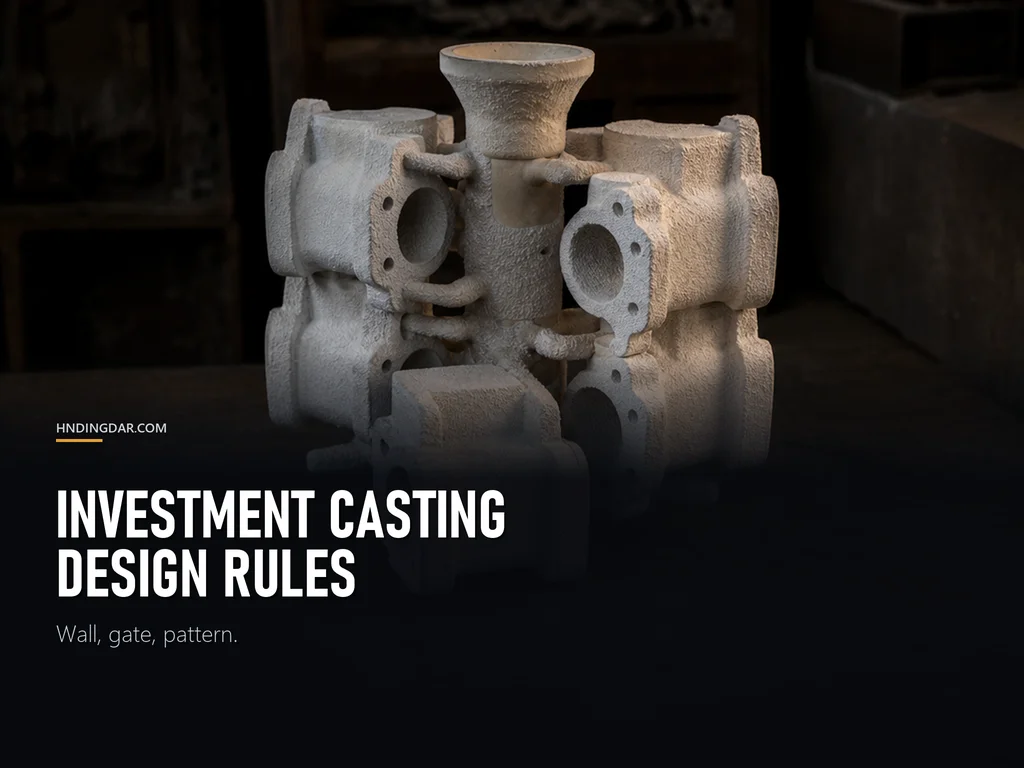
Investment casting, or lost wax, builds a ceramic shell around a wax pattern, melts the wax out, and pours metal into the hollow shell. The result is the tightest tolerance and the smoothest finish of the four routes, which is why it is called near net shape. The part comes out close to the drawing and often needs little or no machining.
It delivers thin walls, fine detail, tight tolerance, and a smooth surface, which suits a small wear insert that must fit a machined seat with almost no cleanup.
Its limits are the highest tooling, since every part needs a wax die, and the highest cost per part at low volume. Part size is limited compared with sand, so it earns its cost on high value parts or where machining is expensive. See how DINGDAR applies it in investment casting.
8. A step-by-step selection workflow
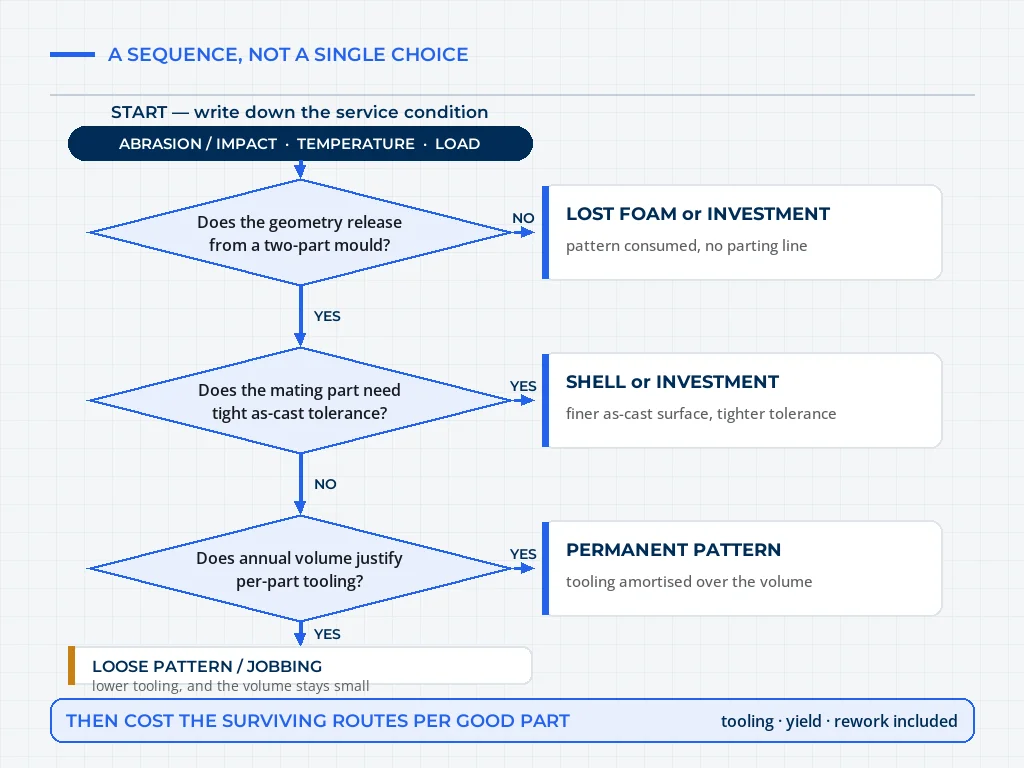
- Write down the service condition: abrasion, impact, or both, plus temperature, load, and the abrasive itself. This sets the alloy before the process.
- Sketch the geometry and mark the functional faces. Only the faces that must fit or seal need tight tolerance; the rest can be loose.
- Set the annual quantity and the expected part life. Volume decides whether per-part tooling is affordable.
- Match geometry to route using the table above. Where two routes fit, keep both.
- Cost both surviving routes per good part, tooling included, and pick the lower, not the lower first price.
- Confirm the material can be produced and heat treated well in that route. If not, go back a step.
- Lock the as-cast tolerance, machining allowance, and inspection plan into the order before production.
If you are evaluating suppliers alongside the route, the checks overlap with how to evaluate a casting supplier. A supplier who cannot explain why a route was chosen is a risk on every future order.
9. Common selection mistakes
Choosing by unit price alone is the most frequent error: the first-order unit price ignores tooling amortisation, yield, and rework, so cost per good part is the honest comparison.
Over-tightening tolerance adds cost with no gain, and ignoring draft and wall thickness lets a design carried over from a machined part fail to release from the mould or fill. Separating material and process is the last mistake, because the alloy, the mould, and the heat treatment are chosen together.
10. How DINGDAR runs the route review
DINGDAR is a casting and foundry equipment manufacturer that has run its own foundry since 1986, giving it more than 40 years in casting. It keeps all four routes, green sand, shell moulding, lost foam, and investment casting, in a 180,000 m² plant, with a 12,000 m² office and R&D building and a team of 720+ staff.
The working method is a single technical review: instead of finding one supplier for a casting and another for a machine, the route, material, as-cast and machining scope, and inspection points are agreed in one pass against the same drawing. Wear parts are produced to a customer drawing, part number, or sample.
Six inspection capabilities sit in-house: a direct-reading spectrometer, a coordinate measuring machine, a Brinell hardness tester, a universal testing machine, a metallographic microscope, and an ultrasonic flaw detector. The plant runs under ISO 9001, IATF 16949, ISO 14001, and ISO 45001 management systems and 6S floor management.
Fact: DINGDAR holds ISO 9001, IATF 16949, ISO 14001, and ISO 45001 certification and runs six in-house inspection capabilities, including a direct-reading spectrometer and a CMM, across its 5,400+ part types (per company data).
Buyers who want to see the parts and the equipment together can start from the mining machinery wear parts and custom castings ranges, or review the full set of casting processes the foundry operates.
11. FAQ: choosing a casting process for wear parts
What is the best casting process for wear parts?
There is no single best route, because the answer depends on geometry, tolerance, and batch size rather than on the part being a wear part. For large, heavy, simple liners and housings, green sand is usually most economical. For mid-size parts that need a cleaner surface, shell moulding is a strong middle option. Lost foam suits complex shapes with cast-in passages, and investment casting suits small parts that need tight tolerance and a smooth finish. Match the route to the part, not to a general rule.
How do I choose a casting process for a wear part?
Work through the criteria in order. Start with the service condition and the alloy it demands, then sketch the geometry and mark the faces that need tight tolerance. Set the annual volume, because volume decides whether per-part tooling is affordable. Match the geometry to the feasible routes, cost the survivors per good part, and confirm the material can be produced and heat treated in the chosen route. Lock the tolerance, machining allowance, and inspection plan into the order before production.
What is the difference between sand casting and investment casting for wear parts?
Green sand casting uses a reusable pattern packed in moist clay bonded sand, which suits large, heavy parts and keeps pattern cost low. Investment casting builds a ceramic shell around a wax pattern that is melted out, giving tighter tolerance and a smoother finish close to the finished shape. Sand casting wins on part size, tooling cost, and flexibility. Investment casting wins on precision and as-cast detail. For a heavy liner, sand is the answer; for a small precise insert, investment often is.
Which casting process is most economical for high volume wear parts?
At high volume, tooling cost is spread thin, so the route with the lowest finishing and rework cost tends to win. Shell moulding and green sand usually lead for mid-size and large wear parts, because their pattern cost is amortised across the batch and their throughput is high. Investment casting stays economical at high volume only when the part is small, high value, or needs machining the tighter as-cast tolerance can eliminate. Compare cost per good part, not cost per pour.
What casting process gives the tightest tolerances?
Investment casting gives the tightest as-cast tolerances of the four routes, typically ISO 8062-3 DCTG 4 to 6, with shell moulding next, lost foam in the middle, and green sand the widest band. A tighter as-cast tolerance reduces or removes machining allowance, which is where the savings come from. But only surfaces that must fit or seal need the tight band. Specifying tight tolerance everywhere is the fastest way to add cost with no functional gain.
Is lost foam casting good for complex wear parts?
Yes, and complexity is exactly where lost foam earns its place. Because the foam pattern is vaporised by the metal instead of being withdrawn, the part needs no draft and no core to be pulled, so internal passages and undercut features become feasible. The unbonded sand supports the metal well, giving a finish and tolerance between green sand and shell moulding. The trade off is that each part needs its own foam pattern, so the route rewards medium batches.
How much does casting tooling cost, and who owns it?
Tooling cost depends on the route and the part. Green sand patterns are the cheapest to start, shell and lost foam patterns sit in the middle, and investment casting needs a wax die per part, which is the highest. Because tooling is a fixed cost, its effect on unit price depends on volume. Agree on tooling ownership and any amortisation before the order, so a later reorder is not repriced. Unevaluated tooling terms are a common surprise in a casting quote.
12. Conclusion: decide the route before the price
The casting route is not a detail to settle after the material. It sets the tolerance, the finish, the feasible geometry, and the tooling economics behind every price you receive. Decide it with the six criteria and put the result into the order before production.
DINGDAR keeps all four routes under one roof and reviews the route, material, and inspection plan in a single technical review. If you have a wear part drawing, a part number, or a sample, send it through and the foundry team will work out which route fits, what tolerance it should carry, and what a batch will cost.
Sources
- [ISO]. "ISO 8062-3:2007, Geometrical product specifications (GPS) - Dimensional and geometrical tolerances for moulded parts." iso.org: Defines the DCTG tolerance grades used here to compare as-cast tolerances between casting processes.
- [Hiler Industries]. "Comparing Shell Molding, Sand Casting, and Investment Casting." hilerindustries.com: Notes that resin bonded shell sand can be finer than green sand, improving surface detail.
- [Batesville Products]. "Which Casting Process Should I Use?" batesvilleproducts.com: Compares sand, permanent mould, die, investment, and lost foam casting on cost, volume, size, tolerance, and complexity.
- [casting-china.org]. "Lost Foam Casting vs Investment Casting: A Comparative Analysis." casting-china.org: Cites investment casting tolerances of plus or minus 0.1 to 0.3 mm and surface finish of Ra 0.8 to 3.2 µm.
- [DINGDAR]. Company data: four in-house casting routes, plant and team figures, certifications, and inspection capabilities. hndingdar.com: Company reported figures marked "(per company data)" in the article body.