Foam Materials for Lost Foam Casting: EPS, EPMMA and PMMA Selection
The pattern foam is the one part of a lost foam casting that disappears before the part exists. Choosing foam materials for lost foam casting decides how cleanly the metal fills the mould, how severe the folded or carbon-rich defects will be, and how much geometry you can hold as-cast. EPS, EPMMA and PMMA look similar in a block yet behave very differently in a mould. A foam that suits a thin aluminium housing can ruin a heavy steel casting.
This guide is for foundry process engineers, OEM buyers sourcing lost foam castings, and contractors setting up a line. It compares the three pattern materials, matches foam to metal and wall thickness, then gives a procurement specification and a trial checklist.
Why the pattern foam carries most of the process risk
In lost foam casting, the pattern is not a mould to be withdrawn later. The molten metal vaporises it as it fills, so for the minutes that matter, the foam is part of the mould. Its chemistry and structure set how smoothly the metal front travels and what it leaves behind.
Three material families cover most industrial work: EPS, EPMMA and PMMA. What separates them is the polymer backbone, the carbon residue, how the pattern collapses against the advancing metal, how easily it moulds to a target density, and how the coating is adjusted around it.
One caution: trade names are not consistent, and the same short label can describe different beads. Confirm the polymer and the specification sheet, not the name.
Fact: DINGDAR (Henan Dingdar Machinery Equipment Manufacture Co., Ltd.) has produced castings since 1986 and runs lost foam casting as one of four in-house routes (green sand, shell moulding, lost foam and investment casting) across a 180,000 m² plant.
The route itself is described on the lost foam casting process page and compared with the others in the casting processes overview. This article stays on the question those pages do not answer: which pattern material to use.
EPS, EPMMA and PMMA compared
The three foams share a job but not a chemistry, and what each is made of explains nearly every trade-off that follows.
EPS, expandable polystyrene
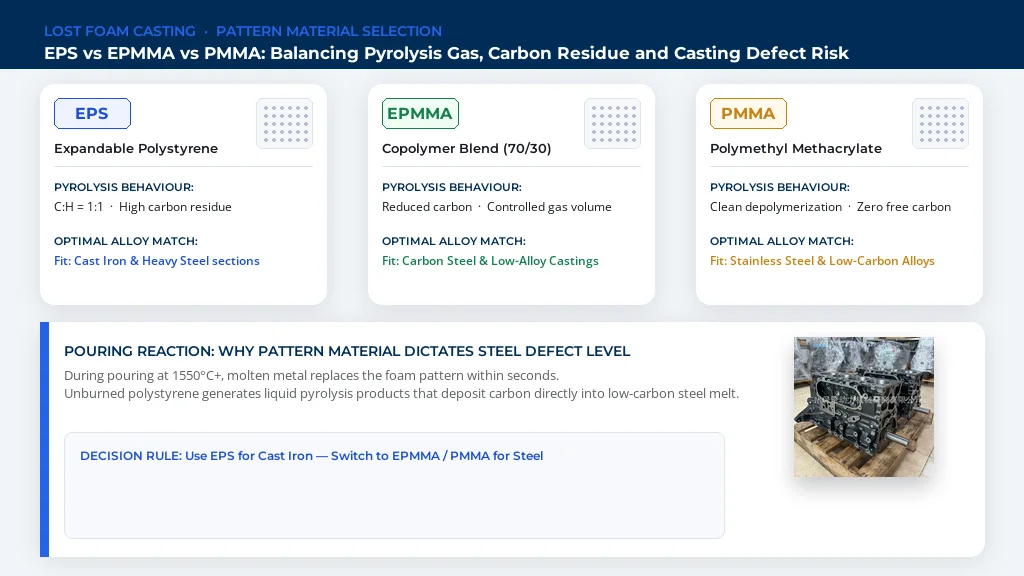
EPS is the workhorse: the cheapest pattern material, the easiest to pre-expand and steam-chest mould, and the most widely available. For aluminium and thin non-ferrous sections it is often all you need. Its weakness is carbon. EPS carries more carbon than the methacrylate foams, and in ferrous castings, especially high-carbon irons and steel, that residue is linked to lustrous carbon and carbon pick-up defects.
EPMMA, an expandable methacrylate copolymer bead
EPMMA trades some polystyrene for methacrylate, which lowers carbon residue. It is the middle option: fewer carbon-related defects than EPS without the cost of a pure methacrylate foam, so it fits most grey iron and mixed ferrous work. The price is a higher material cost, a narrower moulding window, and greater moisture sensitivity.
PMMA, polymethyl methacrylate
PMMA leaves the least residue and is chosen for high-integrity steel and iron castings where carbon contamination or surface defects cannot be accepted. It is the most expensive material, the most demanding to mould, and the most moisture-sensitive, so it is reserved for critical parts or geometries that defeated a cheaper foam.
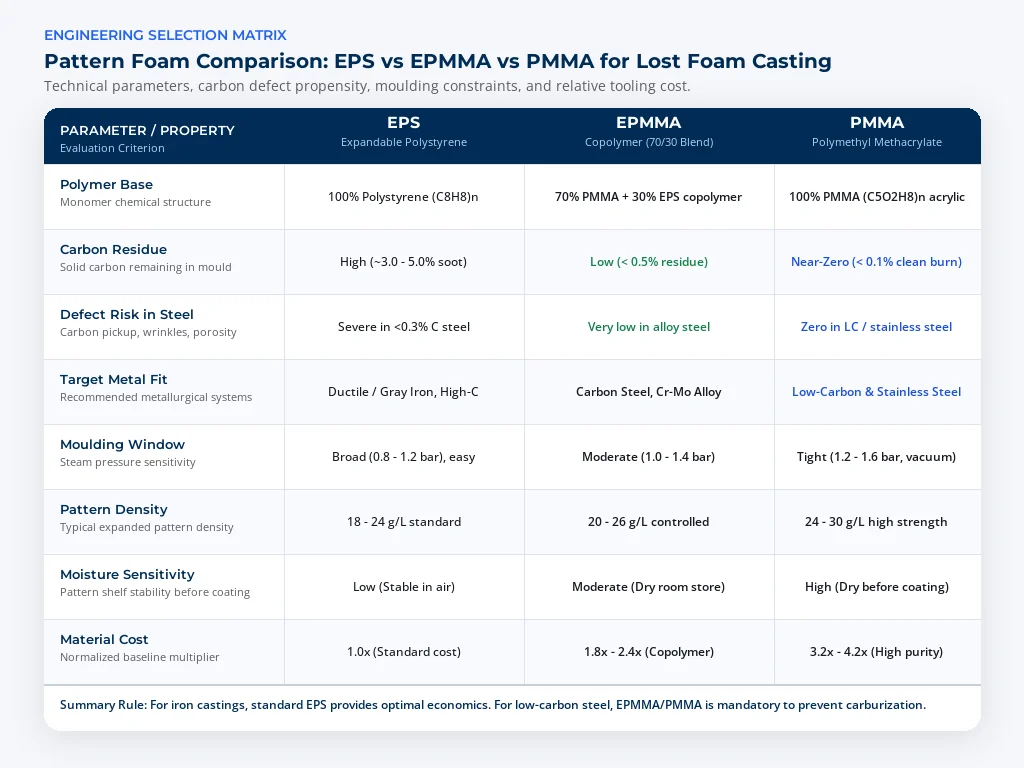
| Factor | EPS | EPMMA | PMMA |
|---|---|---|---|
| Polymer base | Polystyrene | Methacrylate copolymer bead | Polymethyl methacrylate |
| Relative carbon residue | Highest | Lower | Lowest |
| Metal fit, as a starting point | Aluminium, thin non-ferrous | Most ferrous, mixed work | High-integrity steel and iron |
| Relative material cost | Lowest | Mid | Highest |
| Moulding difficulty | Lowest | Mid | Highest |
| Moisture sensitivity | Low to mid | Mid | High |
| Typical defect risk | Lustrous carbon, folds | Reduced carbon, needs tight drying | Very low carbon, handling marks |
| Coating demand | Moderate | Higher permeability | Highest control |
The metal-fit row is a starting point for a technical review, not a rule. A thin steel section may vent easily enough to run on EPS, and a thick aluminium section may still want a lower-residue foam if the geometry traps gas. Those cases are decided on the drawing and the trial.
Pattern decomposition behavior: why the foam leaves marks on the part
The molten metal does not simply melt the foam. It degrades it into gas and liquid products that must escape through the refractory coating. If they cannot leave quickly enough, they are trapped against the metal front and the casting records a defect.
- EPS breaks down into gaseous and liquid styrene-based products. Heavy sections and high pouring temperatures generate more liquid residue, which can wet the coating, restrict flow and leave carbon-rich folds and blowholes.
- EPMMA and PMMA degrade into products carrying less carbon, which reduces carbon pick-up and lustrous carbon and is why they are chosen for high-carbon irons and steel.
- In all three, the products must pass through the coating. A coating that is too tight builds gas pressure and destabilises the metal front; one that is too open lets metal penetrate the sand [4].
Advanced lost foam research found carbon pick-up in steel hard to control once decomposition products had nowhere to go, and noted that vacuum could remove pyrolysis products while raising other defect risks [2]. A study of low-carbon steel castings found different pattern foams gave clearly different surface carbon contamination [3]. Coating suppliers note that high-carbon irons such as ductile iron are prone to lustrous carbon with EPS patterns [1].
So the foam sets how much residue there is, and the coating and the venting decide whether it leaves.
Matching pattern foam to casting metal and wall thickness
Two variables drive the choice more than any other: metal temperature and section thickness. Together they decide how much decomposition product the pattern must shed per unit of advancing metal front.
Thin sections and lower-temperature metals tolerate a cheaper foam, because less material must vaporise and the products escape more easily. Thick sections, high pouring temperatures and carbon-sensitive metals push toward lower-residue foams. The table below is a first pass.
| Casting metal | Thin wall | Medium wall | Heavy or thick section |
|---|---|---|---|
| Aluminium | EPS | EPS or EPMMA | EPMMA, or PMMA for critical parts |
| Grey iron | EPS or EPMMA | EPMMA | EPMMA or PMMA |
| Ductile iron | EPMMA | EPMMA or PMMA | PMMA |
| Carbon and low-alloy steel | EPMMA | EPMMA or PMMA | PMMA |
| High-integrity steel | PMMA | PMMA | PMMA |
Confirm the grid against the actual geometry, coating and pouring practice. A part with a thin wall but a heavy boss is, where it matters, a thick section, and the boss is usually where the defect appears. A heavier section needs a lower-residue foam, a more permeable coating, or venting help, and often all three.
If you are still deciding whether lost foam is the right route at all, the criteria are set out in our guide to choosing a casting process for wear parts, and the review how DINGDAR selects a casting process shows how route and material are fixed together.
Pattern foam density: specify a target and a tolerance
Density is the number buyers reach for first and the one most often misused. Expressed as mass per volume, in grams per litre or pounds per cubic foot, it controls two things at once. Higher density gives a stronger pattern and a better surface, but leaves more residue to vent; lower density decomposes more easily but risks bead gaps, poor fusion and a rough surface [1].
The rule: choose the lowest density that still holds your geometry and survives handling. That depends on wall thickness, section mass and how much residue the coating can clear, so it changes from part to part. Published supplier guidance places pattern densities across a broad band, roughly 16 to 48 kg/m³, depending on the metal and section [1], which is why a number copied from another project tends to fail. Specify a target with a tolerance, state the test method, and require the achieved value per batch.
Density also cannot be judged apart from fusion: a pattern at the right average density is still unusable if the beads did not bond, because the metal front breaks through the gaps.
Pattern expansion and molding: what the foam maker controls
By the time a pattern reaches the foundry, most of the risk is already built in during expansion and moulding: pre-expanding the beads, ageing, steam-chest moulding or cutting from block and gluing sections, then cooling, drying and a dimensional check.
Lock these in a specification: bead type and grade, pre-expansion density, ageing time, moulding pressure and time, bead fusion, moisture after moulding, and the dimensional tolerance of the finished pattern. Each leaves a fingerprint:
- Underfusion shows up as bead gaps and cold joints, where the metal front punches through and creates surface defects.
- Overfusion builds a dense skin that resists collapse and leaves extra residue.
- Residual moisture becomes steam and creates blowholes, which is why drying before coating is not optional.
Glued assemblies need their own line in the specification. Each glue line is extra organic material at the joint and a common source of fold defects, so ask how sections are joined, with what glue, and how thick the joint is. The equipment that produces these patterns sits inside the wider category of foundry equipment, and matching it to the material is part of the same decision.
Coating and venting for lost foam: the foam's other half
The refractory coating is the foam's partner and has to be matched to it. Coating permeability controls how fast decomposition products escape: a higher-residue foam needs a coating that lets more gas out while still resisting metal penetration, and a lower-residue foam tolerates a tighter, smoother coating that gives a better surface.
Venting is the other half. Patterns are glued to a gating system, coated, dried and embedded in unbonded sand, and vacuum is often applied to pull the products away from the metal front and hold the sand. Vacuum can help, but used carelessly it can raise other defect risks [2], so it is tuned rather than simply switched on. Changing the foam without re-checking the coating and vacuum is a common way a working process turns defective. Foam, coating and venting are specified together, so a supplier who quotes a pattern material alone has answered only part of the question.
Buying pattern foam: the specification sheet to ask for
Most pattern foam defects trace back to a specification that named a density and little else. The fields below are worth fixing in writing before an order, because they decide whether the pattern behaves.
| Specification field | What to require |
|---|---|
| Polymer type | Polymer backbone and bead grade, not just a trade name |
| Density | Target value with tolerance band, plus the test method |
| Fusion level | Bead bonding requirement and how it is checked |
| Moisture | Maximum moisture content and the drying condition |
| Dimensional tolerance | Tolerance on the moulded pattern, per drawing |
| Carbon or ash residue | Residue specification where the metal is carbon-sensitive |
| Assembly | Block or net shape, how sections are joined, glue type and joint thickness |
| Traceability | Batch number and a certificate of conformity |
| Storage and packaging | Conditions and packaging that prevent moisture pick-up |
A specification with these fields gives both sides something to measure; one that lists only density leaves fusion and moisture, the two variables behind most surface defects, uncontrolled.
Pattern material trial and acceptance checklist
No foam choice is settled until it has been poured and inspected. A trial is the only way to confirm that a material, density and coating combination survives your geometry and metal. Run it with discipline or the result means nothing.
- Fix the baseline: one drawing revision, one metal grade, one coating and one pouring practice, changing only the foam variables.
- Define the variables under test: foam type, target density, fusion and moisture, one change at a time.
- Record the pattern data: achieved density and moisture, dimensions, glue joints and coating weight.
- Record the pour: metal temperature, filling behaviour, vacuum setting and any turbulence or stall.
- Inspect against the agreed criteria: dimensions, surface, carbon-related defects, and cut sections or non-destructive testing where the part demands it.
- Freeze the approved specification once a combination passes, so production has a baseline to compare against.
The inspection step is where a trial earns its keep, and it needs the same capability you rely on for production.
Fact: DINGDAR's in-house inspection covers six categories with a direct-reading spectrometer, coordinate measuring machine, Brinell hardness tester, universal testing machine, metallographic microscope and ultrasonic flaw detector, and the company is certified to ISO 9001, IATF 16949, ISO 14001 and ISO 45001.
FAQ
Which foam is best for lost foam casting, EPS, EPMMA or PMMA?
There is no single best foam, only the one that matches your metal, wall thickness and defect tolerance. EPS is the cheapest and suits aluminium and thin non-ferrous sections, but leaves the most carbon behind and fits few carbon-sensitive ferrous castings. EPMMA sits in the middle: less residue than EPS at moderate cost, good for most grey iron and mixed ferrous work. PMMA leaves the least residue and is chosen for high-integrity steel and iron, at the highest cost. Start from the metal and section, then confirm on a trial casting.
What pattern foam density should I specify?
Specify a target density with a tolerance band, and require the supplier to report the achieved value per batch. Density is mass per volume, in grams per litre or pounds per cubic foot. Higher density gives a stronger pattern and a better surface but leaves more residue to vent; lower density decomposes more easily but risks bead gaps and a rough surface. Choose the lowest density that still holds your geometry and survives handling, which depends on wall thickness and section mass, so never copy a number from another project.
Why does my lost foam casting show carbon or fold defects?
Because the pattern did not break down cleanly ahead of the metal. When foam degradation products cannot escape through the coating fast enough, they are trapped against the advancing metal front. Liquid styrene-based residue from EPS is the usual source of carbon-rich folds and lustrous carbon, especially in heavy sections and high-carbon irons. Folds also form when the metal front stalls or overtakes unvaporised foam. Switching to EPMMA or PMMA, raising coating permeability, and tuning vacuum assist are the normal fixes, but all three must be checked together.
Can I use EPS for steel or ductile iron?
You can, but you accept a higher risk of carbon-related defects. EPS carries more carbon than the methacrylate foams, high-carbon irons such as ductile iron are prone to lustrous carbon with EPS patterns, and steel can pick up carbon from the residue. Many foundries still run EPS on steel for non-critical parts or thin sections where residue vents easily. For carbon-sensitive or heavy-section steel and ductile iron, EPMMA or PMMA reduce the risk. The decision belongs in the technical review, next to the metal grade and defect criteria.
How does pattern decomposition cause casting defects?
The molten metal does not simply melt the foam; it degrades it into gas and liquid products that must leave through the coating. If they cannot pass, they create defects. Trapped gas becomes blowholes and porosity. Liquid residue wets the coating, restricts flow and leaves carbon-rich folds. Poor bead fusion lets the metal front break through and collapse into surface defects. Each is a balance between how fast the foam decomposes, how open the coating is and how quickly the metal fills the mould, which is why foam, coating and pouring practice must match as one system.
What should a pattern foam specification sheet include?
Ask for the polymer type and bead grade, not just a trade name, because suppliers label similar beads differently. Then request the target density with its tolerance and test method, the bead fusion level, the moisture limit, the moulded dimensional tolerance, and any carbon or ash residue specification. Add how sections are joined and with what glue, the batch number, a certificate of conformity, and storage conditions that prevent moisture pick-up. A spec that names only a density leaves fusion and moisture, the two variables behind most defects, uncontrolled.
How do I run a pattern material trial and what records should I keep?
Hold everything constant except the foam. Use one drawing, one material, one coating and one pouring practice, then vary only foam type, density, fusion and moisture between trials. Record the achieved density and moisture, the pattern dimensions and glue joints, the coating weight, the pouring temperature and how the mould filled. Inspect the castings for dimensions, surface, carbon and internal defects, including cut sections and non-destructive testing where the part demands it. Keep records per batch and freeze the approved specification once a combination passes.
Conclusion
Choosing foam materials for lost foam casting comes down to matching three things to the job: the foam's carbon residue, its density and moulding quality, and the coating and venting built around it. EPS is the economical default for light metal and thin sections, EPMMA the middle ground for most ferrous work, and PMMA the low-residue choice for high-integrity steel and iron. None is right until the metal, wall thickness and defect criteria say so.
Fix the specification in writing, run a trial that changes one variable at a time, and inspect the result against agreed criteria before you freeze the material.
Fact: DINGDAR reviews each requirement in a single technical review that fixes the casting route, material, as-cast and machining scope, inspection points and any sample or first-article confirmation, with a 12-24 hour reply time on enquiries.
Where a project runs on DINGDAR's lost foam route, the pattern material is confirmed in the same technical review as the metal and the inspection scope, so the foam is never decided in isolation from the part it must produce. For work built from a drawing, a sample or a part number, custom castings produced to drawing covers the starting points, and you can contact the DINGDAR team to open a review.
Sources
- Foseco (Vesuvius). "Lost-Foam Casting: Process and Solutions." https://www.foseco.com/en/casting-processes/lost-foam-casting - Industry guidance on pattern density, coating and venting, and lustrous carbon in high-carbon irons with EPS patterns.
- U.S. Department of Energy, Office of Scientific and Technical Information (OSTI). "Final Report on Advanced Lost Foam Casting Technology, Phase V." https://www.osti.gov/servlets/purl/840827 - Government-funded research on carbon pick-up in steel castings, pyrolysis defects and vacuum during pouring.
- China Foundry (Springer). "Investigation of carbon contamination in lost foam castings of low carbon steel." https://link.springer.com/article/10.1007/s41230-018-8091-5 - Reference study comparing pattern foams and their effect on carbon contamination in low-carbon steel.
- Total Materia. "Lost Foam Casting Process: Part Two." https://www.totalmateria.com/en-us/articles/lost-foam-casting-process-2/ - Reference overview of the lost foam process, pattern materials and process control.
Manufacturer specifications: DINGDAR company facts, production routes, plant area, part types, inspection equipment and certifications are stated per manufacturer specifications on https://hndingdar.com/ (brand profile: companies/dingdar.yaml).