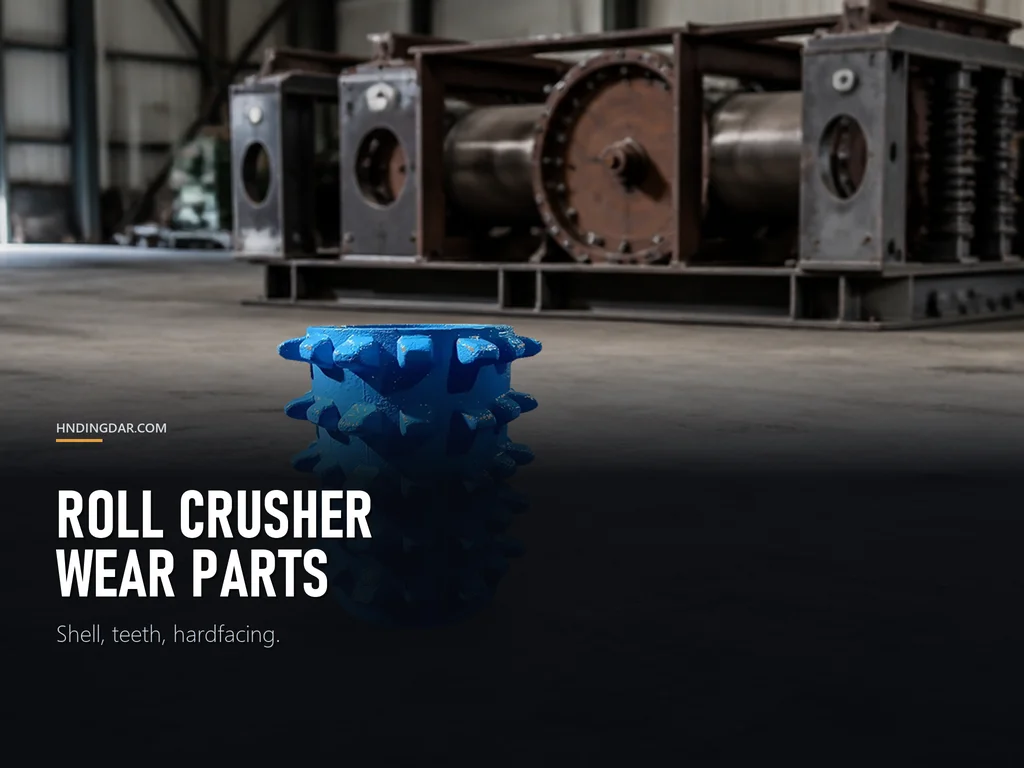
Roll Crusher Wear Parts: Roll Shells, Teeth and Hardfacing Choices
A roll crusher fails in complicated ways. Two rolls turn toward each other, feed drops into the gap, and rock is broken by compression and shear rather than by a swinging blow. Because the loading is slow and repeated, parts rarely break in one dramatic event. They wear, spall, go concave and crack at the tooth root until product size drifts and someone asks for a quotation.
Picking roll crusher wear parts is less about ordering the hardest grade than about knowing which parts are wearing, and whether the cure is a material, a rebuild, or a change upstream.
Which parts inside a roll crusher actually wear
Most buyers start with the roll shell and stop there. At least five items consume budget, and they do not wear at the same rate or for the same reason.
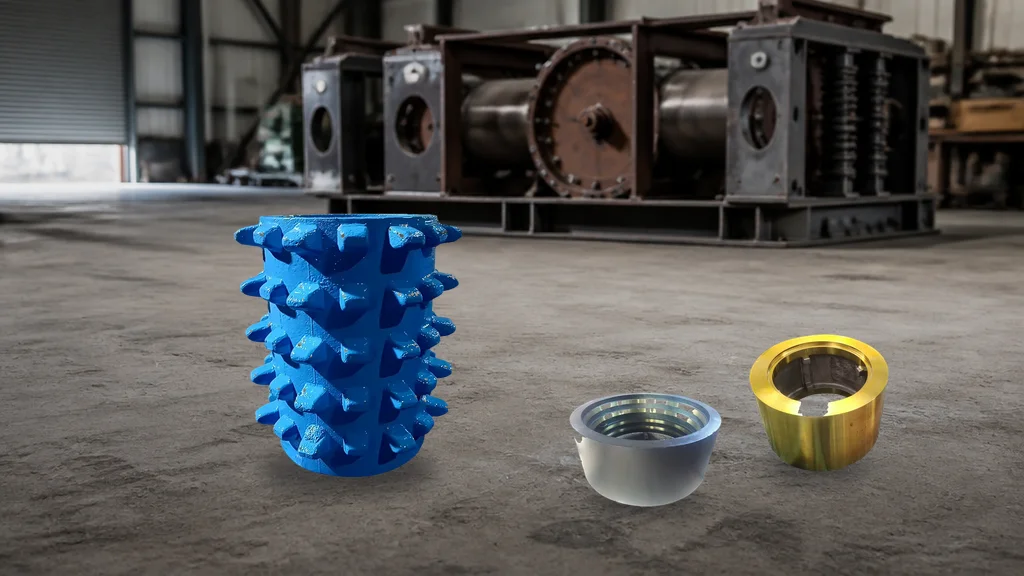
Roll shells and roll tyres. The shell carries the crushing surface. On larger machines it is a separate tyre shrunk or keyed onto a shaft; on smaller ones shell and shaft are replaced together. It sees the contact stress of every pass, so its failure is as much fatigue as abrasion.
Tooth crowns and segment teeth. On a toothed roll the crushing surface is a ring of cast segments bolted to the shell. Teeth grip and break first, so they take sharp point loads and wear far faster than the shell underneath. Segments are meant to be consumed.
Side plates and cheek plates. These close the ends of the crushing chamber. Sitting outside the main compression zone, they are often forgotten, yet they see a steady trickle of fines and edge spill. Worn through, they let material bypass the gap.
Bearing housing liners and seal seats. Small, cheap parts with an outsized effect. Wear here shows as shaft movement, then as uneven roll wear and a product that will not hold size.
Feed chute and hopper liners. Pure sliding abrasion, no compression, and the one place where a very hard, less tough material is usually right.
Fact: DINGDAR (Henan Dingdar Machinery Equipment Manufacture Co., Ltd.) has cast wear parts since 1986, runs four in-house casting routes (green sand, shell moulding, lost foam and investment casting) across a 180,000 m² plant with a further 12,000 m² of office and R&D space, and has produced 5,400+ part types.
Build an order as a bill of parts by location, not one line item; the roll crusher parts range is organised that way.
Tooth form, tooth pitch and the feed in front of you
The roll surface is the only part that touches the rock, so its geometry is a process decision: will the feed be gripped, and what product will come out.
Toothed rolls versus smooth rolls. A toothed roll grips. Its teeth dig into a lump, pull it into the gap and break it in tension as much as compression, which is why toothed rolls take softer, friable and slabby feed at higher reduction ratios. A smooth roll relies on friction and a narrow gap, suits feed that is already small, and gives a tighter, more cubical product. Choosing between them is choosing what the crusher is allowed to swallow.
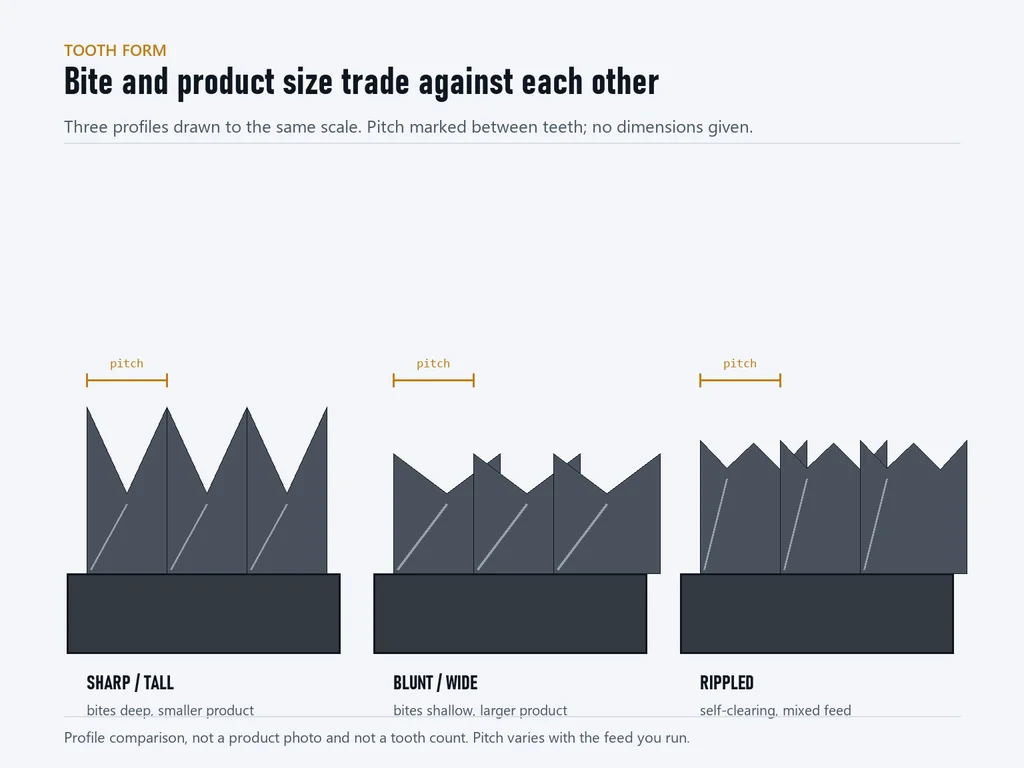
Tooth profile. A sharp, tall, wedge-shaped tooth bites aggressively but its tip is thin and wears back quickly. A blunt, wider tooth holds its height longer but grips less and makes more fines. Rounded or rippled profiles sit between the two, and fine teeth on a coarse feed simply get buried and polished.
Tooth pitch. Pitch sets the largest lump a roll can pinch. Wide pitch with tall teeth handles coarse feed and gives a coarser product. Tight pitch with short teeth gives a finer product but needs feed that is already reduced. Pitch and height together, not the gap alone, set the real product size.
Segmentation. Teeth are cast as segments so a worn crown can be replaced without scrapping the shell. That only works if segments are interchangeable within a set: same profile, same height, same mass.
Reading the failure mode before changing the material
The most expensive mistake in roll crusher maintenance is answering the wrong failure. A material change that fixes abrasion will not fix spalling, and a tougher grade that stops root cracks will usually wear faster. Diagnose first, then specify.
Abrasive wear. Gradual, smooth loss of section: tips round off, the face polishes, product size drifts upward slowly. This is the normal mode, answered by a harder surface or better distributed feed.
Gouging and chipping. Torn metal and chunks missing from a tooth flank, often at one point. This is a point load the surface could not absorb, typically tramp metal, a slab or one oversized lump. A harder material makes it worse; the answer is feed control or a tougher grade.
Fatigue spalling. Shallow patches flake off, sometimes in a repeating pattern around the circumference. The metal did not wear away, it broke away under repeated contact stress, which points at a hardened layer too thin for the load or a shell flexing because the fit is poor.
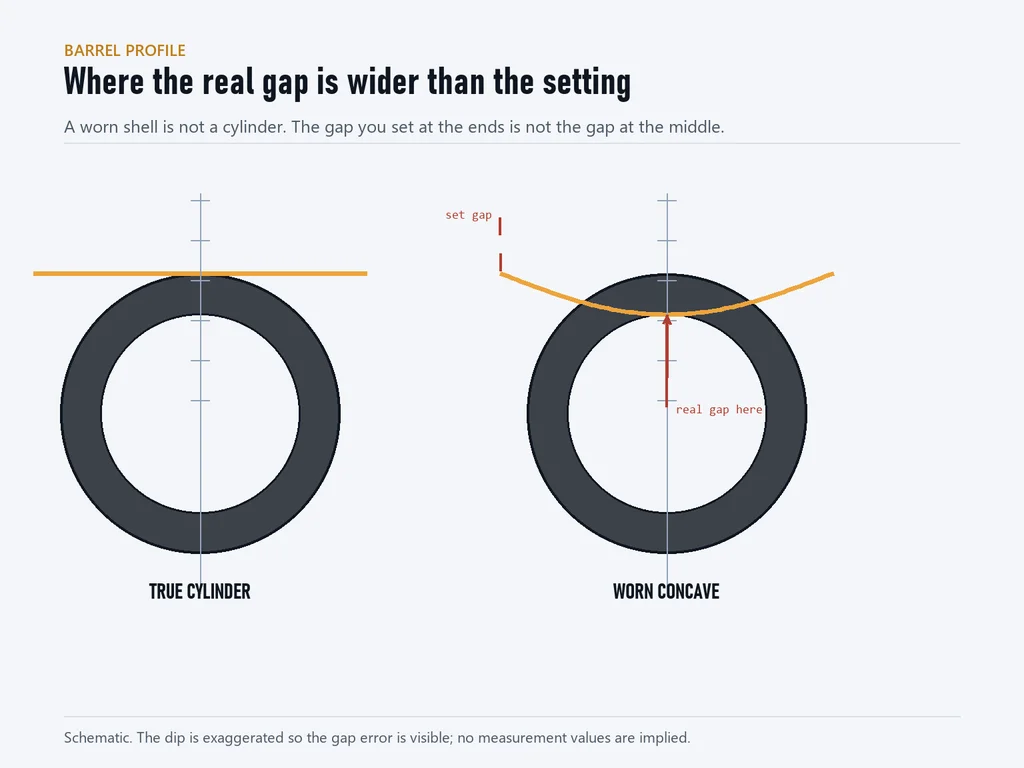
Barrel concavity. The face becomes hollow in the middle and high at the edges, so the real gap is wider at the centre than the setting implies. This is a distribution problem with a wear consequence, covered below.
Tooth root cracking. A crack starts at the fillet where the tooth meets its base and runs into the body, and once it reaches the fixing area the segment can leave the shell. Root cracking is a design and fit issue as much as a material one: too small a root radius, a brittle grade, a segment not seating flat, or a face no longer true.
Each mode points to a different fix, so diagnose before specifying.
Fact: DINGDAR employs 720+ people including 52 R&D engineers, works to 6S shop floor discipline, and holds ISO 9001, IATF 16949, ISO 14001 and ISO 45001 certification.
Material and process combinations that fit roll crusher duty
Wear parts are described by material family, but the family alone does not decide the outcome. What matters is the combination of alloy, casting method and surface treatment, matched to the load.
High chrome iron. A hard, carbide-rich white iron with excellent resistance to sliding abrasion. It suits chute liners, side plates and roll faces in fine, abrasive, well-controlled feed. Its weakness is toughness: under point loads it chips and can crack at a thin tooth root, so it is a poor choice for slender teeth where tramp metal is possible.
Martensitic steel. A heat-treatable steel hardened through the section while keeping a tough core. It is the general-purpose answer for roll shells and for teeth that must survive impact, and it can be re-machined and rebuilt because the base stays weldable. Its abrasion resistance sits below high chrome, which is the price of that toughness.
Austenitic manganese steel. A steel that work-hardens under impact: the surface hardens as it is hammered while the bulk stays tough. It is the classic choice for severe impact and gouging, and it underperforms on low-stress fine abrasion, where it does not harden enough. Being difficult to machine, it is normally used as-cast.
Composite and bi-metal castings. Carbide or ceramic inserts set into a tougher matrix, or a hard layer cast onto a tough backing. The face takes abrasion while the body absorbs load. Once an insert is lost the matrix behind it wears fast, so composites want a stable, screened feed.
Hardfacing overlay. A weld-deposited layer on a cast or fabricated base, a repair route rather than a material in its own right.
| Option | Abrasion resistance | Impact tolerance | Rebuildable | Typical location |
|---|---|---|---|---|
| High chrome iron | High | Low | Limited | Chute liners, side plates, fine-feed faces |
| Martensitic steel | Medium | Medium to high | Yes | Roll shells, toothed segments |
| Austenitic manganese steel | Medium at low stress | High | Limited | Teeth in gouging duty |
| Composite or bi-metal | High | Medium | Limited | Faces with stable, screened feed |
| Hardfacing overlay | Set by deposit | Set by base | It is the rebuild | Worn shells and teeth |
Which route is available also depends on part size and tooth detail. A large shell and a finely detailed crown do not come off the same line, so the casting route decision runs alongside the material choice; the logic is set out in how DINGDAR selects a casting process. The bucket teeth notes apply to teeth here too, while impact crushers load their wear parts very differently, as covered in impact crusher blow bar materials.
Hardfacing repair versus replacement
Hardfacing is the most misunderstood item in roll crusher budgets. Because it is cheap per kilogram against a new shell, it gets applied to parts already past saving, and the crusher then runs out of tolerance with a fresh layer on a dead base. Four checks settle it.
Crack depth relative to section. Surface checking in the overlay is normal. A crack running into base metal, or reaching a bore, a keyway or a fixing face, ends the question: the part is no longer a candidate. Crack inspection, not appearance, decides.
Remaining substrate. The overlay needs something to sit on. Once rebuilding would have to restore section rather than surface, the part has stopped being a wear part and become a fabrication. That is the point to order new.
Distortion and true-running. Every cycle adds heat and stresses the shell. A shell that no longer runs true cannot be corrected by more overlay; it needs machining, and machining needs allowance. When the allowance is gone, so is the rebuild option.
Economics without prices. Compare rebuild and new part on time consumed, life returned, base left for another cycle, and whether the failure was a surface problem at all. If the part failed by cracking or spalling, a rebuild repeats the mistake.
Barrel concavity and gap management
Concave wear is normal on almost every roll crusher and is almost always blamed on the material. The real cause is that the middle of the roll does more work than the ends.
Feed arrives as a stream, not a curtain. It lands near the centre of the face, so the centre passes the full tonnage while the edges pass only what spreads, and the shell deflects slightly under load. The middle therefore wears fastest for two reasons at once: abrasion plus a marginally tighter working gap.
The consequences are easy to miss: the nominal gap is set at the ends, so the centre runs wider and the product carries a coarse fraction. Operators close the gap to fix the product, the ends then run tighter than intended, and edge wear and side plate loading rise.
Correct the cause, then the profile. Spread the feed across the full face, check that the feed box is not delivering to one spot, and confirm the rolls are parallel and the bearings are not letting the shafts move. Only then restore the surface by machining the face back to a true cylinder, within the allowance the shell has left.
Gap management is a check on geometry, not a substitute for it: two rolls with a true face hold a consistent product across the width, two with a hollow centre cannot, whatever the setting.
Buying points that decide whether the part fits
A shell or tooth set is a large, machined casting with several interfaces. Most of the cost of a bad purchase is not the price; it is the weeks lost while a part that does not fit is corrected or remade.
Drawing and physical part consistency. Send both. Drawings drift: a machine may have been rebuilt with a modified shell, a shaft re-metalled, a keyway recut. A foundry quoting only from a drawing number is quoting an assumption.
Dynamic balance. A roll assembly turns, so mass distribution matters. Segments vary in mass from casting and an unmatched set shows as vibration. Ask how the set is matched, and for each segment's mass to be recorded.
Assembly faces. The bore, keyway, shoulder faces and bolt circle carry the fit, so they deserve explicit tolerances rather than "as cast, machined where required".
Interchangeability. Confirm the machine model, the original part number, and whether the part needs a matching change on the other roll. A new shell paired with a worn one gives an uneven working face from day one.
Batch and stocking. Order in sets, because wear parts are consumed in sets. Batch size should follow the rebuild interval and the supplier's lead time, not a discount break. Keep set numbers, store shells so the working face is not dented, and keep segments in their matched packaging.
Fact: DINGDAR answers a technical enquiry within 12 to 24 hours and reviews each wear part requirement in one pass: the casting route, the material, the as-cast and machined scope, the inspection points and any pattern or first-article confirmation.
For buyers who want to know what sits behind those reviews, the DINGDAR background covers the plant, the casting routes and the quality system, and the roll crusher parts page lists the part families the foundry actually casts.
Incoming inspection before the part goes on the machine
Inspection at goods-in is cheaper than finding the problem during a shutdown, and the checks are about acceptance, not installation.
| Check | What to verify | Why it matters |
|---|---|---|
| Identity | Part, set number, drawing revision | Stops mixed batches and wrong-model fitment |
| Bore and keyway | Dimensions against drawing, no burrs | Decides whether the shell runs true |
| Fixing features | Bolt circle, hole positions, threads | A mis-drilled segment cannot be corrected |
| Working profile | Tooth height against a template | Profile drift changes product size |
| Mass record | Segment masses within the set | Balance and vibration |
| Soundness | Visual check at the root radius | Root defects become root cracks |
| Documentation | Material certificate, inspection record | Traceability if the part fails early |
Two additions matter: compare the new part against the worn one on the bench, and log the set number with the hours it delivered. After two or three cycles that log predicts your next order better than any estimate.
Wear part matrix: location, failure and replacement trigger
The trigger column is written as a condition rather than a number, because the number that matters is the one your own machine produces.
| Part | Dominant failure mode | Usual material route | Replacement trigger |
|---|---|---|---|
| Roll shell or tyre | Fatigue plus abrasion, concavity | Martensitic steel, hardfaced | No allowance left, or face cannot be trued |
| Tooth crown segment | Tip abrasion, root cracking | Martensitic, manganese, composite | Height no longer holds size, or crack reaches the fixing area |
| Side plate | Sliding abrasion, edge washout | High chrome iron, wear plate | Worn through, or material bypasses the gap |
| Bearing housing liner | Fretting, clearance growth | Martensitic steel, bronze if specified | Shaft movement measurable, or clearance outside drawing |
| Feed chute liner | Low-stress sliding abrasion | High chrome iron, composite | Consumed to the backing, or holes appear |
| Roll face hardfacing | Rebuild layer wear | Deposit matched to base | Base no longer sound, or distortion out of allowance |
FAQ
Can a toothed roll crusher be converted to smooth rolls?
Sometimes, but it is a machine change rather than a parts swap. A smooth roll needs a different shell and surface, a different approach to gap setting and usually finer feed preparation, because it cannot grip the coarse, slabby feed a toothed roll pulls down. Convert only when the feed is already fine and the goal is a tighter product, and confirm shaft and drive capacity first.
How many times can a roll shell be hardfaced before it must be replaced?
There is no fixed count, because the limit is the substrate rather than the overlay. Each rebuild consumes base metal and adds heat cycles, so ask how much sound base section is left, how much the shell has distorted, and whether cracks have reached the bore or fixing faces. Once the base cannot carry an overlay without cracking, or the shell cannot be trued within its allowance, rebuilding stops paying.
Can different parts of the same crusher use different materials?
Yes, and it is often correct. Shell, tooth crown, side plate and chute liner see different loads. Teeth need toughness at the root; shells need fatigue resistance; chute liners see sliding abrasion and can use a harder grade. Mixing materials within one machine is normal. What must not be mixed is a tooth set, because mismatched segments change the working profile and the balance.
How many spare sets of roll shells and teeth should I stock?
Work from the wear rhythm you observe, not a rule of thumb. Record how many hours each set delivers, how much notice the supplier needs to cast and machine a replacement, and what a day of downtime costs in lost production. If lead time exceeds the interval between failures, keep one full set on the shelf. Where two crushers share a tooth pattern, a common spare pool beats separate stocks.
Why does the middle of the roll wear faster than the edges?
Because the middle does more work. Feed lands in the centre of the face, so the centre sees the full stream while the edges see only spill. The result is a concave barrel, high at both ends and hollow in the middle, with a working gap wider at the centre than the setting suggests. Cure it upstream by spreading the feed, then restore the profile by machining. A new set fitted without fixing distribution goes concave again.
Should tooth segments be replaced as a set or one at a time?
As a set, on any roll where the teeth work together. Replacing one segment leaves a step in the working profile, changes the local bite and shifts mass distribution, which shows as vibration and uneven product size. Spot replacement is defensible only as a short-term measure when one segment has cracked and the rest still has usable height, and even then it should match the set in profile and mass.
What should I send with a roll shell enquiry?
The crusher make and model, the original drawing or part number, dimensions measured from the worn part (outside diameter, face width, bore, keyway, bolt pattern), the feed material and top size, target product size, and how the current part failed, with photos. State whether the shell is a shrunk-on tyre or a bolted assembly, and whether segments are included. Drawing and worn part together is what lets a foundry quote something that fits. The contact page lists the addresses that route to engineering.
Sources
- ASTM International. "ASTM A532/A532M, Standard Specification for Abrasion-Resistant Cast Irons." https://www.astm.org/ - Basis for the high chrome iron family.
- ASM International. "ASM Handbook, Volume 18: Friction, Lubrication, and Wear Technology." https://www.asminternational.org/ - Background on abrasive wear, gouging and spalling as distinct mechanisms.
Manufacturer specifications: DINGDAR company facts, production routes, plant area, part types and certifications are stated on https://hndingdar.com/.