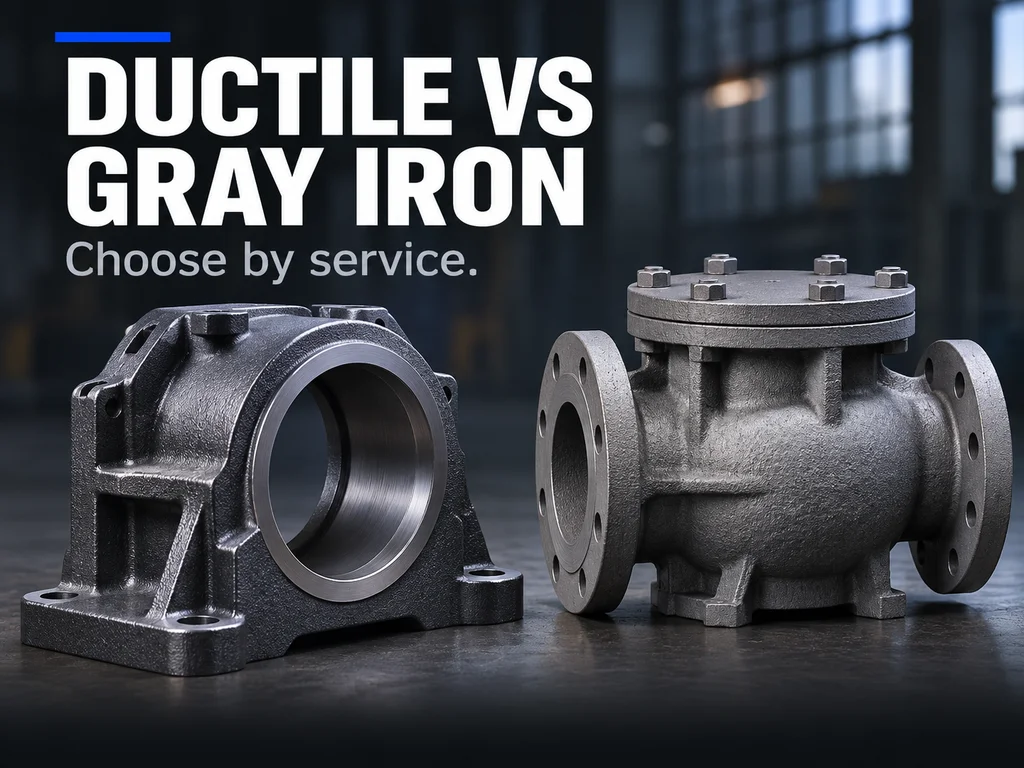
Ductile Iron vs Gray Iron Castings: Choosing for Pressure and Structure
The ductile iron vs gray iron decision usually arrives late, after the part is drawn and quoted, and gets settled by whatever the foundry has in the furnace that week. That is the wrong order. Both irons leave the same melting shop, often down the same sand line, yet they fail in different ways. One warns before it breaks and the other does not. One absorbs vibration and the other rings. One holds a medium across a thin wall and the other weeps through it. That difference comes from the shape the carbon takes as the iron solidifies.
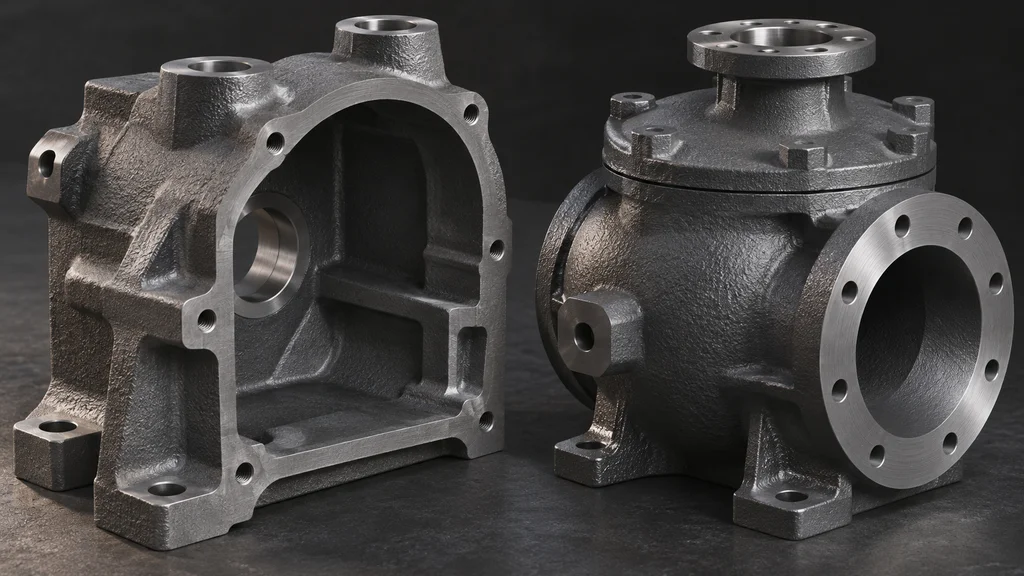
Graphite shape decides everything
Cast iron is an iron and carbon alloy in which most of the carbon leaves solution during solidification and appears as graphite. Gray and ductile iron are both composites: a metallic matrix carrying a graphite network. The matrix can be ferritic or pearlitic in either family, and heat treatment moves it in either family. The graphite is the part that cannot be swapped cheaply.
In gray iron the graphite grows as flakes, and the flakes connect to one another. Each behaves like a sharp, flat internal crack with its tip pressed into the matrix, so under tension the stress concentrates at the flake tips and a crack that starts at one flake has a ready path to the next. The material does not yield in any useful way. It reaches its limit and separates, without warning.
Fact: DINGDAR (Henan Dingdar Machinery Equipment Manufacture Co., Ltd.) has cast industrial parts since 1986, runs four in-house casting routes (green sand, shell moulding, lost foam and investment casting) across a 180,000 m² plant, and reviews every requirement in one technical review.
Ductile iron is made by treating the melt so the graphite spheroidises before the casting freezes. A magnesium based treatment changes the growth mode, so the carbon ends up as isolated nodules instead of connected flakes. A nodule is a blunt inclusion, not a crack: load flows around it, stress concentration is far lower, and the matrix is free to yield at a local overload. That is how the same matrix delivers real ductility in one family and essentially none in the other. The gap is not a matter of degree. It is an order of magnitude in how far the material stretches before it separates.
That changes what the designer may assume. Gray iron is designed as a brittle material: keep the stress field compressive, avoid bending peaks, and never count on yielding to redistribute an overload. Ductile iron is designed as a ductile material: it yields locally, blunts a notch, absorbs impact and survives a bolted joint that bends a flange. Carried over unchanged, a gray iron section in ductile iron runs heavier than needed, and a ductile iron section in gray iron cracks.
A grade label such as HT250 or QT450 encodes a strength level inside a naming system [1][2], and nothing more. It says which family the iron belongs to, not what your section thickness or the cooling rate in a heavy boss will produce.
Pressure service: when ductile iron is the defensible choice
Pressure is the first filter, and it filters on consequence as much as on stress. A casting that contains a medium stores energy; when the wall fails that energy releases at once and the medium goes somewhere. How much is stored, and where it goes, sets how much proof the part deserves.
| Condition on the drawing | Gray iron | Ductile iron | What decides it |
|---|---|---|---|
| Non-hazardous medium, thick walls, static load | Often workable | Not needed | Leak consequence, product standard |
| Gas, steam, flammable or toxic medium | Hard to defend | Usually required | Stored energy, consequence of release |
| Cyclic pressure, water hammer, pulsation | Poor fit | Preferred | Fatigue at stress raisers |
| Thin wall boundary with flanged connections | Poor fit | Preferred | Bending from bolt and pipe load |
| Buried main under ground movement | Poor fit | Standard choice | Deformation without fracture |
Gray iron struggles in these duties for structural reasons, not because it is a weaker metal. A flange face bends as the bolts are tensioned, putting tension into a wall that was thicknessed for internal pressure. Water hammer sends a pressure spike into a material that cannot yield to absorb it. And where the wall is thin, the connected flake network can turn scattered porosity into a leak path, so the part weeps under pressure.
Ductile iron became the default for water and gas transmission for one reason: a ductile main deforms under ground movement instead of cracking, and a cracked buried main is a far larger event than a deformed one. The same logic carries into ductile iron castings for energy and transport service, where the part is often a fitting or a valve body that has to survive installation loads it was never designed to enjoy.
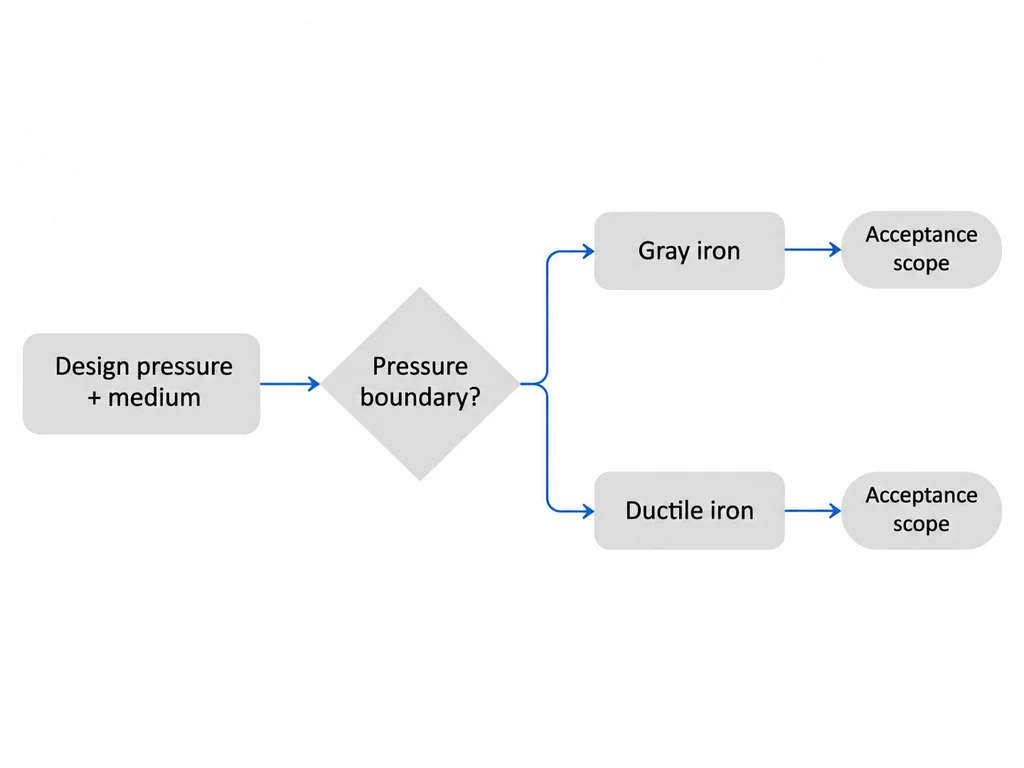
The judgment itself is not improvised. Product standards for a given service list which iron families and grades are permitted, and where a standard permits only one family there is no material debate to have. Where it permits both, the decision belongs to the design authority, taken against design pressure, medium, temperature, cycling and the applicable standard.
Structure and damping: where gray iron still wins
The flake network that limits gray iron in tension makes it valuable in a machine frame. Graphite flake interfaces transmit vibration poorly and slip under alternating stress, turning a little vibration into heat at every boundary, so the material kills vibration quickly. That is why machine tool beds, columns, bases and gear housings have been gray iron for a century. Ductile iron's nodules are isolated and its matrix is continuous, so vibration travels further and the part rings longer.
For a buyer, the test is what the part is asked to do. If its job is to hold a position while something else vibrates, gray iron is often the better material even though it is the weaker one. Chatter and surface finish on a machine tool come out of the structure as much as out of the cutting edge.
If the part's job is to carry load and survive abuse, the answer flips. Brackets, axle housings, hubs, linkage parts and pump bases that see vibration plus load all benefit from the toughness of ductile iron. A gray iron bracket that is overstressed does not bend out of the way. It breaks.
Both irons are stiff, so a deflection limited design can use either family. A strength or toughness limited design normally leaves one option.
Sealing, machining and the surfaces that decide acceptance
Sealing faces and pressure tightness
A sealing face has three jobs: stay flat across the gasket band, hold a finish that lets the gasket seat, and stay that way after the bolts are tensioned. Gray iron machines beautifully, because the graphite lubricates the cut and chips break cleanly, but a pore or cold shut in the gasket band becomes a leak path once the bolts load it. On gray iron pressure faces, the wall behind the face matters more than the finish on it.
Ductile iron is tighter at equal soundness because its nodules are isolated, which is why thin wall pressure castings and pipe are made in it. The cut is tougher, chips string out, the tool smears, and a face can look polished while its profile is wrong. Machining also releases residual stress, so a face that measured flat in the fixture can bow once the clamps come off.
Threads follow the same split. Gray iron threads strip sooner, so deeper engagement and a spot faced boss carry real design weight, while ductile iron takes more thread load and allows a more compact boss. In either family, a tapped hole that breaks into a cored void is an assembly failure waiting for the first torque wrench. Buyers sourcing pump and valve castings learn this split quickly.
Defect sensitivity: two different risks
Ductile iron puts its risk in the treatment and the feeding. Nodularity is a process capability that has to be demonstrated, not assumed, and degenerate, exploded or compacted graphite all reduce local ductility, so a patch of poor nodularity removes the property being paid for. Ductile iron also freezes across a wider interval than gray iron, so it needs more feeding and is more prone to shrinkage porosity at hot spots. The design response is section discipline: uniform walls, generous fillets, risers over the heavy sections, and no isolated boss that nobody can feed.
Gray iron puts its risk in the section. Section size sets cooling rate, so a thin wall can chill to free carbide and become hard and crack prone, while a thick wall cools slowly and grows coarse flakes with lower strength. The same grade can behave differently at two places in one casting. The response is uniform sections, no abrupt thickness changes and machining stock where the section is stable; the wall thickness and draft rules that apply to any sand casting decide local properties here, not only fill.
Acceptance emphasis follows the risk. On ductile iron, expect a nodularity assessment from a coupon, volumetric inspection at the hot spots, and mechanical results from a test piece that represents the section. On gray iron, expect section control, hardness checks at thin and thick locations, visual grading for cold shuts and misruns, and a proof test for tightness.
Weld repair: where the line is drawn
Welding cast iron is not welding steel. The graphite does not dissolve into the weld pool, and the base metal behind the arc cools fast while the graphite structure cannot accommodate the shrinkage. In gray iron the heat affected zone can transform into a hard, brittle layer that cracks as it cools or later in service. In ductile iron, sound procedures exist with preheat, controlled cooling and nickel based consumables, but the repaired zone is still not the parent metal.
Put that zone in a pressure boundary and the arithmetic is poor. A repair weld is a hard patch in the wall, ringed by residual stress, sitting where a crack will eventually start, in a part whose justification for being ductile was tolerance to stress. The usual purchasing position on pressure retaining walls is simple: they are not welded. A defect there is dispositioned by rejection or by engineering concession, not by a welder with a torch.
On a non pressure part, three questions draw the boundary. Is the repair inside the pressure boundary or a primary load path? Then no. Does the applicable standard permit repair, and under what approval? If it is silent, treat repair as not permitted. And is the repair cosmetic or restoring section? Blending a shallow blemish is a different act from filling a shrinkage cavity in a boss that carries load.
Whatever is permitted has to be visible: approved before it happens, recorded, and re-inspected by the method that found the defect. A foundry that repairs quietly and one that repairs under documented concession look identical on the shipping dock.
Buying and accepting: certificates, coupons and NDT scope
A material certificate tells you what the metal is: grade, heat number, chemical analysis and, where the order requires it, mechanical results from a separately cast test piece. It does not tell you whether the casting is sound, whether the sealing face is flat, or whether the wall is thick enough where a core shifted.
The coupon deserves more attention than it gets. It is cast separately and processed with the castings, and it has to represent the section it stands for. Gray iron test bars and ductile iron keel blocks are both section specific, so a result from a thin bar does not certify a heavy flange. Ask which coupon is used, which section it represents, and whether it gets the same heat treatment as the parts.
Non-destructive testing is where the families diverge. Ultrasonic inspection is the workhorse for internal soundness in ductile iron [3], because a nodular structure lets the beam through and returns readable indications from a shrink cavity or an inclusion. In gray iron the flake graphite scatters the beam heavily, so volumetric inspection is far less informative and surface methods cover only what sits near the skin. Ductile iron pressure parts can therefore be inspected volumetrically and usually should be, while gray iron parts lean on section control, visual grading and a proof test. Buyers who want the full picture can read pump and valve casting inspection alongside this article.
For either family, the proof of a pressure boundary is a proof test. A certificate is evidence about metal, not evidence about a wall.
Fact: DINGDAR casts gray iron and ductile iron alongside alloy and carbon steel, stainless steel, high manganese steel and high chrome iron, drawing on 5,400+ part types and 52 engineers and R&D staff within a workforce of 720+.
Side by side: what changes and what it means
| Dimension | Gray iron | Ductile iron | Selection hint |
|---|---|---|---|
| Graphite form | Connected flakes | Isolated nodules | The cause behind every other row |
| Failure mode | Sudden brittle fracture | Yields, then fractures | Decides any part with tensile or impact load |
| Pressure boundary | Low consequence, thick walled duty | Standard choice for a contained medium | Settle it from design pressure, medium and standard |
| Tightness in thin walls | Flake network can link porosity | Sound wall stays tight | Thin wall pressure parts lean ductile |
| Damping | High | Low | Machine tool and frame parts lean gray |
| Section sensitivity | Thin chills, thick coarsens | Moderate, but feeding is harder | Both need uniform sections, for different reasons |
| Weld repair | Not a restoration | Possible, but not parent metal | Pressure walls normally excluded |
| NDT effectiveness | Limited volumetrically | Volumetric inspection practical | Place NDT where the method can see |
Fact: DINGDAR is certified to ISO 9001, IATF 16949, ISO 14001 and ISO 45001, and agrees quality documents per order: grade and heat number, mechanical or hardness results, dimensional records and a certificate of conformity are written into the quotation.
Two buying habits fall out of the table. Write the family and grade on the drawing and let the foundry confirm the route, the section capability and the coupon, because both irons pour on the same green sand casting line and the difference in outcome sits in the treatment and the feeding, not in the mould. Then match the inspection to the material: a volumetric scope written for gray iron will disappoint, and a visual scope written for a ductile iron pressure body will miss the defect that family is prone to.
FAQ
Can ductile iron replace gray iron?
It can, and the swap is easier in one direction than the other. Ductile iron brings ductility and pressure tightness that gray iron does not have, so a part designed as gray iron can usually be re-made in ductile iron with the same geometry. What does not transfer is damping, so a machine tool base that depends on gray iron to absorb vibration will ring longer in ductile iron. The replacement is a material decision, not a substitution.
Do pressure castings need non-destructive testing?
Where the part holds a medium and a failure would release it, internal soundness has to be verified, and a pressure test alone only finds defects that leak. The scope still belongs to the design authority, working from design pressure, medium, temperature and the applicable standard. In practice ductile iron pressure parts are where volumetric inspection is practical and expected, while gray iron parts lean on section control and proof testing.
Who decides the iron grade, the buyer or the foundry?
The buyer's design authority decides, because the grade follows from the duty. The foundry's job is to say what it can achieve in the section being cast and to prove it with a coupon that represents that section. A foundry that picks the grade for you is guessing at loads it has never seen. The workable split is that the drawing names the family and grade, and the foundry confirms the route and the evidence.
Can cast iron be repaired by welding?
Rarely in a way that restores the part. Welding cast iron is not welding steel: the graphite does not dissolve into the weld pool, and the heat affected zone cools into a hard, brittle layer with residual stress around it. On a pressure retaining wall that layer is a crack starter. On a non pressure part, repairs may be permitted by the standard and the design authority, but they must be approved, recorded and re-inspected.
Why does gray iron damp vibration better than ductile iron?
Because of the flakes. The graphite flakes in gray iron are interconnected and their interfaces slip under alternating stress, converting vibration into a small amount of heat at every boundary. The isolated nodules in ductile iron do not provide that sliding network, so vibration travels through the matrix and the part rings longer. That is why machine tool beds and bases remain gray iron even where a stronger iron is available.
Which iron is better for sealing faces and threads?
Ductile iron holds a pressure tight wall and stronger threads, gray iron cuts more freely and finishes more easily. Gray iron machines to a fine finish with little tearing, but its threads strip sooner and its connected flakes can turn scattered porosity into a leak path. Ductile iron needs sharper tooling and a rigid setup because it smears, and its faces must be checked for flatness rather than shine.
Conclusion
The ductile iron vs gray iron question is a consequence test rather than a ranking. Work out what the part contains, what happens if it lets go, whether it is loaded in tension or impact, whether its job is to hold position or absorb vibration, and how it will be inspected and repaired if something goes wrong. Each answer points at a graphite shape before it points at a grade.
Let the design authority then confirm the family, grade and acceptance scope against design pressure, medium, temperature and the applicable standard, and let the foundry confirm what it can cast and prove in the section you have drawn. DINGDAR reviews each requirement in a single technical review that fixes the casting route, material, as-cast and machining scope and inspection points, and produces custom castings from drawings, samples or part numbers. Buyers who want to see how the plant works can read how DINGDAR works, and anyone ready to compare a gray iron and a ductile iron option can contact the DINGDAR team with the drawing, medium and duty. Replies come back within 12 to 24 hours.
Sources
- ASTM International. ASTM A536, Standard Specification for Ductile Iron Castings, and ASTM A48 / A48M, Standard Specification for Gray Iron Castings. https://www.astm.org/ - Define the grade systems and the separately cast test pieces used to certify each family.
- International Organization for Standardization (ISO). ISO 1083, Spheroidal graphite cast irons, classification, and ISO 185, Grey cast irons, classification. https://www.iso.org/ - Classify the families by graphite form and mechanical designation, the basis for matching a national grade to a project specification.
- American Foundry Society (AFS). Technical publications on graphite morphology, nodularity assessment and casting defect analysis. https://www.afsinc.org/ - Industry reference on graphite formation and the defect mechanisms discussed above.