Cone Crusher Mantle and Jaw Plate Castings: Material and Fit Decisions
A cone crusher and a jaw crusher both break rock by squeezing it, so buyers reasonably assume their wear parts can be specified the same way. They cannot. One part works inside a converging chamber kept full and held at a fixed setting, so its geometry has to survive an enormous number of load cycles spread around a ring. The other works between two plates, one of them swinging, and takes its punishment at tooth peaks that grip and break individual lumps.
That difference decides which failure you will actually see, which material family answers it, how much the fit underneath the part matters, and which signal should tell you the part is finished rather than the wear marker on the drawing. This article covers cone crusher mantle and jaw plate castings only, and leaves impact crushing to a separate discussion.
Why a cone and a jaw load their wear parts differently
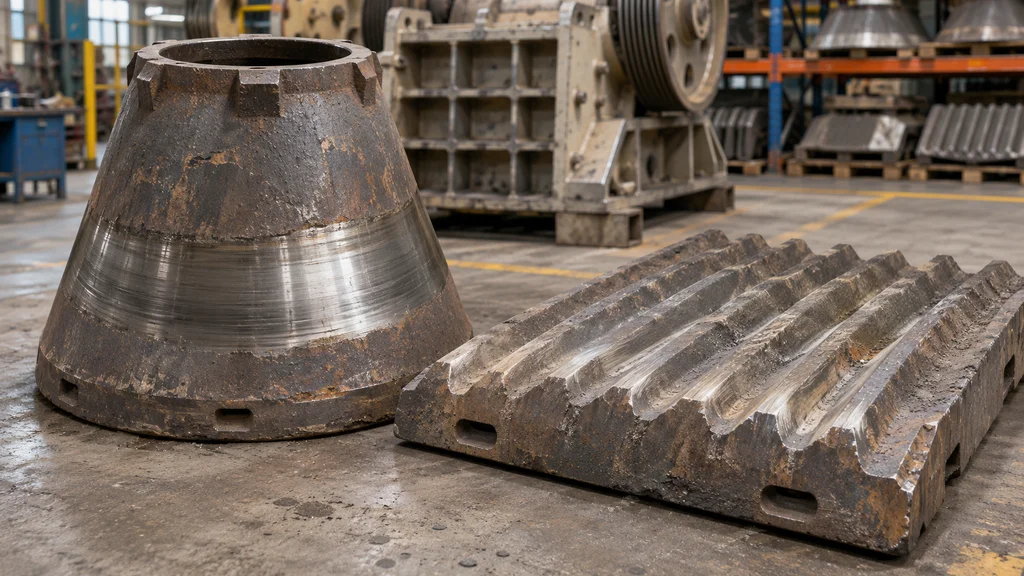
In a cone crusher, rock is squeezed between a mantle that gyrates and a stationary bowl liner. Because the chamber runs full, rock breaks against rock as much as against steel. That is efficient, but it puts the liner inside a pressure vessel made of stone: the load arrives as a high, slowly varying compressive stress around most of the circumference, with the peak travelling around the ring once per revolution. Sliding is present, but it is three-body abrasion rather than a clean cut.
A jaw crusher loads its plates in a different rhythm. The swing jaw opens and closes, so each cycle grips a lump near the top, compresses it and releases it, and the pieces drop a step. The bite travels down the chamber: the top does the coarse work, the bottom does the sizing work, and the plate is loaded in bands rather than around a ring. Every tooth peak takes first contact, and every peak is a stress raiser on a plate that bends.
For the cone, the working surface has to stay round. The setting is one number, taken between mantle and bowl liner at one point, but the product curve depends on the whole chamber, including the parallel zone near the discharge. Even wear opens the chamber gradually. A groove changes the setting locally, and no adjustment at the control panel recovers it.
For the jaw, the surface is a set of teeth whose height sets the bite, so a plate can lose its function with most of its metal still in place.
So the two parts are asked different questions. For a mantle: will this material hold a uniform profile under cyclic compression, and stay in contact with the head? For a jaw plate: will this tooth form grip the feed in front of it, and will the root survive the bending? Asking the wrong question is how a buyer ends up with a part that is harder, dearer and shorter lived. The cone crusher parts range is organised by chamber position for that reason, and where rock is broken by impact rather than compression, impact crusher parts are specified on different grounds.
Three failure patterns in a cone crusher mantle
Most mantle complaints describe one of three patterns, and each calls for a different answer. The expensive mistake is treating all three as a material problem.
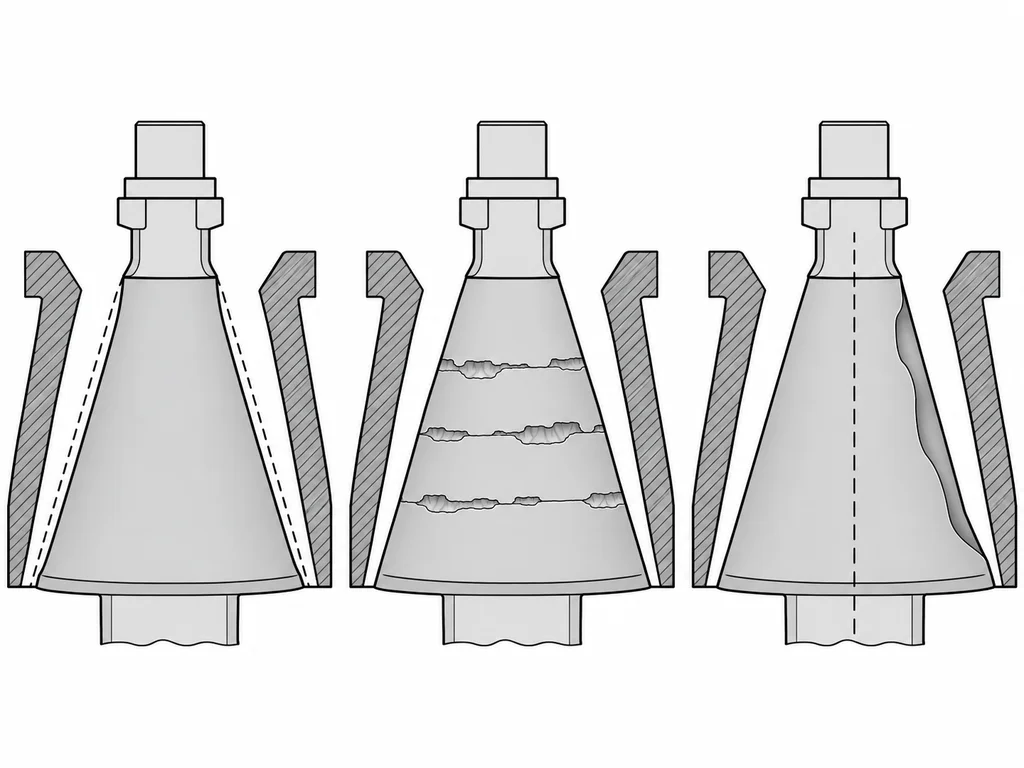
Even abrasive loss. The section thins evenly, brightest near the discharge where the material is finest and the sliding distance longest. Throughput holds for a while and product size creeps up. This is the normal end of a liner's life, and the one case where a harder surface genuinely pays, provided the chamber is not also taking shock loads.
Compression fatigue. Metal comes away in flakes and shallow craters, often in a band, with sound steel beside each crater and sometimes a crack running out of it. The steel did not wear, it broke. Three causes account for most of it: contact that is not full around the head cone, backing that never filled or has degraded, and a grade that is too hard for the load. Location is the clue, because fatigue clusters where the liner flexes, and a liner flexes where it is unsupported.
Off-side wear from uneven feed. A step, groove or polished band on one side, and a chamber that is no longer round. Check the top of the mantle: if one side has lost its profile while the other still shows the cast surface, the chamber is being fed to one side. Segregated feed does the same more slowly, with coarse running down one side of the belt and fines down the other, so one side of the chamber does the work of two. No grade fixes this, and a new mantle fitted without changing the feed point repeats the pattern.
Two lesser patterns get misread as material failure: cracks from a casting defect at a section change, and cracks along a clamp line, which began as movement.
Fact: DINGDAR (Henan Dingdar Machinery Equipment Manufacture Co., Ltd.) has cast wear parts since 1986, runs four in-house casting routes (green sand, shell moulding, lost foam and investment casting) across a 180,000 m² plant with a further 12,000 m² of office and R&D space, and has produced 5,400+ part types.
Two failure patterns in a jaw plate, and what tooth form does with the feed
A jaw plate fails in one of two ways, and they pull the material choice in opposite directions.
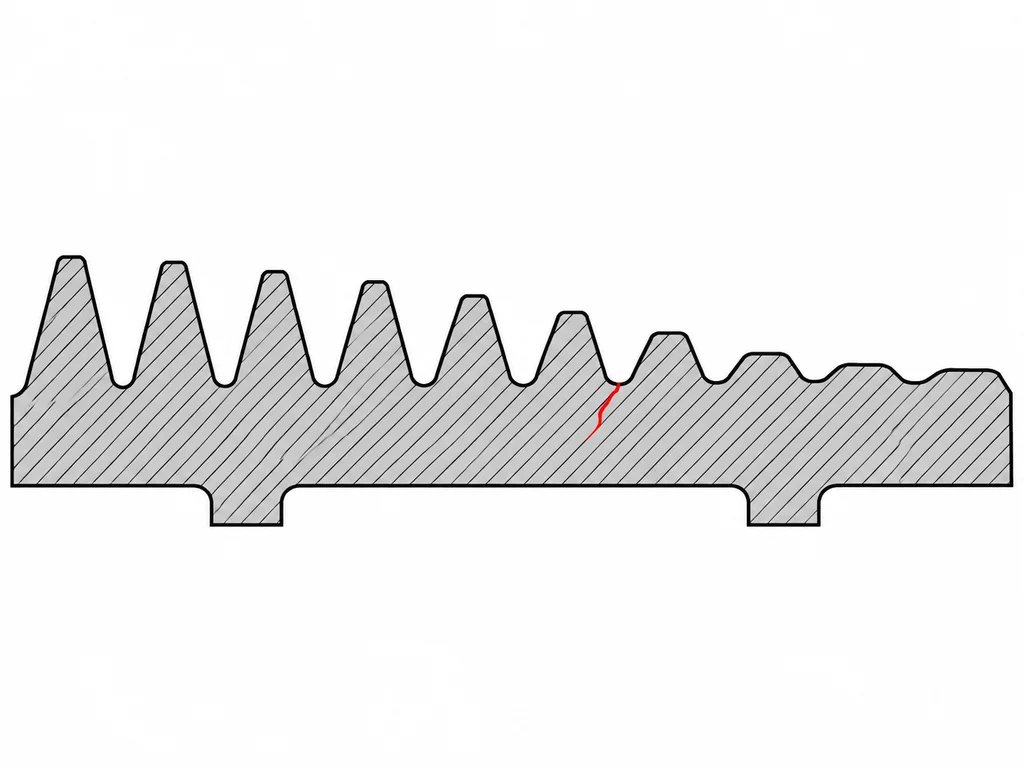
Tooth peaks flattening. The peak is the first thing the rock touches, so it wears back first. As it flattens, the bite angle degrades: the plate grips less, slips more, and the extra sliding accelerates wear around the peak. Throughput falls before product size does. This is the pattern that makes a plate unserviceable while it still looks substantial on the bench.
Tooth root cracking. The peak is loaded in compression, but the root below it bends, and a crack that starts at the fillet propagates through the plate. Three causes cover most cases: a grade too hard for the shock, a casting defect at the fillet, or a plate that is not seating flat and is being flexed against its backing. The last is common and almost always blamed on the casting. A plate that rocks, or that has fines packed behind it acting like a jack, will crack whatever it is made of.
Tooth form is where the feed enters the decision. A tall, narrow, wedge-shaped tooth bites aggressively and handles coarse, slabby feed, but its tip wears back quickly and its root is the most highly stressed point on the plate. A wide, blunt tooth holds its height longer, grips less, and makes more fines and more slip.
Wear along the plate is uneven too. The discharge end usually goes first because it does the sizing work, while the top keeps a usable profile long after the bottom is finished. That is what makes flipping worth designing for, and why a matched pair should be replaced together.
Where a plant also runs an impact stage, the discipline there is different rather than stricter: those parts are governed by impact energy, and that material logic is set out in the blow bar material guide, with the parts themselves listed under impact crusher parts.
Fact: DINGDAR employs 720+ people including 52 R&D engineers, works to 6S shop floor discipline, and holds ISO 9001, IATF 16949, ISO 14001 and ISO 45001 certification.
Material and process combinations, chosen by duty rather than price
Four material families do most of the work in crusher liners. Which one belongs in front of your feed is the decision.
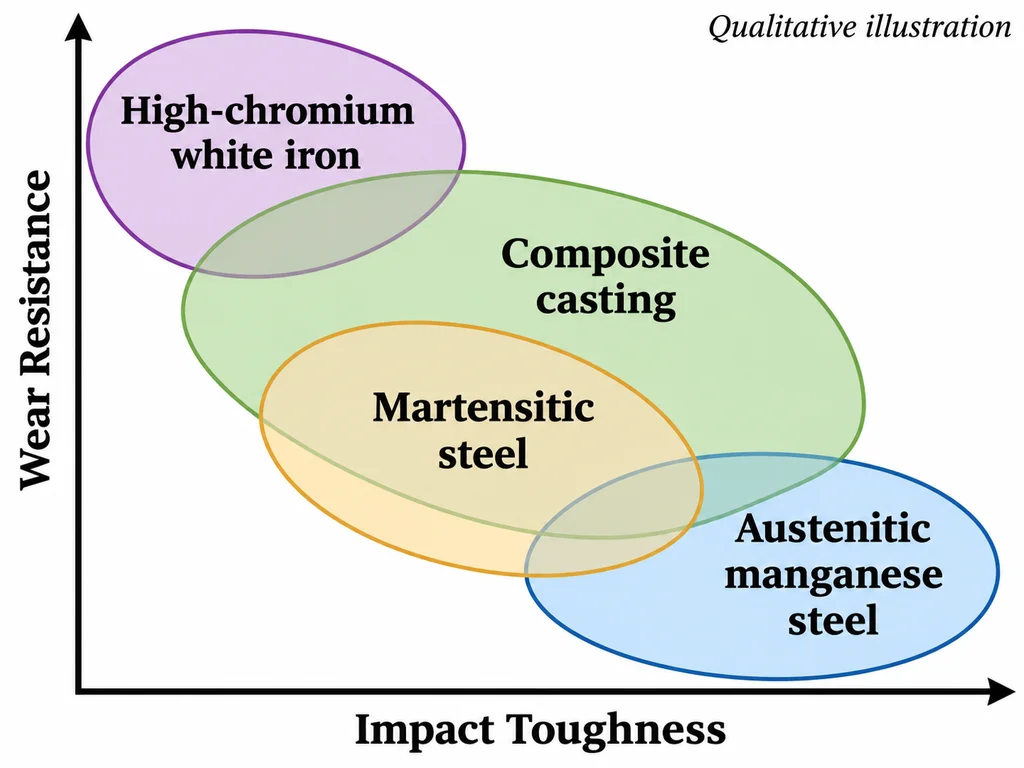
Austenitic manganese steel. It hardens as it is loaded, so the working surface hardens while the core stays tough enough to absorb shock. That only develops where the surface really is loaded hard; in low-stress sliding service the same grade behaves like a relatively soft metal. Casting it well means controlling heavy sections and the post-cast treatment, because an as-cast structure is not the structure the design assumes.
Martensitic steel. Heat treated through the section, so hardness is present from the first ton rather than developing in service. It is consistent, holds a machined fit well, and sits between manganese and white iron on toughness, which suits medium duties where abrasion dominates and shock is moderate. Its weakness is heat, which can soften the working surface back.
High chrome white iron. Carbide-rich and very resistant to sliding abrasion, with low toughness and almost no capacity to absorb impact. It is right where rock slides rather than bites, usually transfer points, chutes and the finer end of a circuit, and wrong at the top of a jaw chamber. It cannot be welded back into service and is finished by grinding, so the fit has to be cast and machined around it.
Composite and bimetal castings. A tough body with a hard working layer, or hard inserts in a manganese matrix: hardness where rock touches, toughness where the part bends, and a machined interface that a solid white iron could not provide. The risk moves to the interface, where two materials that shrink differently must stay bonded.
The casting route follows the material and the section. A heavy manganese section with a machined cone face needs a route that can feed the section and hold soundness; a complex near-net profile may suit another route entirely. DINGDAR runs green sand, shell moulding, lost foam and investment casting in house, which matters because the route can be matched to the part.
The order of decisions matters more than the menu: duty, then failure mode, then family, then process, then inspection, and price last. The families above explain a logic rather than a stocked list, and the grade for a given chamber belongs in a drawing agreed with the foundry.
Fact: DINGDAR answers a technical enquiry within 12 to 24 hours and reviews a crusher wear part in one pass: the casting route, the material family, the as-cast and machined scope, the inspection points and the pattern or first-article confirmation.
Fit, backing and fixing: the interfaces that decide real life
A liner that is cast correctly and fitted badly fails like a bad casting, and the failure gets blamed on the foundry.
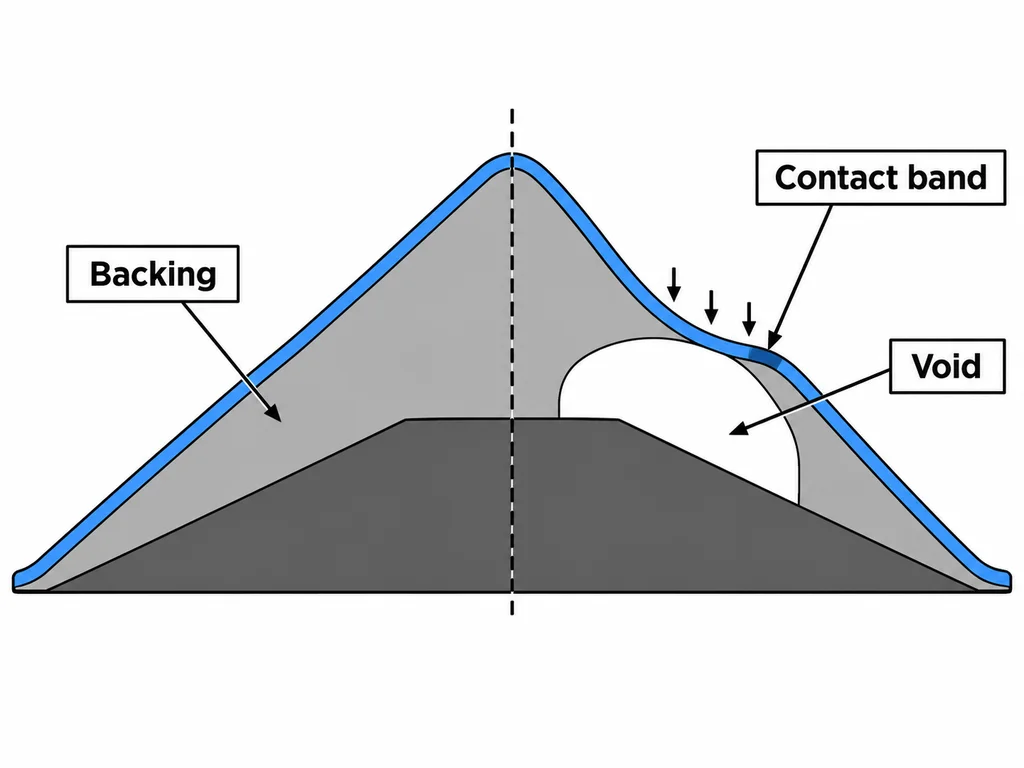
The cone face under a mantle. A mantle is a cone sitting on a cone, and the load passes through that contact. If contact is limited to a few bands, the unsupported areas flex on every cycle, and flexing under a compressive load is how fatigue flaking starts. The check is a blue-marking contact check on the head, done before the new part goes on. A head run through several liner lives is often scored or bell-mouthed, and a new mantle inherits the shape.
Backing. The gap between mantle and head is filled with a backing material, traditionally a poured zinc alloy and now often a resin compound. Its job is not to glue the part on but to make contact continuous so the load spreads, and to stop movement. A backing with voids leaves the same unsupported areas as a poor cone fit, and the symptom shows up as fatigue in a band. Which backing suits a chamber belongs to the machine documentation; what a buyer should confirm is that one is specified and the head prepared for it.
Fixing. Mantles are held by clamping at the top, jaw plates by wedges, bolts or clamped seating. All of them prevent movement, and movement is the enemy: a part that shifts frets at the contact, starts a crack at the fixing line and loses its seating. Tightening figures belong to the machine manual; what matters here is that the fixing features on the casting match the machine.
Jaw seating. Jaw plates sit against a jaw body that is rarely flat after years of service. A plate that rocks, or that has fines packed behind it, is being bent rather than compressed, and it will crack at the tooth root whatever the grade.
If a new part does not sit as the old one did, check the interface before blaming the casting. The mining machinery wear parts range is grouped by machine and position for this reason, and the cone crusher parts pages separate mantle, bowl liner and chamber components so fit questions land on the right item.
Replacement triggers, purchase checks and the part matrix
Wear parts are usually replaced on a thickness measurement, the weakest criterion available. A jaw plate with flattened peaks has failed while it is thick, and a mantle can be past the point where the chamber holds size while the metal still looks respectable.
Throughput. The chamber stops pulling material at the rate it used to. On a cone this shows as a rising circulating load and a fuller crusher; on a jaw as slip and a slower bite. Both are capacity losses that get blamed on the feed before anyone measures the liner.
Product size and shape. The setting has not changed but the product has coarsened, the oversize fraction has grown, or the shape has gone slabby. On a cone, a groove in the chamber does this locally. On a jaw, flattened peaks let long pieces through.
Power and energy per ton. A chamber that has opened up crushes less per revolution, so the same amps buy less reduction and more of the work moves downstream. A drop in draw at the same feed rate is not good news either, it usually means the crusher is doing less work than it should.
Three purchase checks follow, and they are where most of the difference between two quotes hides.
Drawing consistency. Part number, revision and chamber configuration must match, and the drawing must state the working profile, the fixing features and the machined areas.
Unit weight and wall thickness distribution. The same envelope can be cast with more or less metal in the wear zone. A part lighter than the one it replaces has to be explained, because the difference is a thinner working section or a shifted core, and both change life.
Batch to batch and interchangeability. Wear parts are consumed in sets, so a new mantle paired with a part-worn bowl liner gives a chamber that is not round from the first day. Keep set numbers, log the service each set delivered, and treat the log as the specification for the next order.
| Part | Typical duty | Dominant failure | Material direction | Replacement trigger |
|---|---|---|---|---|
| Cone mantle | Secondary or tertiary, choke fed, hard rock | Even abrasion, or fatigue where contact is poor | Manganese for shock, martensitic for steady abrasion | Product coarsens or throughput falls at the setting |
| Bowl liner | Matched to mantle and chamber configuration | Abrasion with profile loss near the discharge | Same family as the mantle, matched profile | Chamber no longer holds size, or the pair is out of step |
| Moving jaw plate | Primary, coarse slabby feed | Peak flattening, then root cracking under shock | Manganese where shock is real, composite where peaks must hold | Bite slips or capacity drops while metal remains |
| Fixed jaw plate | Primary, coarse feed, higher sliding component | Abrasion along the face, root cracks | Manganese or martensitic, set by the shock level | Plate cannot grip, or a crack reaches the seating |
| Cheek plate | Side of the chamber, fines and spill | Sliding abrasion, washout at the edges | High chrome iron or wear plate | Worn through, or material bypasses the chamber |
The material column is short because duty and failure make most of the decision, and the trigger column is written as a condition because the useful number is your own. Buyers who want to see what sits behind the review can look at the DINGDAR background for the plant, the casting routes and the quality system, and the mining and quarrying section for the wider circuit.
FAQ
How do I tell abrasive wear from fatigue when a mantle comes out?
Look at the shape of the loss, not the depth. Abrasion removes metal evenly and leaves a smooth, bright, thinning section. Fatigue removes it in patches and flakes, with sound metal beside the crater. Abrasion is answered by a harder surface; fatigue by contact and toughness.
Does high manganese steel need a water toughening treatment after casting?
Austenitic manganese steel is normally given a solution anneal after casting, because the as-cast structure is brittle and the work hardening behaviour depends on a fully austenitic matrix. Treat that step as part of the material and ask for it to be confirmed in the record.
Can a mantle or a jaw plate be turned over and used again?
It depends on symmetry, and most parts are not symmetric. A jaw plate with a symmetrical profile and an unworn top can sometimes be turned end for end where the machine allows it. A mantle generally cannot be flipped, because the cone angle and the discharge profile only work in one orientation. Flipping has to be designed in at the drawing stage.
Can the tooth profile of a jaw plate be changed on an existing machine?
Often yes, within limits set by the machine rather than the foundry. Tooth height, pitch and peak sharpness change the bite, the throughput and the power draw, so a taller, sharper profile can overload the drive or cut capacity. Treat it as a process change and expect the pattern to be recut.
Why is output lower with a brand new liner?
A new liner has a rough surface and a profile that has not yet matched itself to the feed, so the chamber runs tighter than the setting suggests until the profile seats. If output does not recover, check the fit and the backing, whether the chamber configuration matches the previous one, and the feed distribution.
Does a harder liner always last longer?
No. Hardness buys abrasion resistance and costs toughness, and the trade only pays where the load is mostly sliding. In a chamber that still takes slabby feed or tramp material, a very hard surface chips and spalls before it wears out.
What should I send with a mantle or jaw plate enquiry?
The crusher make and model, the part number and drawing revision, the chamber configuration for a cone, dimensions measured from the worn part, the feed and how it is prepared, the target product, and how the last part failed, with photos of the wear pattern. Drawing and worn part together is what lets a foundry confirm the fit, and the contact page routes an enquiry to engineering.
Sources
- ASTM International. "ASTM A128/A128M, Standard Specification for Steel Castings, Austenitic Manganese." https://www.astm.org/
- ASTM International. "ASTM A532/A532M, Standard Specification for Abrasion-Resistant Cast Irons." https://www.astm.org/
- ASM International. "ASM Handbook, Volume 18: Friction, Lubrication, and Wear Technology." https://www.asminternational.org/