Excavator Tooth Adapters: Weld-On vs Pin-On and Fitment Checks
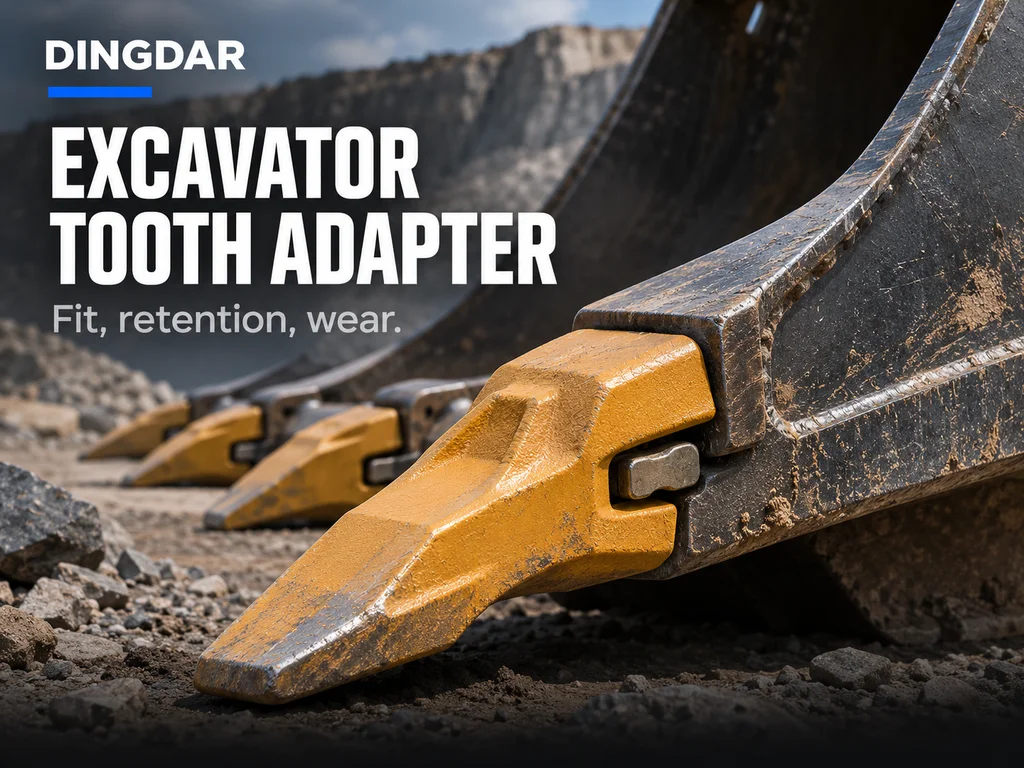
An excavator tooth adapter is the part that decides whether a tooth stays where it was fitted. The tooth takes the abrasion and is replaced on a schedule you can plan. The adapter sits one step back in the wear chain, wears more slowly, and is usually ignored until a new tooth will not sit still on it. By then the problem has moved from a consumable to a structural part, and the repair involves the bucket lip, machine availability and every tooth position that shares the same datum.
This guide stays on the adapter: how weld-on and pin-on connections differ in structure and downtime, what the fit face does, which dimensions prove a replacement will fit, how to read the common failures, and how to choose between a new adapter and a bucket. Welding procedure and hot work are out of scope.
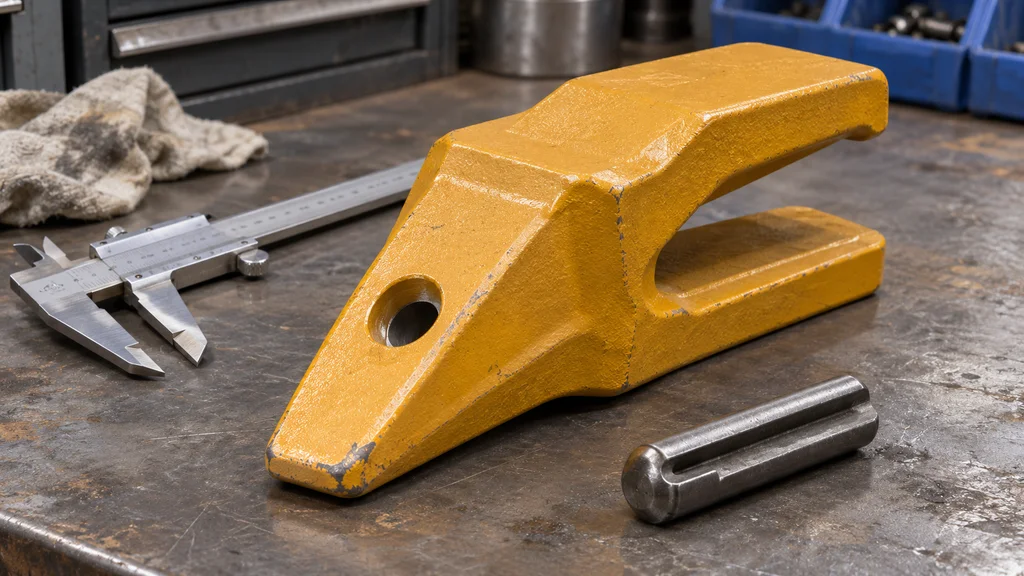
Why the slow-wearing part causes the expensive failure
Wear in a bucket runs through three stages. The lip is the structure. The adapter is the interface. The tooth is the sacrifice. Each is consumed at a different rate, stacked so that the cheapest part goes first.
The tooth covers most of the nose, so the adapter sees a fraction of the abrasive traffic that reaches the point. Adapters are also commonly cast in a tougher, more ductile grade than the tooth, because the part must absorb impact and, on weld-on types, be joined to a structural steel lip. Toughness is bought at the expense of wear resistance, a fair trade while the tooth does its job in front.
So an adapter failure costs more than a tooth failure, and not mainly in the part.
Datum. Every tooth on a position is located by the adapter nose. Once the nose loses its taper or shortens, a new tooth inherits the clearance, hammers, and wears at the point faster than it should. You buy teeth more often while the cause stays on the bucket.
Availability. A tooth change is a hand tool job on most systems. An adapter change is not. On a weld-on bucket the machine usually goes to a workshop.
Scope. Removing an adapter disturbs what it was attached to. Weld-on types leave weld to be removed and replaced, and a crack under a saddle turns an adapter order into a lip repair.
Position. A bucket is not eight identical positions, so a set is rarely uniform.
Measure the adapter at every tooth change: nose width at two stations, bore roundness, the shoulder gap, the retainer. A few minutes tells you whether the next tooth will hold.
Fact: DINGDAR has manufactured castings since 1986, now 40 years, with 720+ employees, 52 engineers and R&D staff, more than 5,400 part types, and four in-house casting routes, on a 180,000 m² production plant with a 12,000 m² office and R&D building.
Weld-on and pin-on adapters: what the connection decides
Two connections hold an adapter on a bucket, and the difference is structural. A weld-on adapter is joined to the lip along a cast saddle; a pin-on adapter is located on a base or in lip holes and held by a pin and retainer. The connection sets the stiffness of the joint, the clearance from day one, and how the bucket behaves under load.
Weld-on adapters
The saddle is cast into the adapter's rear to match the lip profile, and the joint runs continuously along both sides. Adapter and lip then behave as one piece: no assembly clearance to work loose, low stack height, and the point keeps its angle under load. Weld-on is the usual choice where breakout force is high, rock and impact dominate, and the bucket was built around a heavy lip.
The trade is at replacement. The adapter is a hot work item, so the machine goes to a workshop, the lip takes another heat cycle, and a weld toe crack has a path into the lip. Final position depends on the shop's setup, so the job is only as accurate as that setup.
Pin-on adapters
A pin-on adapter is located by a pin through the adapter and its base, kept in place by a clip, ring or threaded lock. A pinned joint needs clearance to assemble, so a little movement exists from day one and grows as bore and pin wear.
What that buys is field serviceability: the adapter comes off with hand tools, the lip takes no heat cycle, and spares ride on the truck. What it costs is a set of wear items, and an oval bore ends an adapter's life even when the nose is sound.
| Connection | Suited to | Change downtime | Main failure | Spares to hold |
|---|---|---|---|---|
| Weld-on | High breakout force, rock, heavy lip | Long, workshop job | Weld toe cracking, taper loss on the nose | Adapters per size, plus lip repair capacity |
| Two-piece (welded base, pinned adapter) | Loader and mixed duty buckets | Medium, base stays on the lip | Base bore and pin wear, base weld cracking | Adapters, pins, retainers, bases |
| Pin-on | Mixed duty, fleets, remote sites | Short, field change with hand tools | Oval pin bore, lost retainer, nose wear | One adapter per size, pins and retainers in quantity |
Nothing in that table recommends a system for a machine. The connection was chosen with the bucket design; your decision is whether it is still serviceable, and what keeps it that way.
The fit face: taper, pin and retainer
The joint does three jobs with one shape. The tapered pocket in the tooth and the tapered nose on the adapter centre the tooth as it seats, carry the digging load in compression over a large contact area, and tighten slightly under load. The pin does one job: it stops the tooth walking off. In normal digging it should not carry load.
That division explains most of what goes wrong. When a pin looks hammered or bent, the taper has stopped doing its share and the pin is carrying load it was never sized for.
Retention systems vary more than the tapers do. A side pin runs horizontally through the pocket and nose, a top pin drops vertically through the tooth body, a diagonal pin crosses at an angle. Retention can be a separate clip or ring, a threaded cap, or a combined pin and retainer. The families are not interchangeable, and a tooth can match on size while the pin hole sits in the wrong place.
Three symptoms cover most failing fits.
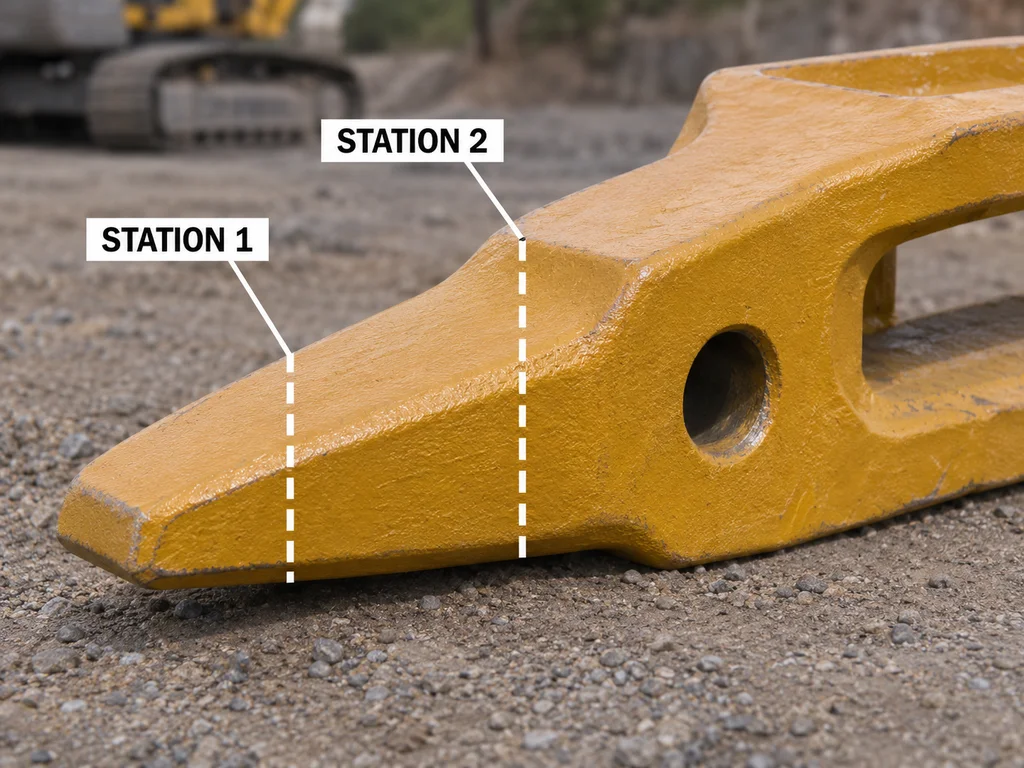
A new tooth rocks on the nose. The nose has worn oval or short, the pocket is oversize from a wrong tooth, or the taper angle does not match. Measure across flats at two stations. Undersize everywhere means even wear. Close to nominal at the front and undersize at the rear means the taper is gone, which is what lets a tooth creep forward until the point angle drops.
The pin will not pass by hand. Hole positions differ, the bore is distorted from a driven pin, there is a burr, or the pin is the wrong diameter. Driving a misaligned pin through the bore starts the ovalization that ends the adapter's life.
The tooth creeps forward and the point angle drops. The retainer is missing or tired, the pin is walking out, or the taper no longer self-tightens. Left alone it ends with a lost tooth and often a damaged nose.
The symptoms feed each other. Movement lets abrasive and water into the taper, the fit face laps and frets, clearance grows, impact loads rise, the bore ovals and the pin bends. Slightly loose is a reading, not a feeling.
Fact: DINGDAR fixes material grade, heat treatment, hardness and acceptance criteria for a part in a single technical review, and supplies the agreed material and heat-treatment records with the inspection plan. Enquiries are answered within 12-24 hours.
Drawing to part: four checks that decide fit
An adapter's outside shape tells you little. Two can look identical on the bench and differ in the four places that decide fit.
Mounting hole centre distance. On a pinned adapter, the distance from pin hole centre to the shoulder face that registers against the lip, and on two-pin designs the centre-to-centre distance. Too short pulls the adapter tight and changes the tooth angle; too long leaves it loose from the start. Measure from a machined or cast datum, not a worn edge.
Taper angle and nose length. Read across the nose at two stations a known distance apart and compare the difference with the drawing. That separates wear from a wrong taper: wear is progressive along the nose, a mismatch is uniform. Nose length matters as much, because a shortened nose lets the tooth sit too deep and drops the point angle.
Pin hole position relative to the shoulder. Height above the bottom face and distance from the shoulder. This dimension is often correct on the drawing and slightly off on the casting, because pattern wear and core shift move a hole in ways a visual check cannot see.
The lip interface. Saddle width and the lip thickness it accepts, the gap between adapter rear and lip edge, corner geometry, and on weld-on types the condition of the mating land. Left and right corners are different parts, and a repaired bucket may not present the profile the drawing assumes.
Clean the fit face, take the tooth off, and use the same stations each time. Record worn values as worn values, never as nominal, and cross-check the matching position on the other side of the bucket.
Reading the failure before you order
Two adapters can fail in the same place for opposite reasons, and the difference decides whether a replacement fixes the problem or repeats it. Wear leaves polished facets and a slow loss of section. Overload leaves a crack with little material lost around it.
| Failure | Where it shows | Usual cause | What it means for the order |
|---|---|---|---|
| Abrasive wear on the nose | Polished facets, uniform loss along the taper and flanks | Normal service in abrasive ground | Quote the adapter with the teeth; a worn nose accelerates tooth wear |
| Oval pin bore | Bore out of round, witness marks at the bore ends, sloppy pin | Clearance plus movement, a driven pin, a bent pin left in service | The adapter is finished even when the nose is still good |
| Seized or galled fit face | Tooth will not release, pick-up and rust on the taper | Fine abrasive and water packed into the taper, long intervals | Expect to cut the tooth off, then inspect the nose for cracks |
| Weld toe cracking | Crack along the toe of the weld, sometimes running into the lip | Stress concentration, lip flex, adapter to lip mismatch | Stop and assess the lip; an adapter order alone will not close this |
| Body fracture | Crack through the nose, saddle or a corner | Casting soundness, a single overload, or fatigue from a tooth hammering on a loose fit | Check the other positions; repeated fractures point at fit or duty |
The last row is the one buyers misread. A broken nose on one position can be a single bad event. The same break at three positions is not bad luck: it is a fit problem, a duty problem, or a part too light for the application, and the answer starts with measurement.
Material data has a limited role. A laboratory abrasion test ranks materials against a standardized condition and, as ASTM notes, cannot predict the exact resistance of a material in a specific environment [2]. Field evidence from your own bucket outranks a data sheet.
Adapter or bucket, and how to buy the replacement
The decision is not really about the part. It is about how much of the bucket is worth keeping, and how often you want the machine down.
Replace the adapter alone when the damage is local: the taper is worn so a new tooth rocks, the pin bore is oval beyond what a pin can hold, the nose or saddle is cracked, and the lip under the saddle is sound with nearby positions close to nominal.
Look at the bucket when the damage is distributed. A lip cracked, bowed or locally thin at several positions is a structural problem, and adapters fitted to it will not hold geometry. The same applies when several positions need work at once, when adapter spacing has drifted, or when the lip has already been repaired in that area.
Five dimensions drive that judgement, none of them a price: sound lip section left at the position, positions affected, whether the machine can come off site, whether the failure has happened there before, and the adapters and locking parts you hold in stock.
Procurement carries most of the risk, because an adapter that is dimensionally close is not interchangeable.
- Material and process consistency. Specify the grade and casting route that worked, and ask for the material and heat-treatment record with the batch, not a generic data sheet.
- Interchangeability. Put the four fit dimensions on the order as acceptance items, measured on the casting. A drawing used only to make the pattern does not control the part [1].
- Batch consistency. Patterns wear and cores shift over a run, so ask how a repeat order is verified against the first article [3].
- Stock policy. Adapters wear slowly: hold one spare per size, keep pins and retainers in quantity as separate line items, and standardize the tooth system across a mixed fleet.
- Numbering. Record the drawing revision against the part and in your register, and keep left and right corners as separate lines.
Receiving is the last cheap check. Confirm part number and revision, count the pieces, check handedness, and measure the four fit dimensions against the drawing or the old part. Trial the pin through the bore by hand, look for a bearing pattern on the taper, and check the nose and saddle for surface defects and the mating land for cast skin. File the documents against the batch, and mark each adapter with its position before it enters stock.
If nothing matches, a replacement can be produced from a sample or a rebuilt drawing, which is how loader tooth adapters and non-standard geometry are handled.
Fact: DINGDAR produces bucket teeth, adapters and custom castings to drawing, sample or part number, and holds ISO 9001, IATF 16949, ISO 14001 and ISO 45001 certification.
FAQ
What is the difference between a weld-on and a pin-on excavator tooth adapter?
A weld-on adapter is joined to the lip along a cast saddle, so the two act as one stiff unit with no assembly clearance. A pin-on adapter sits on a base or in lip holes, held by a pin and retainer, which needs a little clearance and changes in the field with hand tools. Weld-on suits high breakout force and rock; pin-on suits mixed duty and machines that cannot leave site.
Can I fit a tooth from one brand to another brand's adapter?
Only if the taper, pin hole position and retention system match, and that is decided by measurement rather than by brand. Teeth from different sources are routinely mixed on one bucket when the connection is the same, and fail when it is not. Compare pocket taper, pin hole centre position and pin diameter. A tooth that seats but rocks has a taper problem or a worn nose, and changing brand solves neither.
Can a pin-on adapter be converted to weld-on?
It is a bucket modification, not a parts swap. A pin-on lip is drilled or fitted with a base and was not designed for a continuous welded saddle, so the conversion changes the load path, the lip's heat history and the adapter spacing. Treat it as an engineering decision made with the bucket drawing. If the original connection is worn out, replacing it in kind is the lower risk route.
What should I do when the adapter feels loose?
Find out which part moved before ordering. With the tooth off, check the nose for taper loss and ovality, the bore for out of round, and that the pin and retainer are correct and serviceable. A tooth that rocks on a good nose is the wrong tooth or a worn pocket. A new tooth that rocks on the same nose means the adapter is worn and belongs in the same order as the teeth.
How do I match an adapter when the drawing is lost?
Rebuild it from the part and the bucket: pin hole centre distance, taper across the nose at two stations, nose length, pin hole position from the shoulder, lip interface, plus photographs with a caliper in frame and, if possible, the worn part as a sample. A foundry that works to sample can produce from that, and the adapter wears more slowly than the teeth, so it is the better reference.
How do I tell whether the taper or the tooth is worn?
Measure the nose, not the tooth, across flats at two stations with the tooth off and the surface cleaned. Undersize along the whole length is even wear. Close to nominal at the front and undersize at the rear means the taper is lost, which is what lets a tooth creep forward. Pockets can be checked the same way but wear far less.
Do all adapters on a bucket need replacing at once?
Not as a rule, but positions are not equal. Corner adapters carry different loads and usually wear faster, and one failed adapter can mean the lip around it has been working loose. Replace what measurement says is worn, then read the pattern: several positions in similar condition argue for one shutdown instead of two.
Conclusion
The adapter holds the fit together, and it fails slowly enough to be measured before it fails badly. Check the taper, the bore and the retainer at every tooth change, keep the four fit dimensions on the order, and measure them again on arrival. Decide between adapter and bucket on how much sound lip is left.
DINGDAR casts loader tooth adapters and the loader bucket teeth and adapters range to drawing, sample or part number, and reviews geometry, material and connection in one technical review with a 12-24 hour reply. See how DINGDAR builds wear castings, read the bucket teeth cross reference method when a part number is all you have, or contact the DINGDAR team with a photograph of the nose and your measurements.
Sources
- SFSA (Steel Founders' Society of America). "Ordering Steel Castings." https://www.sfsa.org/subject-areas/education/ordering-steel-castings/ - Tolerances, datums and acceptance criteria belong on the order, the principle behind putting fit dimensions on the purchase document.
- ASTM International. "ASTM G65-16(2021), Standard Test Method for Measuring Abrasion Using the Dry Sand/Rubber Wheel Apparatus." https://www.astm.org/g0065-16r21.html - The test ranks materials under a standardized condition and does not predict exact resistance in a specific environment.
- ISO. "ISO 9000 family, Quality management." https://www.iso.org/iso-9001-quality-management.html - The quality management family behind batch traceability and repeat-order records.