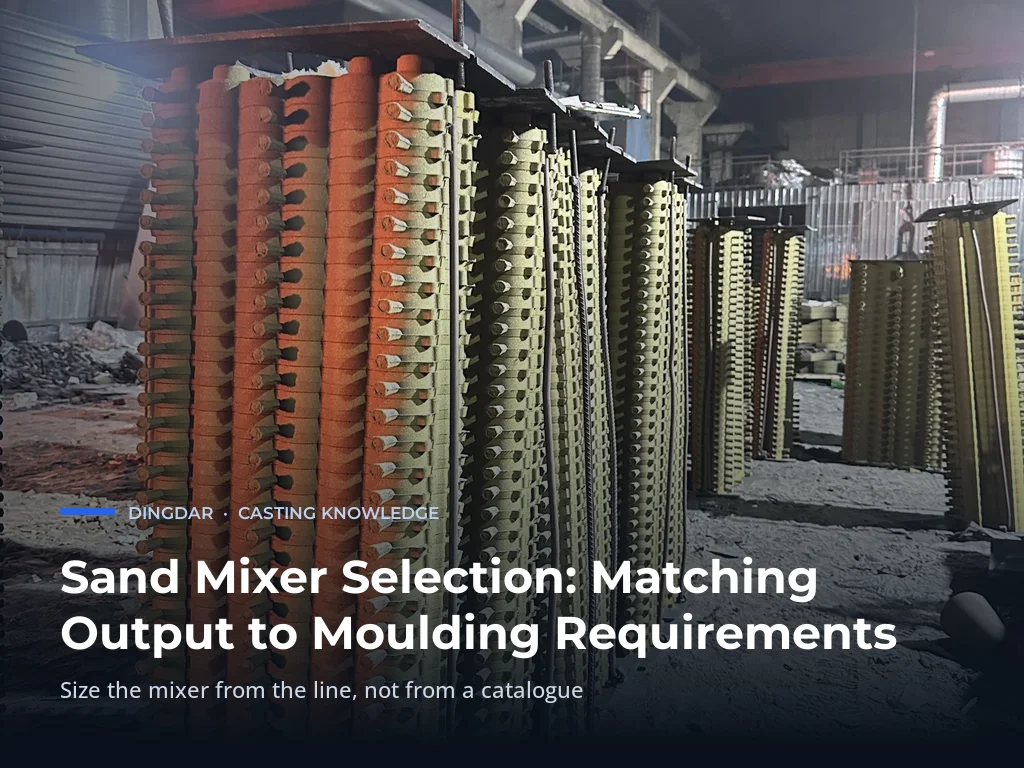
Sand Mixer Selection: Matching Output to Moulding Requirements
Sand mixer selection is the decision that connects your sand plant to your moulding line. The mixer is the last machine to touch the sand before it becomes a mould, and its output sets whether the line runs at its rated speed or waits for a fresh batch. Get this choice right and the other specifications, from arm reach to binder pumps, fall into place.
There are two ways a foundry consumes sand, and they pull the mixer in opposite directions. A moulding line wants sand the moment a flask arrives, in an unbroken stream. A core shop or a jobbing shop wants a measured batch it can test and control. Sand mixer selection starts by naming which of those you are.
What a foundry sand mixer does
A sand mixer for foundry use blends silica sand with a binder, water, and additives so that the binder coats every sand grain evenly. That coating is what gives a mould its strength and its surface finish. Uneven coating shows up later as broken moulds, rough castings, or scrap, so the mixer's real job is consistency, not speed alone.
Foundries run two broad sand systems, and each has its own family of mixers. Green sand uses clay (bentonite) and water, and it needs kneading and squeezing to activate the clay, which is the work of a muller or an intensive batch mixer. Chemically bonded sand uses resin, sodium silicate, or another binder that hardens on its own, and it is usually mixed continuously right before the mould or core is made, because the sand starts to cure the moment the binder touches it.
The mixer sits inside a chain: return sand is cooled and reclaimed, additives are metered, the mixer blends them, and the finished sand goes to the moulding line or core shooter. A mixer that is perfectly sized on its own still fails if the cooling or return loop cannot keep up.
Batch and continuous mixers: the core decision
The first real fork in sand mixer selection is batch versus continuous. Everything else, from capacity to controls, follows this choice.
Batch mixers
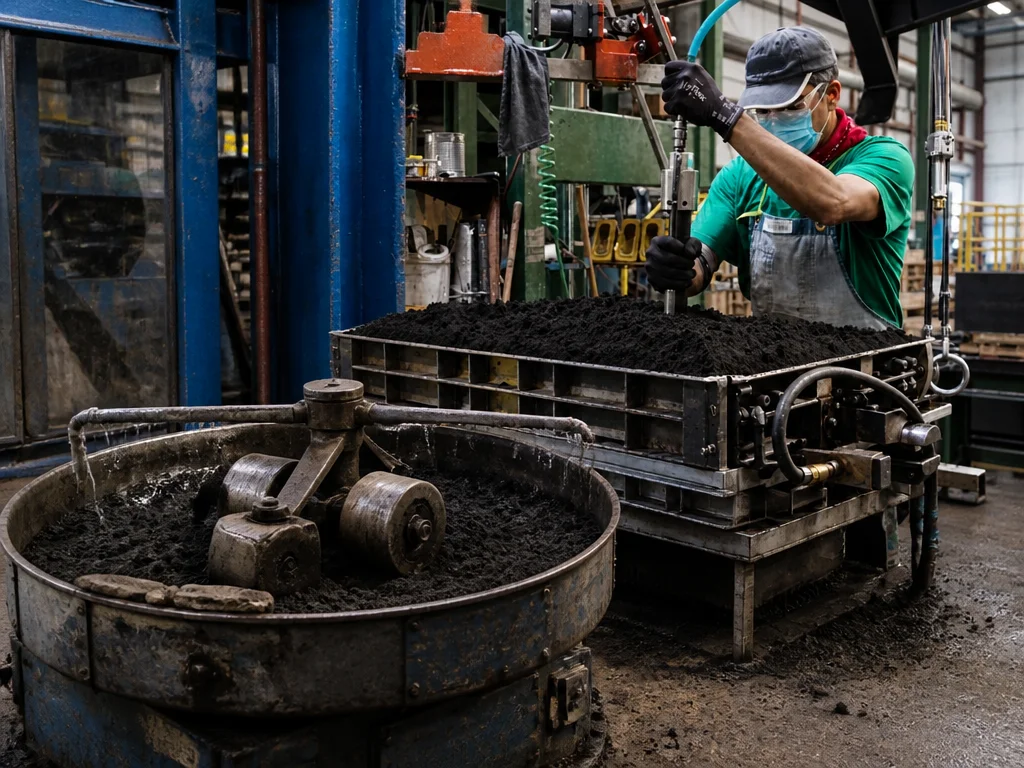
A batch mixer loads a measured charge of sand and binder, mixes it for a set time, then discharges the whole load. Its output is measured in kilograms per batch, and one batch makes one or a few moulds or cores. The foundry sand muller is the classic green sand batch mixer: a rotating pan with wheels that rubs and squeezes the sand to develop clay strength.
Batch mixing wins where control matters most. Every batch can be timed to the second, tested for strength and compactability, and self-cleaned before the next charge. That repeatability is why core shops and jobbing foundries lean on batch mixers for cold-box, no-bake, and shell cores, where a single bad batch ruins a set of cores.
The trade-off is rhythm. A batch mixer stops to load and discharge, so it cannot match a moulding line that never pauses. It also needs handling equipment to move each batch, which adds labour and layout.
Continuous mixers
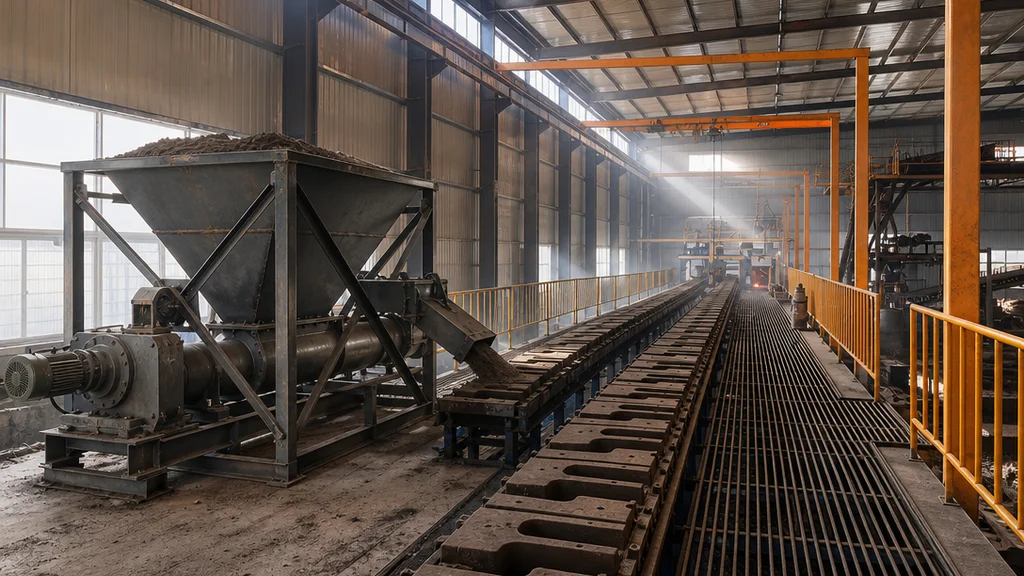
A continuous mixer meters sand and binder into a mixing chamber and discharges mixed sand without stopping. Its output is measured in tons per hour. Sand enters, binder is injected, the two are blended in seconds by a rotor or arms, and the finished sand flows out straight to the flask or core box.
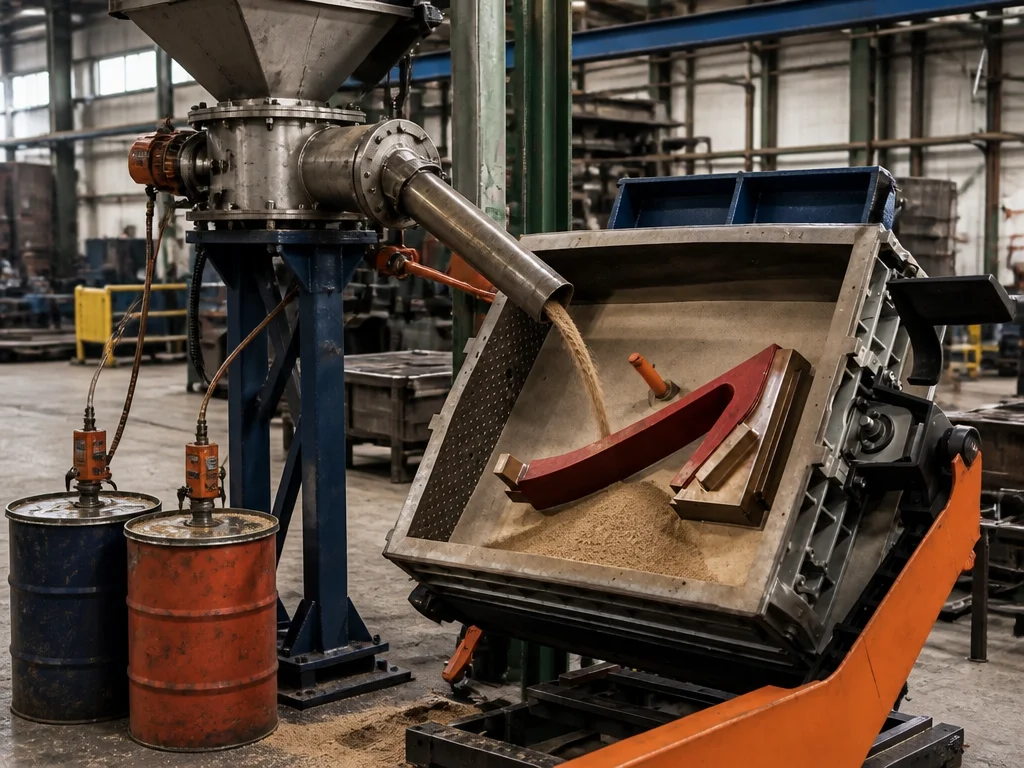
Continuous mixers match high-throughput moulding lines because their output can track the line's demand. They come as single-arm and double-arm units, and as fixed, articulated, or mobile machines that travel to the mould. For self-setting no-bake sand, a continuous mixer is the norm: it mixes the resin and hardener at the point of use, so the sand bonds in the flask instead of curing in a hopper.
The trade-offs are different from batch mixing. The first seconds of output can be off ratio while the pumps settle, so the operator discards or diverts that sand. Cleanout and binder-pump calibration matter more than on a batch machine, because a drifted pump quietly changes every mould. The table below sets the two families side by side.
| Factor | Batch mixer | Continuous mixer |
|---|---|---|
| Output unit | kg (or lb) per batch | tons per hour |
| Best fit | Cores, small lots, jobbing work | High-volume moulding lines, no-bake |
| Binder control | Per batch, testable | Continuous dosing, needs calibration |
| Rhythm | Load, mix, discharge cycle | Steady stream, no cycle gap |
| Repeatability | High within a batch | High once pumps are locked in |
| Cleanout | Self-clean cycles available | First-second sand needs diverting |
| Layout | Needs batch handling | Feeds line directly |
Matching mixer output to your moulding line
A mixer is sized, not shopped for. Sand mixer selection should start from the sand your line consumes and work backwards to the machine, because the mixer serves the line, not the other way around.
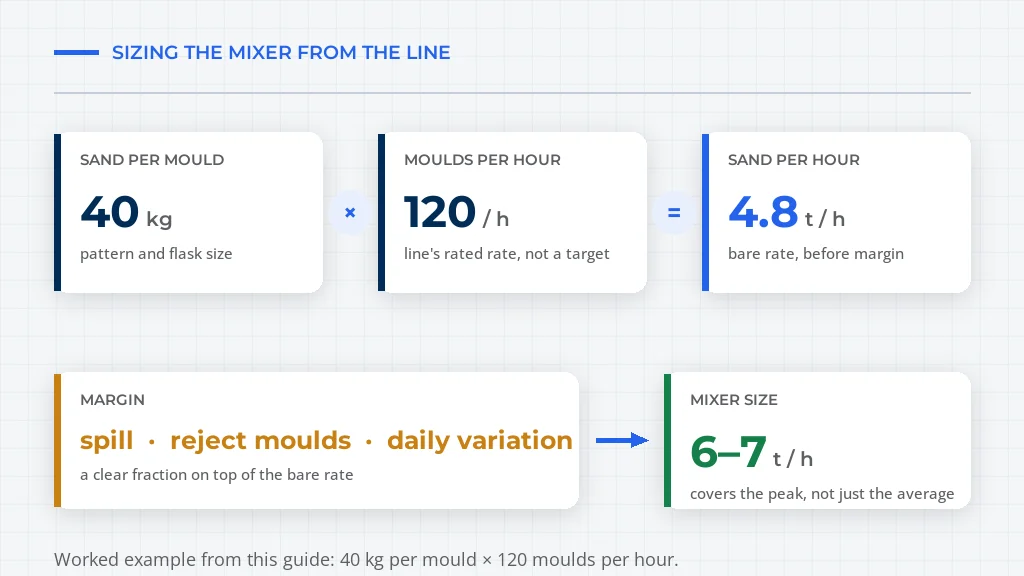
The core number is tons per hour. Multiply the sand mass in one mould by the moulds per hour the line runs, then add a margin for spill, reject moulds, and daily variation. A line that makes 120 moulds per hour at 40 kg of sand per mould needs 4.8 tons per hour before margin, and a 6 to 7 ton per hour mixer covers the peak without running flat out.
Size to peak, not average. A mixer that meets the average rate will stall during a run of heavy moulds, and every stall stops the moulding line behind it. It is better to have headroom on the mixer than to have sand waiting on the line.
The second number is the binder dosing range. A mixer that can make the tonnage but cannot hold a low resin percentage wastes binder on every mould, and binder is one of the larger costs in a sand system. Confirm the mixer's minimum and maximum dosing, not just its top output.
Sizing steps
- Find the sand mass per mould, from the pattern and flask size.
- Find the line's rated moulds per hour, from the moulding machine, not from a target.
- Multiply the two to get sand mass per hour.
- Add a margin for spill, reject moulds, and variation, usually a clear fraction on top.
- Convert to tons per hour and choose a mixer at or above that figure.
- Check the binder dosing range matches your lowest and highest binder demand.
- Match the mixer to the rest of the sand plant: return sand, cooling, and reclamation must feed and clear the same tonnage.
Green sand vs resin-bonded sand: what changes the mixer choice
The sand system, not the foundry's size, decides the mixer family. Green sand and resin-bonded sand pull the choice in different directions, and mixing them up is a common selection error.
Green sand is clay-bonded and reusable. It is mulled, because the clay needs rubbing and squeezing to coat the grains and to wake up the bentonite. Green sand mixers carry moisture control, and the return sand loop matters as much as the mixer, since the same sand comes back hot and needs cooling and reconditioning before it is mixed again. A green sand casting line depends on the consistency of that loop.
Resin-bonded no-bake sand is mixed once and used once. The binder and hardener are added at the mixer, and the sand sets in the flask on its own, so the mixer must mix fast and dose accurately before the cure starts. These mixers are almost always continuous, feeding the flask directly. Shell sand is different again: resin-coated sand is prepared in a coating plant, and the mixer at the core shooter handles core sand feeding rather than green sand.
If your foundry runs more than one route, your sand mixer selection should follow the route that carries the most moulds, with a second mixer for the rest rather than a compromise machine that does neither job well.
Matching the mixer to your binder system
Binder system drives the mixer's pumps and its mixing action, and it is worth mapping the two before you request a quote.
Green sand, bentonite, and water call for a muller or an intensive batch mixer with moisture control. The action is rubbing and kneading, and the controls hold compactability steady.
No-bake and self-setting sand (furan, phenolic, and similar) call for a continuous mixer with two or more dosing pumps, one for resin and one for hardener, and a mixing tube sized to the setting time. If the sand sets too fast for the tube, the mixer plugs; too slow and the mould sags.
Sodium silicate sand calls for a continuous mixer matched to the binder's viscosity, because a pump sized for thin resin will not dose thick silicate accurately.
Cold-box and shell core sand calls for a core sand mixer, batch or continuous, feeding the core shooter. Here the mixer's job is a consistent, free-flowing core sand, and cleanout between recipes matters more than raw tonnage.
Whichever binder you run, the pumps decide accuracy more than the mixing chamber does. Ask for the pump calibration routine and the acceptable drift before you buy.
Fact: DINGDAR supplies foundry equipment across eight process categories, and sand mixers sit in the Molding & Core Making group alongside moulding machines, core shooters, and tooling. The company runs four in-house casting routes (green sand, shell moulding, lost foam, and investment casting), so sand preparation is reviewed in the same technical review as the castings (per DINGDAR company data).
Specification checklist before you buy
Turn the selection into a checklist so a quote answers real questions rather than listing a machine. Use the table below to compare offers on the same terms.
| Specification | Why it matters | What to confirm |
|---|---|---|
| Capacity (t/h or kg/batch) | Must cover the line's peak, not its average | Output at your binder ratio, not a lab figure |
| Mode | Batch or continuous follows the sand system | Matches green sand or no-bake demand |
| Arm configuration | Reach and pattern size decide mould coverage | Fix, articulated, or mobile fits your layout |
| Binder dosing range | Low and high binder demand on the same machine | Minimum and maximum dose, and turndown |
| Mixing time | Must sit inside the binder's setting window | Mix time versus cure time |
| Moisture and temperature control | Green sand strength depends on both | In-line measurement or manual sampling |
| Controls | PLC and dosing repeatability set consistency | Recipe storage, alarms, drift logging |
| Dust extraction | Binder and sand dust need capture | Extraction point and airflow |
| Cleanout and access | Downtime between recipes and shifts | Self-clean cycle and service access |
| Acceptance test | Proves the mixer on your sand, not theirs | First-second sand, homogeneity, strength test |
Two checklist items carry more weight than the rest. The acceptance test is where a mixer is proven on your sand and your binder at your ratios, not on a supplier sample. And the arm configuration is where an otherwise correct mixer either reaches your largest mould or leaves half of it short. Both are worth settling before the order, not after.
Fact: DINGDAR builds complete moulding and sand systems, including green sand casting lines, automatic moulding lines, and sand reclamation systems. Line planning is done around capacity, layout, material flow, and plant conditions rather than from a fixed mixer catalogue (per DINGDAR company data).
Common sand mixer selection mistakes
Most bad mixer choices trace back to a handful of avoidable errors, and they share one root: the mixer was chosen in isolation instead of from the line.
Sizing to average output rather than peak is the usual mistake. The mixer looks fine on paper and then stalls during a heavy run, and the line pays for it.
The setting window is easy to ignore. A continuous mixer whose tube is sized for a slow binder plugs the moment a fast binder arrives, or the reverse leaves a mould that sags before it sets.
Then there is the sand loop. A mixer is only as good as the return, cooling, and reclamation behind it, and a mixer sized to the line still fails if the loop cannot clear the same tonnage.
Buying past the plant is quieter, and just as costly. A mixer bigger than the rest of the sand system can feed either sits idle or starves the line, and the capacity you paid for never arrives.
Cleanout and binder-pump drift round out the list. On a continuous mixer, an uncalibrated pump changes every mould without any alarm, and a machine that is hard to clean grows downtime shift after shift.
If your foundry also buys castings, the same discipline applies to the parts themselves. Two companion guides cover how to choose a casting process for wear parts and how to compare casting quotations so equipment and castings are judged on the same evidence.
FAQ
What is a sand mixer for foundry use?
A sand mixer for foundry use is the machine that blends silica sand with a binder, water, and additives to produce moulding sand or core sand. It is the last step in sand preparation before the sand reaches a moulding line or core shooter. Green sand is usually mixed or mulled with clay and water, while chemically bonded sand is mixed with resin, sodium silicate, or a hardening agent. The mixer decides how evenly the binder coats each sand grain, and that coating controls mould strength, surface finish, and casting scrap.
What is the difference between a batch and a continuous sand mixer?
A batch mixer loads a measured charge of sand and binder, mixes it for a set time, then discharges the whole load, so its output is measured in kilograms per batch. A continuous mixer meters sand and binder into a mixing chamber and discharges mixed sand without stopping, so its output is measured in tons per hour. Batch mixers give tight repeatability and suit cores and small lots. Continuous mixers match the steady demand of a moulding line. Choose on how your line consumes sand, not on which machine is cheaper.
How do I calculate the sand mixer capacity my moulding line needs?
Multiply the sand mass in one mould by the moulds your line produces per hour, then add a margin for spill, reject moulds, and daily variation. If a mould uses 40 kg of sand and the line runs 120 moulds per hour, that is 4.8 tons per hour before margin, so a 6 to 7 ton per hour mixer covers the peak. Always size to the line's peak rate, not its average, because a mixer that falls short stops the whole line. Confirm the figure against your sand plant's return and cooling capacity.
Is a muller the same as a sand mixer?
A muller is a type of batch mixer for green sand. It kneads and squeezes the sand against a rotating pan and wheels, which rubs the clay coating onto each sand grain instead of only stirring the mixture. A general sand mixer may stir or blend, but a muller adds the rubbing and squeezing action that green sand needs to develop strength. Mullers sit in the green sand family. Resin-bonded and no-bake sands use different mixers, usually continuous, because they do not rely on clay activation.
Can one mixer handle both green sand and resin-bonded sand?
Not usually, because the two systems need different actions and different binder hardware. Green sand needs clay activation by mulling with moisture control, while resin-bonded no-bake sand needs fast, short mixing with accurate resin and hardener pumps before the sand starts to cure. A few intensive mixers run both large continuous batches and smaller lots, but the binder dosing, mixing time, and cleanout differ. Plan separate mixers, or confirm with the supplier that the machine is genuinely configured for both before you buy.
How much does a foundry sand mixer cost?
Foundry sand mixer cost depends on capacity, mode, arm configuration, binder pumps, and controls, so there is no single list price. A small batch muller for a jobbing foundry and a 100 ton per hour continuous mixer for an automatic line sit at very different price points. Price the machine against the throughput it must hold, not in isolation, because an undersized mixer that stalls the line costs more than the purchase gap. Ask for a quote with capacity, binder range, and control scope stated so offers are comparable.
What mixers does DINGDAR supply for foundry lines?
DINGDAR supplies sand mixers as part of its Molding & Core Making equipment, next to moulding machines, core shooters, and tooling. Because DINGDAR also builds full lines and runs four in-house casting routes, it plans sand preparation around the moulding line's capacity, layout, and material flow rather than selling a standalone machine. Sand treatment equipment for reclamation, cooling, and sand preparation is reviewed in the same technical review as the mixers, so the sand system and the castings it feeds are specified together.
Conclusion
Sand mixer selection comes down to one question first: does your line want a measured batch or a steady stream? Answer that, size to peak rather than average, and match the mixer to your binder system, and the rest of the specification becomes a checklist you can compare across quotes.
Fact: Founded in 1986, DINGDAR has over 40 years in casting, a 180,000 m² production plant, a 12,000 m² office and R&D building, 720+ employees, and 52 engineers and R&D staff, with ISO 9001, IATF 16949, ISO 14001, and ISO 45001 certification (per DINGDAR company data).
Start from the line your mixer has to feed. Review the foundry equipment range and the lines and systems that pair mixers with a full sand loop, compare it against your green sand casting or no-bake route, and check how to evaluate a casting supplier so the sand system and the castings that come off it are judged together. When you are ready, contact DINGDAR with your mould size, line rate, and binder system.
Sources
- DINGDAR. "Foundry Equipment." Henan Dingdar Machinery Equipment Manufacture Co., Ltd., 2026. https://hndingdar.com/foundry-equipment. Manufacturer description of the eight foundry equipment categories, including Molding & Core Making and sand treatment.
- DINGDAR. "Lines and Systems." Henan Dingdar Machinery Equipment Manufacture Co., Ltd., 2026. https://hndingdar.com/lines-and-systems. Manufacturer description of green sand, automatic moulding, and sand reclamation systems.
- DINGDAR. "Contact." Henan Dingdar Machinery Equipment Manufacture Co., Ltd., 2026. https://hndingdar.com/contact. Company profile, certifications, and enquiry channel referenced in this guide.